Biophysical Characterization Service
At Creative Biolabs, protein-based drug conformation, along with the biophysical characterization of proteins, constitutes a high-order structure of biology, assessing the biophysical structure, function, and stability of biological macromolecules such as proteins, nucleic acids, lipids, and their complexes. Characterization techniques we offer include circular dichroism, differential scanning fluorescence, differential scanning calorimetry, dynamic light scattering, and UV/visible spectroscopy. The kinetics and their iterative thermodynamic parameters (microscale thermophoresis, surface plasmon resonance, and isothermal titration calorimetry) are also characterized according to the specific needs of the customers.
Introduction of Biophysical Characterization
Biophysical characterization is essential for studying a biologic's higher-order structure (HOS), which dictates efficacy and stability. We analyze secondary structure (alpha-helices, beta-sheets) using Fourier transform infrared (FTIR) and far ultraviolet circular dichroism (far-UV CD), and tertiary structure using near-UV CD to evaluate residue environment. Thermal stability is assessed via differential scanning calorimetry (DSC) to determine the melting temperature, revealing protein conformation and folding patterns. Creative Biolabs leverages cutting-edge insights like diffusion NMR and the link between Developability and Evolvability for a superior, predictive service platform.
Overview of Our Services
| Services | Techniques |
| Secondary structure | Fourier transform infrared (FTIR) spectroscopy, circular dichroism |
| Tertiary structure | Near-UV circular dichroism (near-UV CD) spectroscopy, differential scanning calorimetry, X-ray crystallography |
| Thermal stability | Differential scanning calorimetry (DSC) |
We address critical development questions by providing quantitative answers across four key areas:
Minimizing Immunogenicity Risk
We rigorously pinpoint subtle aggregation pathways and characterize concentration-dependent protein-protein interactions (P-PIs). This allows us to identify optimal stabilizing excipients and buffer systems to maximize solubility and minimize the risk of immunogenicity, which is paramount for patient safety and successful regulatory submission.
Validating Process Consistency
Our services confirm that manufacturing process changes—including cell line changes, purification steps, or scale-up procedures—do not induce unintended conformational shifts in the HOS. This data provides irrefutable proof of batch-to-batch consistency required for compliance.
Optimizing Lead Selection
We deliver highly resolved KD (binding affinity) and a full thermodynamic profile to determine not just affinity, but the precise driving forces of the binding interaction. This allows clients to select candidates with the most favorable and robust binding mechanisms for downstream optimization.
Defining Formulation Strategy
We deliver a robust thermal stability report and chemical stability data, which are essential for predicting a molecule's long-term shelf-life and defining optimal storage and shipping conditions for the final drug product.
The success of your therapeutic program depends on data that withstands intense regulatory scrutiny. Discover How We Can Help - Request a Consultation to discuss your molecule's unique characterization needs and receive a tailored quote today.
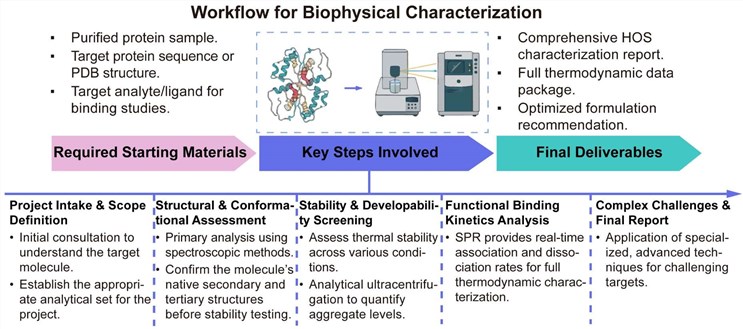
Workflow: Integrated Strategy for De-Risking Your Biologics
Our comprehensive, staged workflow is designed for maximum efficiency and robust, high-quality data generation, providing clear decision points that prevent costly pivots late in development.
Publication
This article presents a novel, label-free NMR method to comprehensively characterize biomolecular condensates. By measuring restricted diffusion and exchange dynamics, it simultaneously quantifies key properties—diffusion coefficients, partitioning, droplet size, and exchange rates—without perturbing fluorescent tags. Validated on systems from disordered proteins (FUS) to structured RNA-binding complexes, REDIFINE provides an integrative tool for studying native phase separation, offering crucial insights into the biophysics of membraneless organelles in health and disease.
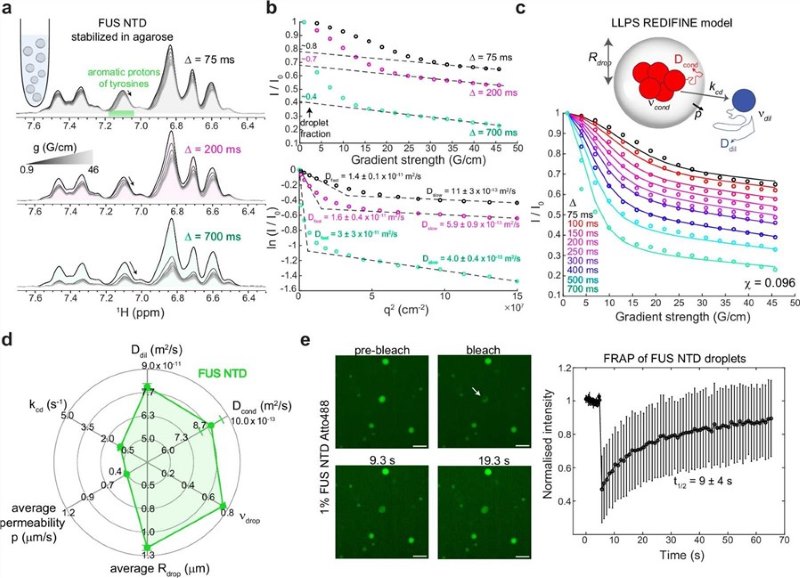 Fig.1 Structural characterization of the low-complexity N-terminal domain of human FUS protein. 1
Why Choose Creative Biolabs?
Creative Biolabs integrates predictive evolvability assessment—linking a scaffold's inherent stability (developability) to its functional evolution potential—to guide robust protein engineering. We specialize in complex targets, employing proprietary label-free diffusion NMR to characterize biomolecular condensates and advanced membrane mimetics (e.g., nanodiscs) to stabilize and analyze membrane proteins. This unique combination of predictive insight and cutting-edge methodology de-risks development and accelerates the identification of high-potential leads for clinical translation.
Experience the Creative Biolabs Advantage - Get a Quote Today to leverage our proprietary expertise in complex target characterization and predictive screening.
FAQs
What are the minimum sample requirements for a comprehensive HOS package, and can you handle precious samples?
We strive for efficiency, but optimal data quality for gold-standard techniques like AUC and DSC typically requires high purity (≥95%) and concentrations around 1-5 mg/mL.
Which technique is the regulatory gold standard for quantifying aggregates in my final drug product?
Analytical ultracentrifugation (AUC) provides the definitive gold standard for quantifying aggregation. AUC delivers superior resolution for detecting and quantifying reversible and irreversible aggregates and fragments.
Can Creative Biolabs characterize my membrane protein (GPCR), which requires a lipid environment for stability?
Absolutely. We employ advanced membrane mimetics to encapsulate your membrane protein in a native-like, detergent-free lipid environment. This is the crucial step that preserves function and enables high-quality stability, binding, and structural analysis.
Customer Review
-
Complex Sample Handling
The use of Creative Biolabs' service in our research has significantly facilitated our ability to obtain high-quality data on an otherwise unstable membrane protein target. This work provided the first-ever thermodynamic characterization of this receptor. – Jo*n S -
Speed and Efficiency
The use of Creative Biolabs' service in our research has significantly improved the speed and accuracy of screening thousands of ligand candidates. The dual readout of thermal stabilization and kinetic affinity is indispensable for rapid lead selection. – Mar*a L
Related Services
Creative Biolabs offers a comprehensive suite of services that complement our biophysical characterization platform, ensuring end-to-end support for your therapeutic development needs.
Physical and Chemical Property Analysis Service
Creative Biolabs' physicochemical property analysis and conformational analysis provide essential data for ADEPT development and optimization, ensuring drug consistency, specificity, and safety.
Learn More →Antibody Maturation Service
Creative Biolabs offers antibody affinity maturation service using phage display (via random mutagenesis and stringent selection) and computational methods to enhance antibody/fragment/peptide binding affinity.
Learn More →Contact Us
Ready to solidify the foundation of your therapeutic success? Our expert team at Creative Biolabs is prepared to tailor a biophysical characterization strategy specifically for your unique molecule and project needs. Partner with us to transform complex data into actionable development strategies.
Reference
- Novakovic, M., et al. "LLPS REDIFINE allows the biophysical characterization of multicomponent condensates without tags or labels." Nat Commun 16.1 (2025): 4628. Distributed under Open Access license CC BY 4.0, without modification. https://doi.org/10.1038/s41467-025-59759-2
 Download our brochure