Helicase Assay Service
Creative Biolabs offers a comprehensive Helicase Assay Service to support functional analysis, inhibitor discovery, and immune signaling evaluation of helicases relevant to cancer research.
Background
Helicases are essential ATP-dependent motor proteins that catalyze the unwinding of DNA or RNA duplexes, playing indispensable roles in genome replication, repair, transcription, and RNA metabolism. Within the context of tumor immunology, helicases such as DDX3, DDX5, RIG-I (DDX58), and MDA5 (IFIH1) have emerged as critical regulators of innate immune signaling, nucleic acid sensing, and immune checkpoint modulation. Dysregulation or overexpression of specific helicase family members has been observed across various cancers, making them increasingly attractive targets for mechanism-of-action studies and therapeutic screening in the immuno-oncology field.
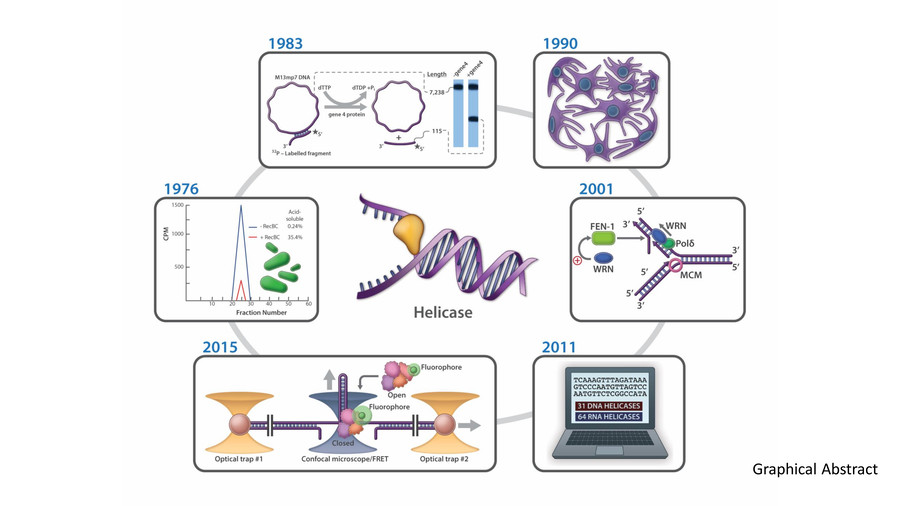 Fig.1 History of DNA Helicases.1
Featured Services at Creative Biolabs
We provide a robust suite of biochemical and cell-based helicase assays tailored to evaluate enzymatic activity, substrate specificity, and modulation by external agents such as inhibitors or stress stimuli. Our core offerings include:
Molecular Beacon-Based Helicase Assays
Fluorescence-based readouts using dual-labeled oligonucleotide substrates that release signal upon strand separation.
ATPase Assays
Quantification of ADP formation during ATP hydrolysis, allowing indirect but precise monitoring of helicase catalytic activity.
Gel-Based Unwinding Assays
Traditional PAGE-based readouts for validating helicase strand displacement activity using labeled nucleic acid substrates.
High-Throughput Screening (HTS) Format
Assays optimized for 96- or 384-well formats, enabling primary screening and dose–response profiling.
Target Coverage
Support for helicases relevant to immune activation and oncogenic pathways, including DDX3, DHX9, WRN, BLM, MDA5, and viral helicases (e.g., NSP13).
All services are adaptable to human, murine, or viral helicase targets with customizable detection formats.
Workflow

Highlights
- Onco-Immunology Relevance – Focus on helicases involved in tumor immune signaling (e.g., RIG-I/MDA5)
- Multiple Assay Modalities – From real-time fluorescence to gel-based validation
- High-Quality Screening Readouts – Z' > 0.7 for robust reproducibility
- Customizable Across Species & Enzymes – Tailored systems for human, mouse, and pathogen helicases
- Integrated Analysis Services – Functional validation, immune gene expression profiling, and more
FAQs
Q1: Which helicase targets are most relevant for tumor immunity?
A1: DDX3, RIG-I (DDX58), MDA5 (IFIH1), and DHX9 are heavily implicated in immune sensing pathways, interferon response, and inflammation, making them valuable targets in tumor immune modulation studies.
Q2: Can I use my own recombinant helicase or substrate?
A2: Yes. We support both client-supplied and in-house generated enzymes or nucleic acid substrates, and we can assist in assay adaptation accordingly.
Q3: Do you offer secondary validation after screening?
A3: Absolutely. We offer dose–response assays, orthogonal validation methods (e.g., PAGE), and immunoassay integration upon request.
Q4: Are these assays suitable for studying helicase–RNA immune signaling?
A4: Yes. Our platforms can be adapted to analyze helicase involvement in RNA sensing pathways, such as type I interferon production or inflammasome activation.
Partner with Experts in Helicase Biology and Immuno-Oncology
Creative Biolabs is committed to accelerating discovery in cancer biology and immune regulation through advanced helicase assay platforms. Whether you're targeting ATP-dependent unwinding activity or immune-regulatory roles of helicases, we provide flexible, validated, and insightful assay solutions.
Reference
- Brosh, Robert M Jr, and Steven W Matson. "History of DNA Helicases." Genes vol. 11,3 255. DOI: 10.3390/genes11030255. Distributed under Open Access license CC BY 4.0, without modification.
 Download our brochure