Comprehensive Aptamer Characterization Platforms
Creative Biolabs' comprehensive aptamer characterization platforms are designed to answer the critical questions that arise after selection and before downstream deployment. We provide advanced structural analytics, quantitative binding assays, thermodynamic profiling, and competition-based specificity assessment.
Submit Your Request Now
Why Comprehensive Aptamer Characterization Matters
In early discovery stages, aptamers are often evaluated primarily by apparent affinity. However, as programs advance toward application-driven validation, limitations frequently surface:
-
Unexpected structural instability under physiological or assay-relevant conditions
-
Affinity loss when transitioning from purified targets to complex matrices
-
Cross-reactivity with homologous proteins or pathway-related molecules
-
Poor performance reproducibility across batches, platforms, or environments
Comprehensive characterization mitigates these risks by generating an integrated performance profile. This approach enables informed go/no-go decisions, rational optimization, and smooth handoff to formulation, assay development, or therapeutic engineering workflows.
Great Minds Choose Creative Biolabs
Our Comprehensive Aptamer Characterization Platforms
Our platforms consist of four tightly coordinated service modules. Each module can function independently or as part of a full characterization pipeline, depending on project scope and development stage.
Discuss Your Needs
Applications Across Research and Development
Our platform supports a wide range of research scenarios, including:

Aptamer-based diagnostic and biosensor development

Biomarker validation and detection assay optimization

Comparative evaluation of aptamer libraries or variants

Pre-optimization studies prior to chemical modification or conjugation
Start Your Project
Case Studies
Case 1
The Selection and Characterization of A Novel ssDNA Aptamer Targeting Carcinoembryonic Antigen
Carcinoembryonic antigen (CEA), a well-known cancer biomarker that is used to diagnose various cancers, notably colorectal cancer, was used as a target to select and characterize single-stranded DNA aptamers. In this study, SELEX and NGS techniques were employed in the aptamer selection processes. Aptamer characterization techniques, such as enzyme-linked oligonucleotide assay (ELONA), dot blot, and bioinformatics assays, were conducted to observe the affinity binding of the selected aptamer to the target protein.
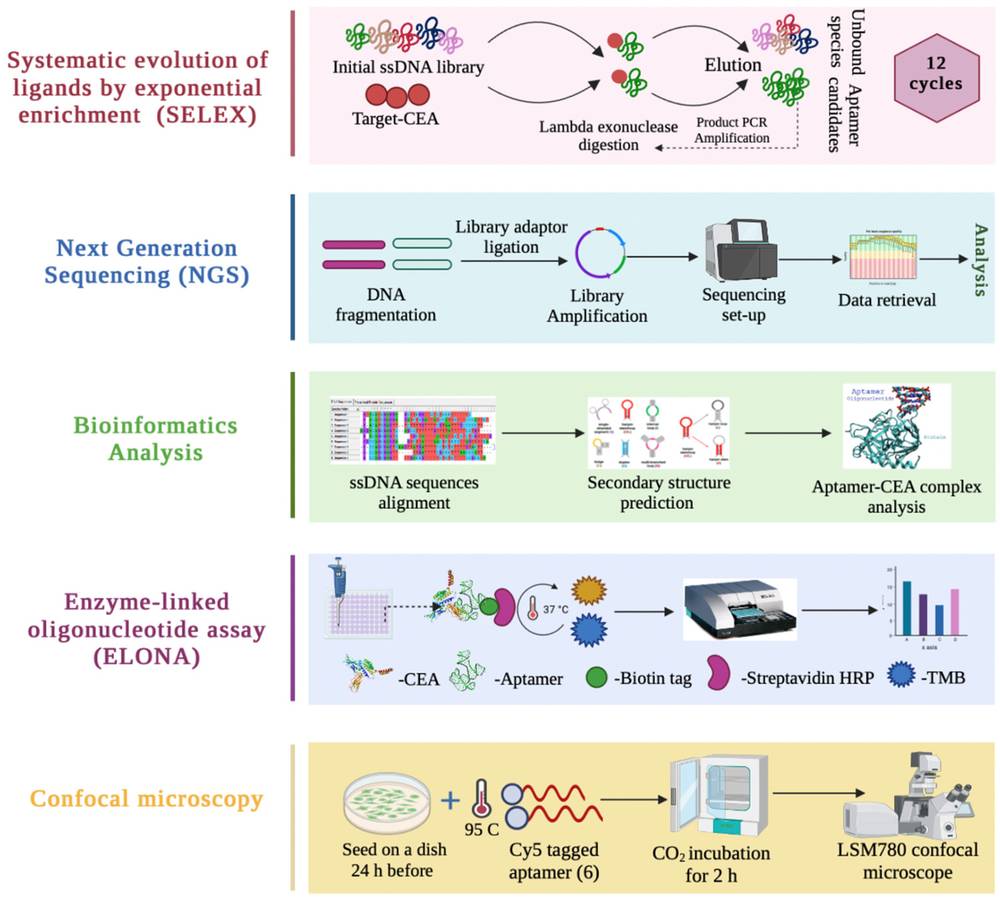 Fig.1 Schematic overview of CEA aptamer selection and characterization.1,2
References
-
Yunussova, Nigara, et al. "A Novel ssDNA Aptamer Targeting Carcinoembryonic Antigen: Selection and Characterization." Biology 11.10 (2022): 1540. https://www.mdpi.com/2079-7737/11/10/1540
-
Distributed under Open Access license CC BY 4.0, without modification.
FAQs
Can I select only specific characterization modules instead of the full platform?
Yes. All modules are fully modular. Clients may choose individual services based on immediate research needs or integrate multiple modules into a comprehensive workflow. Many projects begin with one module and expand as development progresses.
How do these services differ from basic affinity testing?
Basic affinity testing provides a single snapshot of binding strength. Our platform expands beyond that by analyzing kinetics, stability, structural integrity, and competitive behavior, offering a multidimensional understanding of aptamer performance that is critical for downstream reliability.
Are chemically modified or labeled aptamers compatible with these assays?
Absolutely. We routinely characterize chemically modified, labeled, and application-specific aptamers. Experimental conditions and analytical approaches are adjusted to accurately assess how modifications impact folding, binding, stability, and specificity.
Can multiple aptamer candidates be compared side by side?
Yes. Comparative characterization is one of the most common use cases. Multiple aptamers can be evaluated under identical conditions, enabling objective ranking and evidence-based candidate prioritization.
Are assays performed under physiologically or application-relevant conditions?
Where appropriate, assays can be conducted under conditions that mimic physiological or application-specific environments, such as defined ionic strength, temperature ranges, or buffer systems, to enhance translational relevance.
What does the final report include?
Each project includes a structured, presentation-ready report with experimental summaries, module-specific results, integrated interpretation, and application-oriented conclusions. Reports are designed to support internal review, decision-making, and downstream planning.
Can results from this platform support optimization or redesign of aptamers?
Yes. By correlating structural features with binding behavior, stability, and competition outcomes, our data often highlights specific optimization opportunities—such as sequence refinement, modification strategy adjustments, or condition tuning—reducing reliance on trial-and-error approaches.