Endothelial Cell Tube Formation Assay Service
Angiogenesis & Diseases
Angiogenesis, the physiological process through which new blood vessels form from pre-existing ones, serves as a cornerstone for both health and disease. Under normal conditions, angiogenesis plays a vital role in wound healing, menstrual cycles, and embryonic development. However, its deregulation is linked to numerous diseases, including cancer, diabetic retinopathy, rheumatoid arthritis, and psoriasis. Uncontrolled angiogenesis can fuel tumor growth and metastasis, turning a manageable tumor into an aggressive malignancy. Conversely, insufficient angiogenesis can contribute to conditions like chronic wounds and ischemic diseases, where inadequate blood supply hampers tissue repair. Therefore, angiogenesis represents a compelling target for therapeutic interventions, necessitating precise and reliable methods for its evaluation and modulation.
Endothelial Cell Tube Formation Assay Service
Creative Biolabs offers a reliable and comprehensive endothelial cell tube formation assay service, designed to evaluate the process of angiogenesis accurately. The tube formation assay is a well-established in vitro method that allows researchers to observe and quantify the formation of capillary-like structures by endothelial cells. This assay provides valuable insights into the pro-angiogenic and anti-angiogenic potentials of various compounds, growth factors, and genetic modifications. Leveraging state-of-the-art imaging systems and sophisticated analysis software, we provide high-resolution quantification and detailed interpretations that aid in a deeper understanding of angiogenesis. Our service is highly customizable, catering to the specific needs of your research project, whether you're studying cancer, cardiovascular conditions, or wound healing.
Diverse Endothelial Cell Lines for Tube Formation Assay
The choice of cell lines significantly influences the outcomes and relevance of tube formation assays. At Creative Biolabs, we provide a diversified selection of cell lines to cater to the varying requirements of your angiogenesis research. Our offerings include primary endothelial cells, such as human umbilical vein endothelial cells (HUVECs), which are highly responsive to angiogenic stimuli and widely recognized for their physiologically relevant in vitro behavior. Besides, we offer an extensive collection of endothelial cell lines from other tissues for specialized applications, including human dermal microvascular endothelial cells (HDMEC), human coronary artery endothelial cells (HCAEC), human pulmonary microvascular endothelial cells (HPMEC), human cardiac microvascular endothelial cells (HCMEC) and human aortic endothelial cells (HAoEC). Each of these cell lines is meticulously cultured and validated to ensure their quality, viability, and usability in tube formation assays.
Comprehensive Services Tailored to Your Needs
At Creative Biolabs, we are committed to delivering tailored solutions that meet the specific demands of your research. Our endothelial cell tube formation assay services are fully customizable, offering flexible experimental designs, scalable protocols, and detailed data analysis. Contact us today to learn more about our endothelial cell tube formation assay services and how we can support your angiogenesis research. Partner with Creative Biolabs to advance your discoveries and therapeutic innovations in the field of angiogenesis.
- Fully tailored solution to meet your specific research requirements and objectives.
- A diversified selection of primary endothelial cells to meet the varying requirements of specific angiogenesis research.
- Several image analysis techniques to capture detailed aspects of tube formation including calcein AM labeling, crystal violet staining, and high-resolution light microscopy
Published Data
A study has reported the tube-forming assay conducted on HUVECs, comparing the effects of vehicle control (Fig. 1A) with varying concentrations of compounds (Fig. 1B-D). The results showed a significant inhibition ability of tube formation in the presence of these compounds.
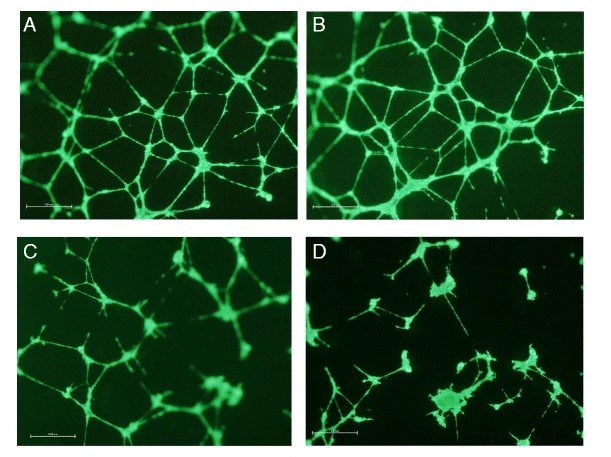 Fig.1 HUVEC tube-forming assay.1,
Reference
- Dorward, Hilary S., et al. "Pharmacological blockade of aquaporin-1 water channel by AqB013 restricts migration and invasiveness of colon cancer cells and prevents endothelial tube formation in vitro." Journal of Experimental & Clinical Cancer Research 35 (2016): 1-9. Distributed under Open Access license CC BY 4.0, without modification.
 Download our brochure