Utilize patient tumor samples to generate PDX models that preserve the native tumor heterogeneity, microarchitecture, and complex TME stromal components.
Learn More →Macrophage involved Immuno-Oncology Modeling Service for In Vivo Testing
Creative Biolabs' macrophage-involved immuno-oncology models for in vivo testing assist in accelerating critical decision-making and validating therapeutic mechanisms through the utilization of advanced humanized myeloid-enabled xenografts and engineered polarization assessment protocols. The primary objective of this service is the provision of precise, quantitative, and translationally relevant data concerning the impact of therapeutic agents on tumor associated macrophages (TAMs). This approach moves beyond rudimentary efficacy assessment to validate the core mechanism of action, which is imperative for regulatory submission and subsequent clinical success.
Introduction What We Can Offer Workflow Why Creative Biolabs Customer Reviews FAQs Related Services Contact Us
Macrophage-Involved Immuno-oncology Models Serve as Important Tools for In Vivo Testing
Various immunotherapies and anticancer drugs have achieved certain success in cancer treatment, and preclinical evaluation of these drugs and therapies is an essential step before being applied to clinical settings. However, there is a limited number of models available to evaluate the interaction between the human immune system and tumors. Evidence shows that macrophages are powerful immune effector cells that play important functions in tumor immunotherapy. Given the active role of macrophages in therapeutic strategies, they have become potential targets for improved cancer treatment. Therefore, it is crucial to develop macrophage-involved immuno-oncology models for in vivo testing.
Initiate a confidential consultation to delineate project-specific solutions.
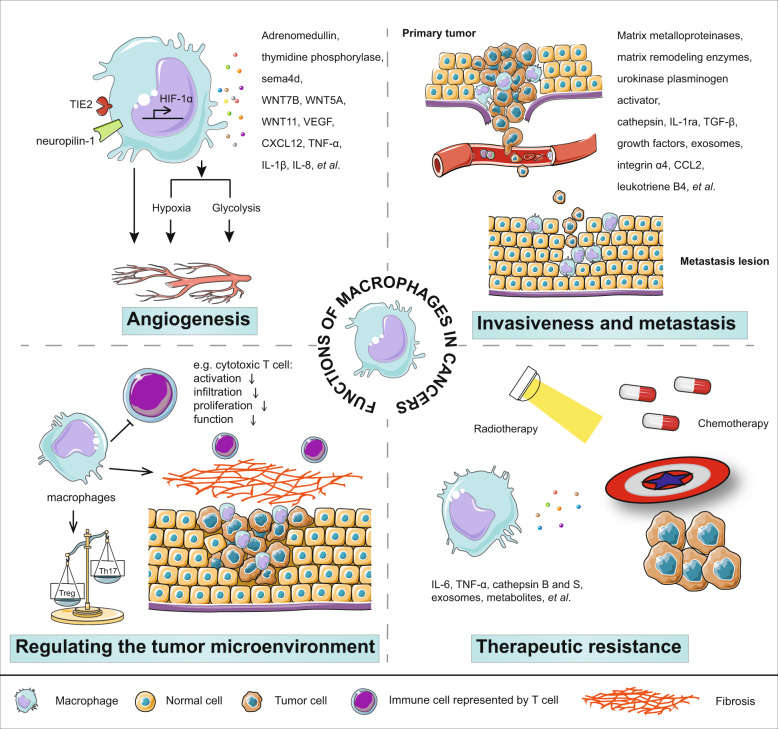 Fig.1 Macrophages play an important role in cancer. 1
What We Can Offer
Our Macrophage-Involved Immuno-Oncology Models for In Vivo Testing
To evaluate the effectiveness against tumors in animal models, Creative Biolabs succeeded in developing macrophage-involved immuno-oncology models for in vivo testing. We employ the co-inoculation approach to generate macrophage-involved immuno-oncology models co-inoculated with CD3+ T cells, induced macrophage, and cancer cells. Based on this, we provide multiple types of macrophage-involved immune-oncology models for global customers' immediate use. In addition, we are confident in providing customized solutions to develop a model that is appropriate for your diverse demands. Noteworthy, we also offer other types of immune-oncology models (DCs-involved immune-oncology models) to support your projects. Together with our top-ranking research team, we have more confidence in helping every customer to:
- Select the appropriate cancer models/cell lines;
- Select suitable host animals consistent with customers' needs;
- Make a design for projects;
- Observe the model and analyze its efficacy;
- Evaluate the macrophage-involved immune-oncology models.
Our Humanized Immunodeficient Mouse Models Used in Immuno-Oncology
| Strains | Mouse models |
|---|---|
| General strains | B-NDG; BRG; C57BL/6-RG; CIEA BRG; CIEA NOG; NCG; NOG; NRG; NOD-RG; NSG; NSI |
| MHC-affected strains with genetic alterations | DRAGA; HUMAMICE; NOG-dKO or NOG-B2Mnull, IAnull; NOG I-Abeta <-/->; NSG-A2/DR1; NSG-B2Mnull IA IEnull; NSG-(KbDb)null IAnull |
| Genetically modified strains for cytokine overexpression | BRGST; hIL2-NOG; MISTRG; MISTRG6; NOG-EXL; NSG-SGM3 |
| Other genetically modified strains | BRGS; BRGSKW-v; NBSGW; NOG-pRorc γc; NSG-W41; TKO |
Macrophage-Involved IO Models at Creative Biolabs
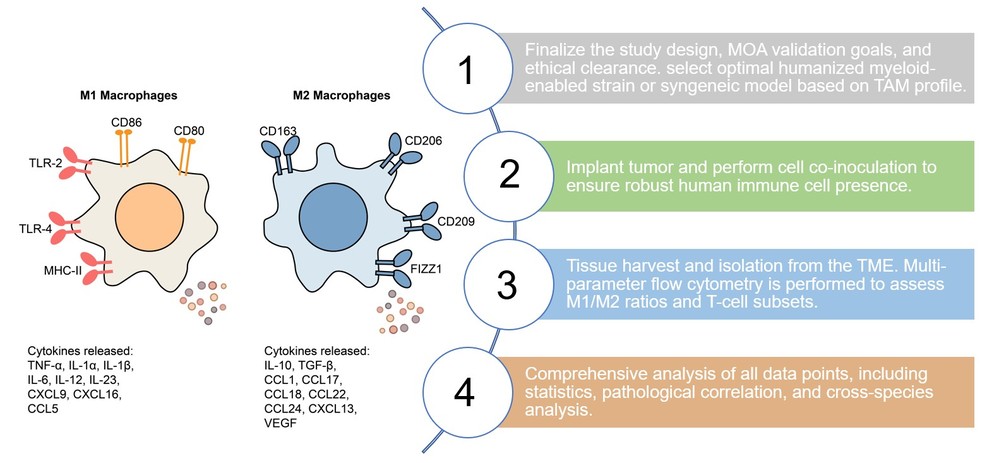
Highlights
TME Immune Regulation
Our myeloid models provide superior capability to facilitate research on the immune regulatory properties of the tumor microenvironment. This enables deep analysis of macrophage-T-cell cross-talk and therapeutic resistance mechanisms unique to the TME.
High Translational Fidelity
These humanized systems are excellent models to replicate the dynamics of human immune system interactions with tumors. This fidelity dramatically improves the predictive validity of your preclinical data compared to simpler, less relevant murine alternatives.

Stimuli Responsiveness
The engrafted human macrophages and immune cells are highly sensitive in response to therapeutic stimuli. This ensures that even subtle drug effects and low PK/PD signatures are reliably detectable, providing clearer efficacy readouts.
Extended Study Duration
Our optimized cytokine-enabled mouse strains provide an extensive experimental window duration. This allows for long-term PK/PD assessments, chronic dosing, and comprehensive analysis of therapeutic resistance and relapse mechanisms within a single study.
Explore strategic partnership opportunities - Request a detailed project quotation.
Customer Reviews
-
Early De-risking of Tox
Using Creative Biolabs' macrophage-involved immuno-oncology models for in vivo testing in our research has significantly improved/facilitated the early de-risking of off-target effects by assessing cross-species reactivity. - Dr. Jon **s. -
Combination Efficacy Insight
The phagocytosis Indices using Creative Biolabs' macrophage-involved immuno-oncology models for in vivo testing in our research have significantly improved/facilitated our understanding of drug combination effects on TAM clearance. - Li*** Chen.
FAQs
Q: How do these macrophage models enhance translational predictability for IO agents?
A: These systems incorporate functional human TAMs within the tumor microenvironment, enabling the direct quantification of macrophage reprogramming and phagocytic induction. This higher-fidelity approach significantly reduces the translational gap observed with standard, non-myeloid-enabled xenograft models.
Q: What is the primary advantage of utilizing humanized myeloid models over standard syngeneic models?
A: Humanized models facilitate the direct investigation of human-specific targets like CD47 and CSF1R in a relevant in vivo context. The utilization of human immune components ensures that the observed therapeutic mechanism is directly transferable to clinical application.
Related Services
PDX Models
CDX Models
Leverage our extensive catalog of established CDX lines or develop a custom model from your proprietary cell line. CDX models offer unparalleled standardization, high reproducibility, and are ideal for early-stage, high-throughput screening and establishing initial PK/PD relationships.
Learn More →How to Contact Us
As a leading company in the tumor research industry, Creative Biolabs is constantly developing more effective tools to evaluate anti-cancer drugs and immunotherapies in preclinical examination. If you want to know more details about our macrophage-involved immune-oncology models for in vivo testing, please get in touch with us without hesitation. We will try our best to deliver the best service to you.
Reference
- Duan, Zhaojun, and Yunping Luo. "Targeting macrophages in cancer immunotherapy." Signal transduction and targeted therapy vol. 6,1 127. 26 Mar. 2021. Distributed under an Open Access license CC BY 4.0, without modification. https://doi.org/10.1038/s41392-021-00506-6
 Download our brochure
Loading case studies...
Online Inquiry