Introduction What We Can Offer Workflow Published Data Why Choose Us? Applications FAQs Featured Services Featured Products
Aptamers are high-affinity oligonucleotide ligands often limited by rapid nuclease degradation in biological environments. At Creative Biolabs, we provide industry-leading 2′ fluoro (2′-F) modification services, empowering researchers to develop exceptionally stable, functional aptamers and advancing their scientific research.
Contact our team to get an inquiry now!
2′-Fluoro Modifications of Aptamer
The 2′-F modification is a premier chemical strategy used to enhance the metabolic stability of RNA and DNA aptamers. By replacing the 2′-hydroxyl group (2'-OH) of the ribose ring with a fluorine atom, the phosphodiester backbone becomes significantly more resistant to endonuclease cleavage. This substitution also favors a C3′-endo (A-form) sugar pucker, which increases the melting temperature (Tm) and improves the overall structural rigidity of the aptamer. This modification is widely validated in high-impact research; notably, the anti-VEGF aptamer utilizes 2′-F pyrimidines to achieve a half-life of 18 hours in human plasma, a massive leap from the few seconds typical of unmodified sequences.
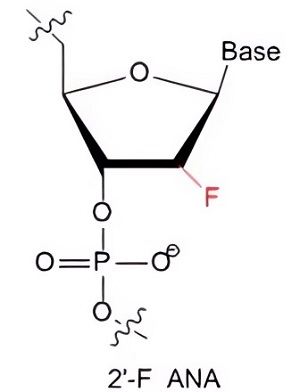 Fig.1 2' fluoro modification.1,3
What We Can Offer
We offer a comprehensive suite of 2′-F integration services designed to optimize the biochemical and biophysical profiles of your nucleic acid leads, ensuring high-purity delivery and consistent binding kinetics for every project.
Specialized Service Offerings:
Direct SELEX with 2′-F Pyrimidines
We utilize specialized mutant polymerases (such as the Y639F T7 variant) to incorporate 2′-F nucleotides directly into the starting library. This "selection-first" approach ensures that the resulting aptamer's binding motif is fundamentally dependent on the modified chemistry.
Post-Selection Modification Mapping
For established 2′-OH RNA sequences, our team performs systematic "fluorine scanning." We identify non-critical residues where 2′-F can be introduced without disrupting the tertiary fold, effectively stabilizing your existing leads for complex assays.
Custom Phosphoramidite Synthesis
We provide high-scale solid-phase synthesis of oligonucleotides containing 2′-F-dC and 2′-F-dU, as well as 2′-F purines (2′-F-dA, 2′-F-dG) for maximum protection against aggressive nucleases.
Affinity & Stability Validation
Every modified candidate undergoes rigorous characterization, including Surface Plasmon Resonance (SPR) or MicroScale Thermophoresis (MST), to confirm that the modification has preserved or enhanced target binding affinity.
Multimodal Synergy Integration
To address metabolic clearance in experimental models, we offer the conjugation of 2′-F modified aptamers with PEG (polyethylene glycol) or the addition of 3′-inverted thymidine caps for comprehensive protection against exonucleases.
Workflow
01
Initial Consultation: We define the target protein/molecule and discuss whether you require a new selection (de novo) or modification of an existing sequence for your specific research goals.
02
Material Submission: For post-selection services, the client provides the sequence and previous binding data. For de novo SELEX, the client provides the target protein (typically >90% purity).
03
Experimental Phase: We execute either the 2′-F library selection or the site-specific modification synthesis. This includes iterative rounds of partitioning and PCR amplification using modified dNTPs.
04
Characterization: We perform mass spectrometry and HPLC to verify purity, followed by Kd determination.
05
Final Delivery: We provide a comprehensive project report, raw binding data, and the lyophilized 2′-F modified aptamers for research use.
Published Data
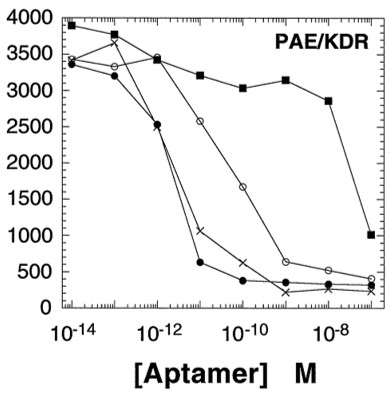 Fig.2 VEGF receptor binding inhibition.2,3
In this study, researchers utilized the SELEX process to isolate 2′-fluoropyrimidine RNA-based aptamers targeting the 165-amino acid form of vascular endothelial growth factor (VEGF165 ). The project successfully identified several sequence families with high specificity for the heparin-binding domain of VEGF. Key results demonstrated that the 2′-F modification provided the structural integrity necessary to inhibit the binding of VEGF165 to its receptors (KDR and Flt-1) with high potency. Furthermore, these modified aptamers effectively blocked VEGF-induced vascular permeability in vivo. This classic case illustrates how 2′-F modifications enable the selection of ligands that are not only stable in biological matrices but also possess potent functional inhibitory characteristics.
Why Choose Us?
-
Expert Consultation: Our PhD-level scientists provide flexible solutions for complex chemical integrations.
-
End-to-End Solutions: We manage every step, from initial library design to the final delivery of stable leads.
-
Guaranteed Quality: We utilize HPLC and ESI-MS to ensure consistent reproducibility and high purity.
-
Research Optimization: Our modifications are optimized for experimental longevity and performance in complex biological matrices.
-
Rapid Turnaround: We streamline the SELEX and synthesis processes to accelerate your development timeline.
-
Premier Support: Our after-sales team provides technical assistance for your downstream assays.
Applications
-
Ophthalmic Research: Enabling the development of long-lasting inhibitors for VEGF or complement factors in model systems of macular degeneration, ensuring sustained binding activity and target inhibition within the complex vitreous fluid environment.
-
Targeted Drug Delivery Studies: Ensuring aptamers survive systemic circulation in in vivo models to target specific tissues or tumors, preventing premature degradation by aggressive blood-borne nucleases before the molecule reaches its destination.
-
Molecular Imaging: Constructing 2′-F modified PET or SPECT probes that maintain structural integrity during the imaging window, allowing for high-resolution preclinical evaluation of disease markers, biodistribution patterns, and target occupancy in real-time.
-
Biosensors and Diagnostics: Enhancing the shelf-life and robustness of aptamer-based sensors in complex environmental or analytical samples where temperature fluctuations or enzymatic contaminants would otherwise compromise the sensitivity of unmodified nucleic acid sequences.
FAQs
Q: How does the 2′-F modification compare to 2′-O-methyl in terms of binding affinity?
A: Generally, the 2′-F modification is less sterically demanding than the 2′-O-methyl group. Because fluorine is small and highly electronegative, it promotes an A-form helix, which often enhances binding affinity for protein targets. In many cases, replacing a 2′-OH with 2′-F results in a Tm increase, whereas 2′-O-methyl can sometimes interfere with high-resolution hydrogen bonding at the binding interface.
Q: Can I introduce 2′-F modifications into both pyrimidines and purines?
A: Yes, though it is most common to start with 2′-F pyrimidines (C and U) because the mutant polymerases used in SELEX handle them more efficiently. However, Creative Biolabs also offers 2′-F purine modifications for projects requiring absolute nuclease immunity, which is particularly useful for long-term experimental applications.
Q: Will the inclusion of 2′-F affect the immunogenicity of my aptamer in model systems?
A: Research suggests that 2′-F modifications can help "shield" the aptamer from detection by innate immune sensors. Specifically, these modifications can prevent the activation of Toll-like receptors (TLR7 and TLR8), which normally recognize single-stranded RNA, thereby reducing the risk of an inflammatory response in your assays.
Q: How do you ensure the modified polymerases don't introduce sequence bias?
A: Our scientists use highly optimized buffer conditions and proprietary mutant polymerases that have been calibrated to maintain high fidelity. We perform deep sequencing at various rounds of selection to monitor the library diversity and ensure that the selection is driven by binding affinity rather than enzymatic preference.
Q: Can 2′-F aptamers be conjugated to PEG?
A: Absolutely. We frequently combine 2′-F modifications with 5′-PEGylation. This "dual-layer" protection addresses both enzymatic degradation (via 2′-F) and rapid clearance (via the large PEG chain), which is a standard configuration for enhancing the performance of aptamers in systemic circulation studies.
Q: Does the 2′-F modification influence the hydrophobicity of the aptamer?
A: Fluorine does slightly increase the lipophilicity of the oligonucleotide. In some cases, this can be advantageous, allowing the aptamer to interact with hydrophobic pockets on a protein surface that would be inaccessible to standard RNA, potentially increasing the diversity of targets you can investigate.
With decades of expertise in nucleic acid chemistry, Creative Biolabs is your trusted partner for creating high-performance, stable aptamers. We invite you to contact our technical team to discuss how our 2′ fluoro modification services can stabilize your discovery and accelerate your scientific research goals.
Featured Services
Featured Products
References
-
Yu, Yuanyuan, et al. "Molecular selection, modification and development of therapeutic oligonucleotide aptamers." International journal of molecular sciences 17.3 (2016): 358. https://doi.org/10.3390/ijms17030358
-
Ruckman, Judy, et al. "2′-Fluoropyrimidine RNA-based aptamers to the 165-amino acid form of vascular endothelial growth factor (VEGF165): Inhibition of receptor binding and VEGF-induced vascular permeability through interactions requiring the exon 7-encoded domain." Journal of Biological Chemistry 273.32 (1998): 20556-20567. https://doi.org/10.1074/jbc.273.32.20556
-
Distributed under Open Access license CC BY 4.0. The image was modified by extracting and using only part of the original image.
For Research Use Only.
Related Sections: