Introduction What Can We Offer? Workflow Published Data Why Choose Us? Applications FAQs Featured Services Featured Products
Creative Biolabs offers specialized terminal capping services using 3′ inverted thymidine to drastically improve the stability of your aptamer candidates. Our professional modifications solve the critical challenge of rapid exonuclease degradation, helping researchers transition from discovery to robust downstream applications.
Contact our team to get an inquiry now!
3′ Inverted Thymidine Modifications of Aptamer
The 3′ inverted thymidine (3′-idT) modification is a premier strategy for safeguarding nucleic acid aptamers against enzymatic attack. Naturally, DNA and RNA sequences are highly vulnerable to 3′ to 5′ exonucleases prevalent in biological fluids. By incorporating a deoxy-thymidine residue via a unique 3′→3′ phosphodiester linkage, as opposed to the standard 5′→3′ bond, the terminal polarity is inverted. This structural "flip" removes the free 3′-hydroxyl group, creating a steric mismatch that serum enzymes cannot recognize or hydrolyze. Consequently, the aptamer remains structurally intact and functionally active for significantly longer durations, all while maintaining its precise three-dimensional folding and high binding affinity for the intended target.
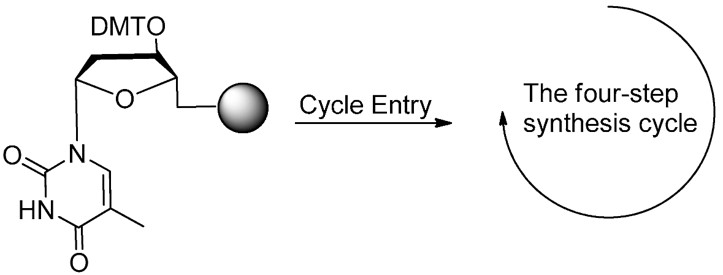 Fig.1 Synthesis of 3′-idT modified aptamers.1,3
What Can We Offer?
Creative Biolabs provides a comprehensive end-to-end service for the design and synthesis of 3′-idT modified aptamers. We integrate these terminal caps into custom oligonucleotide sequences to ensure maximum biostability and sustained performance in complex environments.
Detailed Service Features:
Customized Synthesis Architecture
We utilize specialized 5′-hydroxyl-attached Controlled Pore Glass (CPG) supports to initiate synthesis from the inverted position. This ensures that the 3′→3′ bond is architecturally perfect and integrated seamlessly into the sequence.
Synergistic Modification Design
Our scientists don't just add a cap; we design holistic stabilization profiles. We can combine 3′-idT with internal 2′-fluoro or 2′-O-methyl ribose modifications and 5′-PEGylation to create a "multi-shielded" molecule that resists both endonucleases and renal clearance.
Preservation of Binding Kinetics
We conduct thorough post-modification assessments to ensure that the inversion does not interfere with the aptamer's paratope. Our goal is to extend the half-life without compromising the dissociation constant (Kd) or the slow off-rate characteristics.
High-Purity Delivery
Every modified aptamer undergoes rigorous HPLC or PAGE purification. We provide comprehensive QC documentation, including Mass Spectrometry (MS) verification to confirm the precise molecular weight of the inverted construct.
Consultative Development
We act as a collaborative partner rather than a simple manufacturer. Our experts provide advice on the optimal placement of modifications based on the predicted secondary structure of your specific aptamer.
Workflow
01
Initial Consultation: Clients provide the aptamer sequence, target information, and required stability duration. We discuss the feasibility of 3′-idT integration.
02
Strategic Design: Our team analyzes the sequence for potential structural interference and confirms the complementary modification strategy (e.g., adding 5′-biotin or internal ribose changes).
03
Specialized Synthesis: We perform solid-phase phosphoramidite synthesis starting with 5′-dT CPG. This allows for the standard 3′ to 5′ elongation to occur on top of the inverted base.
04
Purification & QC: The crude product is purified via HPLC. We perform MS and analytical HPLC to verify the presence of the 3′→3′ linkage.
05
Final Delivery: The lyophilized, stabilized aptamer is shipped with a detailed Certificate of Analysis (CoA) and stability data reports.
Published Data
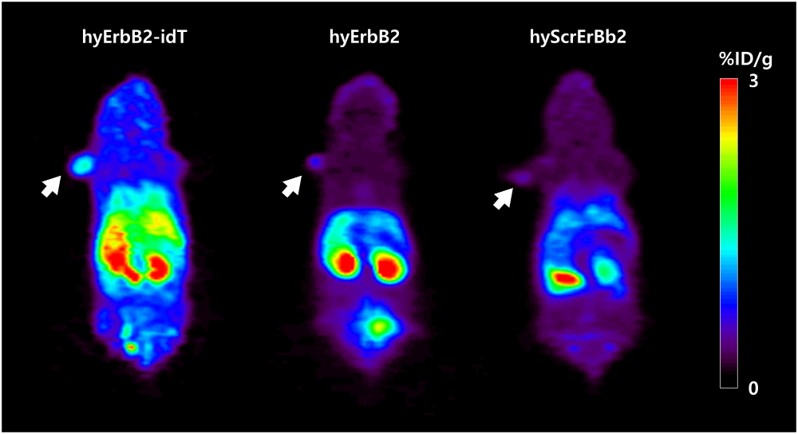 Fig.2 In vivo imaging of hybridized ErbB2-idT (hyErbB2-idT) aptamer.2,3
In a significant study, researchers evaluated the enhancement of in vivo targeting properties of an ErbB2-specific DNA aptamer through chemical modification. The study demonstrated that while the original aptamer was vulnerable to enzymatic attack, the introduction of a 3′-idT modification drastically improved its biostability. Serum stability assays revealed that the 3′-idT modified version remained substantially intact even after 24 hours of incubation, whereas the unmodified aptamer showed significant degradation. Furthermore, in vivo imaging showed that this terminal capping enabled better tumor-specific accumulation and prolonged retention in ErbB2-positive xenograft models. This authentic case confirms that 3′-idT is a vital chemical tool for researchers aiming to transform laboratory aptamers into robust molecular probes capable of performing in complex biological systems.
Why Choose Us?
-
Scientific Management: Our facility is led by doctoral-level scientists who understand the nuances of nucleic acid chemistry and terminal inversions.
-
Specialized CPG Technology: We utilize premium 5′-reversed supports to ensure the highest coupling efficiency for the initial inverted base.
-
Cost-Effective Scalability: We provide high-end modifications at competitive rates by optimizing our solid-phase synthesis protocols for high yields.
-
Proven Stability Gains: Our 3′-idT strategies are validated to extend aptamer half-lives from minutes to several hours or even days.
-
Collaborative Interaction: We offer direct communication with the synthesis team to answer complex research questions regarding structural stability.
-
Rapid Turnaround: Our optimized workflow allows for the rapid delivery of modified sequences, minimizing the time between design and experimental testing.
Applications
-
Nuclease-Resistant Biosensors: By capping the 3′ end with inverted thymidine, biosensors utilized for analyzing complex biological matrices (such as whole blood, serum, or saliva) maintain structural integrity for extended periods. This prevents signal drift or false negatives caused by terminal degradation during real-time monitoring.
-
In Vitro Diagnostic Probes: Modified aptamers are excellent candidates for ELONA (Enzyme-Linked Oligonucleotide Assays) and flow cytometry. The 3′-idT cap enables these probes to survive prolonged incubation steps in serum-rich environments, where unmodified oligonucleotides would succumb to enzymatic failure within minutes.
-
Targeted Molecular Imaging: For molecular imaging, stabilized aptamers offer an expanded kinetic window. This allows for optimal target accumulation and more efficient systemic clearance of background signals, resulting in significantly higher contrast and signal-to-noise ratios in high-resolution tissue imaging.
-
Antidote-Controlled Regulatory Systems: Because 3′-idT blocks polymerase-mediated extension while permitting hybridization, these aptamers are ideal for "switchable" therapeutic systems. A complementary "antidote" sequence can effectively displace the aptamer from its target, providing a mechanism for reversible activity and precise spatial control.
-
Targeted Drug Delivery Conjugates: Aptamers modified with 3′-idT serve as robust delivery vehicles for drug-loaded nanoparticles or toxins. The terminal modification ensures that the targeting ligand remains functional during its journey through the systemic circulation, ensuring the payload is delivered specifically to the target cell surface without premature ligand breakdown.
FAQs
Q: Is it possible to use 3′-idT if my aptamer already has a 5′ modification like a fluorophore or PEG?
A: Yes, our synthesis process is fully compatible with dual modifications. Because we start the synthesis at the 3′ end with the inverted base and move toward the 5′ end, we can easily add fluorophores, biotin, or PEG handles to the 5′ terminus as the final step of the synthesis.
Q: How does 3′-idT compare to phosphorothioate (PS) modifications for stability?
A: While PS modifications improve resistance to endonucleases by altering the phosphate backbone, they can sometimes increase non-specific binding or toxicity. 3′-idT is a "cleaner" terminal-specific block that provides superior protection against exonucleases, the primary cause of rapid degradation, without altering the backbone chemistry of the rest of the sequence.
Q: Will the 3′-idT modification make the aptamer more hydrophobic?
A: The addition of a single thymidine residue does not significantly alter the overall hydrophobicity or solubility of the oligonucleotide. It remains highly soluble in standard buffers like PBS or Tris-HCl, making it easy to integrate into your existing experimental protocols.
Q: Can this modification be applied to both DNA and RNA aptamers?
A: Absolutely. While the "T" in 3′-idT stands for thymidine (a DNA base), it is the standard capping agent for both DNA and RNA sequences. It provides excellent protection for RNA aptamers, which are traditionally much more fragile than their DNA counterparts.
Q: How do I know if I need a 3′-idT or a 5′ modification?
A: Serum degradation is primarily driven by 3′ to 5′ exonucleases, so 3′-idT is usually the priority for stability. If your application involves long-term circulation or exposure to 5′ exonucleases, we may suggest a 5′ cap or PEGylation as a secondary measure to provide "all-around" protection.
Creative Biolabs' expert-led team is dedicated to providing high-precision terminal modifications that empower your research. Our 3′ inverted thymidine services ensure your aptamers maintain peak performance in demanding environments. Contact us today to discuss your project requirements and receive a specialized consultation.
Featured Services
Featured Products
References
-
Ni, Shuaijian, et al. "Chemical modifications of nucleic acid aptamers for therapeutic purposes." International Journal of Molecular Sciences 18.8 (2017): 1683. https://doi.org/10.3390/ijms18081683
-
Park, Jun Young, et al. "Enhancement of in vivo targeting properties of ErbB2 aptamer by chemical modification." PLOS ONE 18.9 (2023): e0291624. https://doi.org/10.1371/journal.pone.0291624
-
Distributed under Open Access license CC BY 4.0, without modification.
For Research Use Only.
Related Sections: