Why Complement Inhibition Functional Assays Matter
Complement activation is not a single linear event. It is a dynamic cascade initiated through the classical, lectin, or alternative pathway and amplified through C3 convertase formation. Downstream events include C3 cleavage, C3b deposition, C5 convertase assembly, C5a generation, terminal pathway activation, and C5b-9 membrane attack complex formation. Because each pathway has different triggers, molecular players, amplification loops, and regulatory checkpoints, functional inhibition must be evaluated in a pathway-resolved manner.
A robust complement inhibition functional assay can answer key questions:
-
Does your candidate inhibit the classical pathway triggered by antibody-antigen immune complexes?
-
Does it block lectin pathway activation driven by mannose-binding lectin, ficolins, or MASP-mediated cleavage events?
-
Does it suppress alternative pathway amplification under Mg-EGTA conditions?
-
Does it prevent C3b deposition, C3 convertase formation, or downstream opsonization?
-
Does it block C5 cleavage, C5a release, or terminal C5b-9 assembly?
-
Does the inhibitor act upstream or downstream of C3 activation?
-
Does the molecule retain potency in normal human serum, patient serum, plasma, or customized buffer systems?
-
Does inhibition reduce complement-mediated cell lysis, inflammatory signaling, or biomaterial opsonization?
Creative Biolabs supports these decisions with customized, high-quality functional assay development and execution.
Great Minds Choose Creative Biolabs
Pathway-Resolved Readout Panels
Creative Biolabs recommends selecting readouts based on the expected mechanism of action. A single endpoint may not be sufficient for complex complement programs.

Upstream Inhibition Panel
Designed for inhibitors targeting initiation or early convertase formation.

Amplification Inhibition Panel
Designed for alternative pathway and amplification loop inhibitors.

Translational Biomarker Panel
Designed to support preclinical and clinical biomarker strategy.
Assay Formats
|
Assay Formats
|
Descriptions
|
|
Classical Pathway Inhibition Assay
|
The classical pathway is typically activated by antibody-antigen immune complexes or antibody-coated target surfaces. Creative Biolabs designs classical pathway inhibition assays using sensitized sheep red blood cells, immune-complex-coated plates, antigen-antibody systems, antibody-coated cells, or customized target surfaces.
|
|
Lectin Pathway Inhibition Assay
|
The lectin pathway is initiated by pattern-recognition molecules such as mannose-binding lectin, ficolins, and collectins, followed by MASP-mediated cleavage of downstream components. Creative Biolabs develops lectin pathway inhibition assays using mannan-coated plates, pathway-selective buffer conditions, serum-based systems, and detection of C4d, C3b, C5a, or terminal complement complex formation.
|
|
Alternative Pathway Inhibition Assay
|
The alternative pathway provides a powerful amplification loop and can be activated by susceptible surfaces under selective conditions. Creative Biolabs supports alternative pathway inhibition testing using rabbit red blood cell hemolysis, zymosan particles, LPS-coated surfaces, pathway-selective buffers, C3b-coated plates, and cell- or particle-based models.
|
|
Terminal Pathway Inhibition Assay
|
Terminal pathway activation involves C5 cleavage, C5b generation, and assembly of C5b-6, C5b-7, C5b-8, and C5b-9. Creative Biolabs provides terminal complement inhibition assays to assess inhibitors targeting C5, C5a, C5b, C6, C7, C8, C9, or MAC assembly.
|
|
C3b Deposition Inhibition Assay
|
C3b deposition is a central marker of complement activation and amplification. Creative Biolabs offers plate-based and flow cytometry-based C3b/iC3b deposition inhibition assays to determine whether a candidate reduces opsonization on proteins, immune complexes, cells, nanoparticles, microbes, or biomaterial surfaces.
|
|
C5a and Anaphylatoxin Suppression Assay
|
C5a is a potent inflammatory mediator that drives neutrophil activation, chemotaxis, endothelial activation, and cytokine amplification. Creative Biolabs can assess whether complement inhibitors reduce C5a generation under pathway-specific or disease-relevant activation conditions.
|
|
Cell-Based Complement Inhibition Assay
|
Cell-based assays provide biological context that purified biochemical systems cannot fully capture. We support assays using tumor cells, endothelial cells, red blood cells, platelets, primary cells, engineered cells, bacteria, yeast, extracellular vesicles, viral vectors, or nanoparticles.
|
|
Hemolysis Inhibition Assay
|
Hemolysis inhibition assays remain widely used for evaluating complement pathway activity. Creative Biolabs provides CH50-like classical pathway inhibition assays and AH50-like alternative pathway inhibition assays.
|
Design Your Assay Formats
Customization Options
Every complement inhibition program is different. Creative Biolabs provides extensive customization to maximize biological relevance.
|
Customization
|
Descriptions
|
|
Pathway Customization
|
-
Classical pathway-biased conditions
-
Lectin pathway-biased conditions
-
Alternative pathway-selective conditions
-
Terminal pathway-focused readouts
-
Amplification loop-specific designs
-
Combined pathway panels
|
|
Readout Customization
|
-
Colorimetric ELISA
-
Chemiluminescence
-
Fluorescence
-
Flow cytometry
-
Multiplex immunoassay
-
Hemolysis
-
Cell viability
-
Plate-based deposition
-
Microscopy-compatible detection
|
|
Matrix Customization
|
-
Normal human serum
-
Patient serum
-
Species-specific serum
-
Complement-depleted serum
-
Reconstituted serum
-
Low-serum systems
-
High-serum challenge conditions
-
Customized buffer systems
|
|
Analysis Customization
|
-
IC50 calculation
-
Percent inhibition
-
Maximum inhibition
-
Residual activity
-
Dose-response modeling
-
Candidate ranking
-
Lot-to-lot comparison
-
Species cross-reactivity comparison
-
Mechanistic interpretation
|
Design Your Customization
Case Studies
Case 1
Complement classical pathway test and alternative pathway test
The researchers developed a model system to form purified alternative pathway (AP) C5 convertases on C3b-coated beads and quantify C5 conversion via functional analysis of released C5a. Then, they developed a C3aR cell reporter system that enables functional discrimination between C3 and C5 convertases. Their models enable functional characterization of purified convertase enzymes and provide a platform for the identification and development of specific convertase inhibitors for treatment of complement-mediated disorders.
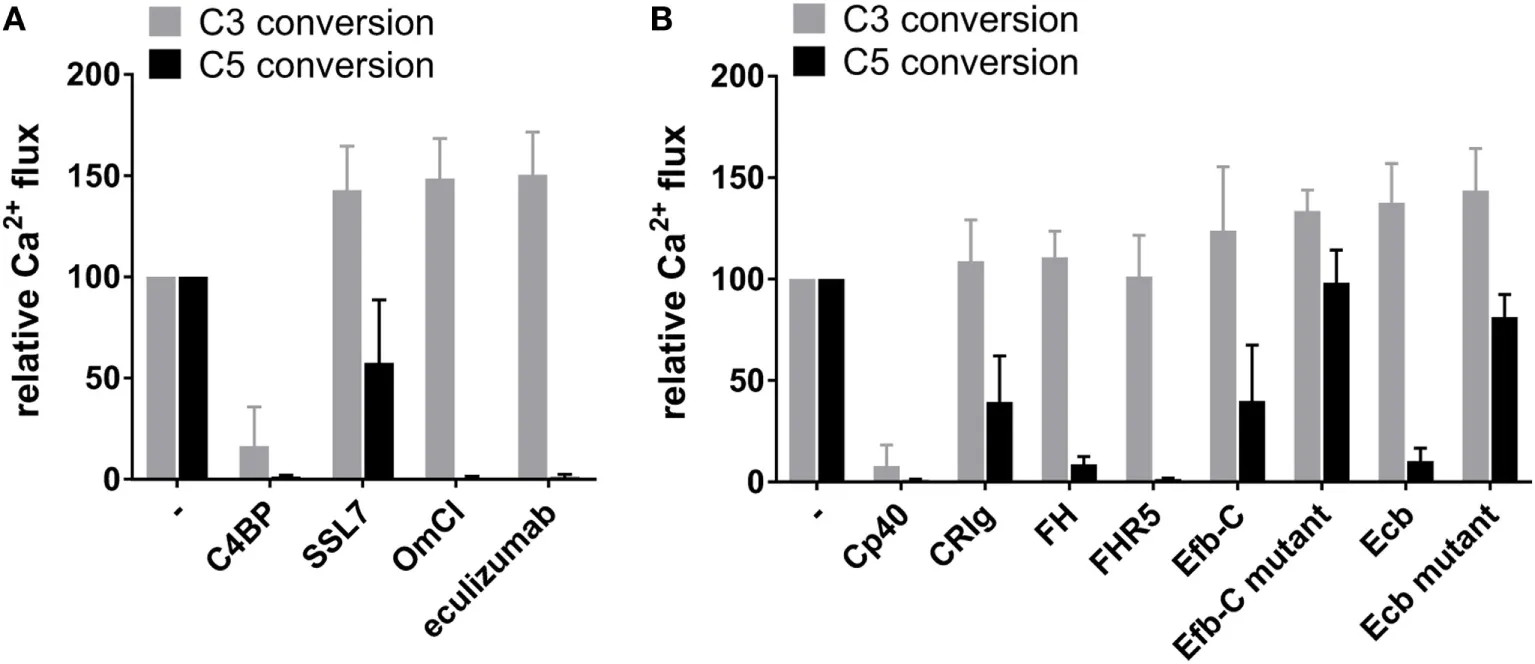 Fig. 1 The effect of inhibitors on classical pathway C3 and C5 conversion.1,2
References
-
Zwarthoff, Seline A., et al. "Functional characterization of alternative and classical pathway C3/C5 convertase activity and inhibition using purified models." Frontiers in immunology 9 (2018): 1691. https://doi.org/10.3389/fimmu.2018.01691
-
Distributed under Open Access license CC BY 4.0, without modification.
Frequently Asked Questions
How do you choose the right complement inhibition functional assay for my candidate?
The assay format is selected according to the candidate's target, proposed mechanism of action, development stage, species requirement, and intended decision point. For example, a C1s or C1q inhibitor is typically evaluated under classical pathway-biased conditions, while a Factor B or Factor D inhibitor requires alternative pathway-selective conditions. A C5 inhibitor may require terminal pathway endpoints such as C5a, sC5b-9, and hemolysis inhibition.
What sample types can be evaluated?
We can evaluate antibodies, recombinant proteins, peptides, aptamers, small molecules, fusion proteins, complement regulators, nucleic acid delivery systems, viral vectors, nanoparticles, biomaterials, engineered cells, primary cells, and other customized test articles. Normal human serum, donor-specific serum, disease-state serum, species-specific serum, depleted serum, and reconstituted serum systems can also be incorporated.
Can you distinguish upstream inhibition from terminal pathway inhibition?
Yes. This is one of the major advantages of a multi-readout functional assay panel. If a candidate reduces C3b deposition, C5a generation, and sC5b-9 formation, the result may support upstream inhibition. If C3b deposition remains detectable while C5a, sC5b-9, or hemolysis is reduced, the candidate may act downstream, such as at C5 or terminal pathway assembly.
How long does a complement inhibition functional assay project take?
The timeline depends on assay complexity, number of candidates, number of pathways, sample availability, species, readouts, and whether custom optimization is required. For milestone-driven programs, Creative Biolabs can design staged workflows to support rapid early decisions followed by deeper confirmatory testing.
Can the assay be customized for my internal development criteria?
Yes. Creative Biolabs can customize pathway triggers, serum concentration, species matrix, target surface, detection antibodies, incubation conditions, inhibitor concentration range, controls, acceptance criteria, statistical outputs, and report format according to the client's internal decision framework.
What information should I provide before starting a project?
Useful information includes candidate format, target, expected mechanism of action, concentration, buffer composition, storage condition, species of interest, preferred pathway, sample type, available reference inhibitors, desired readouts, prior data, and the key decision the assay should support.