Agonist Neurite Outgrowth Assay Service
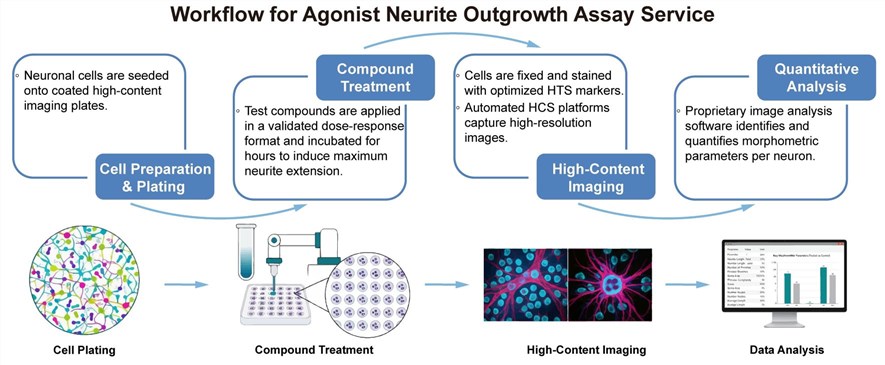
Creative Biolabs' service provides you with a robust platform to evaluate the effects of various compounds on neuronal growth and differentiation. Utilizing established neuronal cell lines or primary neurons, this assay measures neurite outgrowth in response to agonist treatments, enabling the identification of potential neuroregenerative therapeutics. By quantifying parameters such as neurite length, branching, and overall cell morphology, the service delivers comprehensive insights into the efficacy of test compounds. The assay is adaptable to various experimental conditions, allowing for the assessment of different dosages, treatment durations, and environmental factors.
A Critical Process: Extension of Neurites
Neurons extend long, slender projections called axons and dendrites, a process fundamental to nervous system development and function. Axons transmit electrical signals away from the cell body, while dendrites receive incoming signals from other neurons. This precise growth and branching, guided by molecular cues, is essential for forming the complex neural networks that enable efficient information processing and adaptation. Disruptions in this intricate process of neurite outgrowth can lead to developmental disorders and neurological diseases, highlighting its critical role in both health and disease.
Featured Disease-Specific Models
| Assay Model | Disease Focus | Rationale & Value Proposition |
|---|---|---|
| Alpha-synuclein A53T genetic assay | Parkinson's disease (PD) | Directly models familial PD pathology. Testing in this system allows identification of compounds that rescue neurite retraction caused by α-synuclein aggregation, a key step toward disease modification. |
| APOEε4 C130R sporadic AD assay | Sporadic Alzheimer's disease (AD) | The APOEε4 allele is the strongest genetic risk factor for sporadic AD. This model provides crucial insight into how your agonist interacts with fundamental AD pathways, including lipid metabolism and neuroinflammation. |
| APP-PS1-MAPT familial AD assay | Familial Alzheimer's disease (AD) | A robust triple-transgenic system that captures multiple facets of AD pathology. This is the gold standard for testing agents targeting complex disease mechanisms. |
To explore how our platform can accelerate the validation of your unique compound library, we invite you to consult with our specialized neurobiology team.
Comprehensive Workflow
We follow a rigorous, stage-gated process optimized for scientific precision and reproducibility, ensuring high-quality data is generated at every step.
Publication
This study demonstrates that TS-157, a selective sigma-1 receptor agonist, promotes functional recovery after stroke in rats. It enhanced motor function without reducing infarct volume, indicating its action is through neurorestoration, not neuroprotection. TS-157 induced neurite outgrowth in neuronal cells via sigma-1 receptor activation and upregulated phosphorylated ERK (pERK), a key signaling protein. The findings highlight TS-157's potential as a therapeutic candidate that aids recovery from ischemic stroke by promoting neural plasticity and repair.
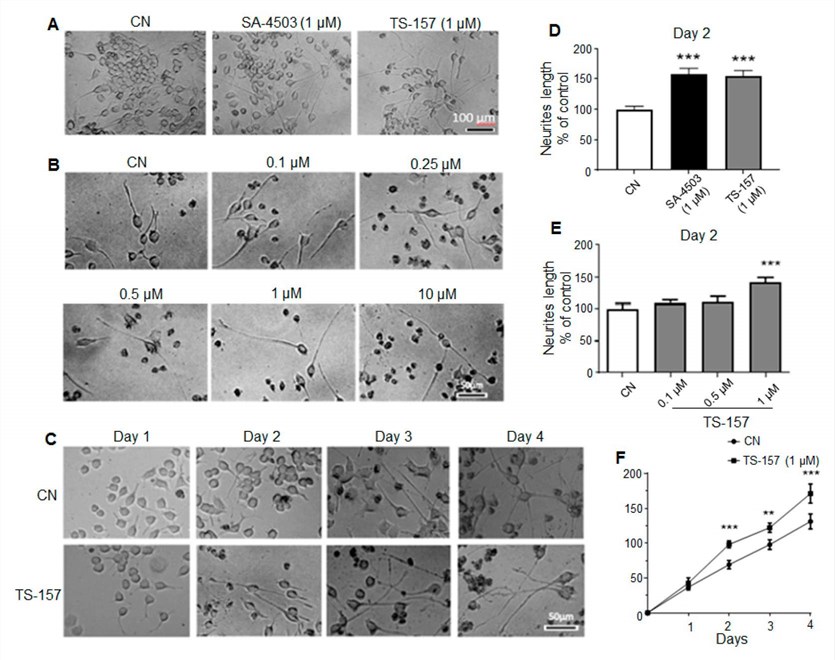 Fig. 1 TS-157 promotes neurite outgrowth in N1E-115 cells. 1
Why Choose Us
Creative Biolabs distinguishes itself through deep mechanistic insight, advanced high-throughput screening efficiency, and integrated screening capabilities. Our assays confirm compound engagement with key pathways like LPA1R and σ-1R, moving beyond phenotype to provide proof-of-action. Utilizing cost-effective HCS and responsive NS-1 PC12 cells, we deliver rapid, affordable high-throughput screening. Furthermore, we uniquely combine regeneration and neuroprotection assessments in a single workflow, evaluating neurite growth under basal conditions and resilience against toxins, thereby maximizing the translational relevance of your data for neuroregenerative drug discovery.
Experience the Creative Biolabs Advantage – Get a Quote Today and secure a partnership dedicated to accelerating your success.
FAQs
Which neuronal cell models are compatible with this assay, and how do you ensure their relevance for translational success?
We use the industry-standard cell line and the highly-responsive NS-1 (PC12 subclone) for general screening efficiency. For higher translational relevance, we specialize in primary cultures (DRG or cortical neurons) and disease-specific models (APOEε4 C130R).
What specific data points are provided beyond the basic total neurite length measurement?
Our comprehensive analysis provides over 15 parameters per neuron, including the critical metrics of branching points (essential for functional network complexity), average process length, and the calculated neurite mass.
How does the speed of your HTS method compare to traditional, low-throughput immunofluorescence protocols?
By using our proprietary optimization methods, including validated fluorescent labels and fully automated image analysis, we can process a 384-well plate in a fraction of the time required for manual βIII-tubulin staining and analysis.
Customer Reviews
-
Targeted Mechanism
Using Creative Biolabs' service in our research has significantly improved/facilitated the validation of our novel targets. The clear correlation between our compound's EC50 and the activation of Rac1/Cdc42 signaling provided the mechanistic proof we needed. - D***n K***r -
Disease Model Relevance
Their capability to run the assay in the APOEε4 C130R model was critical. We used the neurite outgrowth data to demonstrate the neuroprotective effect of our compound against α-synuclein pathology, confirming its dual benefit. - J***e S***e
Related Services
To complement your success in identifying neuroregenerative leads, Creative Biolabs offers an array of synergistic services designed to provide comprehensive validation:
Pre-enzyme Drug Chemical Synthesis Service
Creative Biolabs offers pre-enzyme drug synthesis services for ADEPT, focusing on effective, accurate chemical synthesis to enhance drug development and expand cancer treatment solutions.
Learn More →Dendritic Cell Engineering Service
Creative Biolabs offers DC engineering services, genetically manipulating dendritic cells to enhance their function in initiating and regulating immune responses, thereby optimizing them for therapeutic applications against cancers and infections.
Learn More →How to Contact Creative Biolabs
Creative Biolabs' agonist neurite outgrowth assay service offers unparalleled speed, detail, and mechanistic relevance for validating neuroregenerative drug candidates. Leveraging HCS, validated cell models, and a focus on critical pathways, we provide the quantitative proof needed to advance your therapeutic program.
Ready to gain definitive proof of your compound's neuroregenerative potential and accelerate your timeline? Contact our specialists today.
Reference
- Shi, Jun-Jie, et al. "Sigma-1 receptor agonist TS-157 improves motor functional recovery by promoting neurite outgrowth and pERK in rats with focal cerebral ischemia." Molecules 26.5 (2021): 1212. Distributed under Open Access license CC BY 4.0, without modification. https://doi.org/10.3390/molecules26051212
 Download our brochure