Cancer Cell Engineering Service with PPAR-δ Specific Aptamer for Cancer Immunotherapy
Peroxisome proliferator-activated receptor δ (PPAR-δ), one of three PPARs, is a lipid-sensing nuclear receptor and is a ligand-activated transcription factor that has been implicated in multiple processes, including cancer. Creative Biolabs has 10-year experience in cancer cell engineering for immunotherapy development. Our experienced scientists are glad to apply our special expertise in engineering cancer cells with PPAR-δ specific aptamer for cancer immunotherapy.
Importance of PPARs
PPARs belong to the nuclear hormone receptor family. There are three different isoforms, PPARα, PPAR β/δ and PPAR-γ. They all form heterodimers with retinoic X receptors to activate or repress downstream target genes. Each isotype displays a tissue-selective expression profile, ligands and specific agonists and antagonists, and has been proposed to have distinct roles in inflammation and cancer development. PPAR-δ regulates important cellular metabolic functions that contribute to maintaining energy balance. PPAR-δ is especially important in regulating fatty acid uptake, transport, and β-oxidation as well as insulin secretion and sensitivity. From studies on the homozygous deletion of PPAR-δ in colon cancer cell lines, and the activation of PPAR-δ by a selective synthetic agonist and endogenous activator in APCmin/+ mice, scientists have a proposal that PPAR-δ is linked to colon cancer development. All the evidence turn to shown that PPAR-δ represents an attractive target.
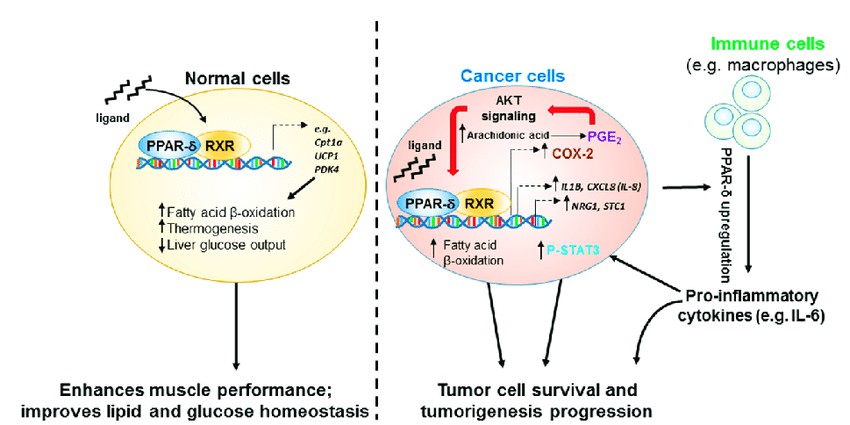 Fig.1 Ligand-dependent actions of PPAR-δ in normal versus cancer cells.1
Engineering Cancer Cells with PPAR-δ-specific Aptamer Service at Creative Biolabs
RNA aptamers provide an opportunity to modulate PPAR-δ–mediated cancer development and progression. PPAR-δ–specific aptamer can reduce the tumor-forming potential of HCT116 human colorectal carcinoma cells. Previous studies suggest that the RNA aptamer is a useful tool for obtaining further insight into the functional properties of nuclear PPR-δ.
Creative Biolabs has accumulated extensive experience in aptamer screening, our scientists are proficient at selecting high-affinity PPAR-δ–specific RNA aptamers and engineering cancer cells with PPAR-δ-specific aptamer. Moreover, soft agar colony formation assay will be performed to test whether the RNA aptamer could suppress the transforming potential of PPAR-δ, and cell proliferation will be measured to examine the effect of the RNA aptamers.
Except for engineering cancer cells with PPAR-δ-specific aptamer, we also have several other cutting-edging strategies for engineering cancer cells for cancer immunotherapy, including:
- Engineering Cancer Cells with Cytokine Overexpression for Stronger T Cell Activation
- Engineering Cancer Cells With Aptamer-siRNA for Enhanced Antitumor T Cell Immunity
- Engineering Cancer Cells with Synthetic Immunomodulatory Gene Circuits for Cancer Immunotherapy
- Engineering Cancer Cells with Targeted siRNA for Cancer Immunotherapy
Different efficient Genetic Methods for cancer cell engineering are available at Creative Biolabs, including but not limited to:
For more detailed information on our engineering cancer cell with PPAR-δ-specific aptamer service, please feel free to contact us or directly send us an inquiry.
Reference
- Liu, Yi, et al. "The role of PPAR-δ in metabolism, inflammation, and cancer: many characters of a critical transcription factor." International journal of molecular sciences 19.11 (2018): 3339. Distributed under Open Access license CC BY 4.0, without modification.
 Download our brochure