Myeloid-derived Suppressor Cell (MDSC) Immunophenotyping Service
Background Service Highlights FAQs Contact Us
Introduction: The Enigmatic Role of Myeloid-Derived Suppressor Cells in Pathophysiology
Myeloid-Derived Suppressor Cells (MDSCs) represent a profoundly heterogeneous population of immature myeloid cells that have emerged as pivotal regulators of immune responses, particularly in contexts of chronic inflammation, malignancy, and infection. Their capacity to potently suppress the activity of other immune cells, most notably T lymphocytes, underscores their critical, often detrimental, role in various pathophysiological conditions. The sustained accumulation and aberrant differentiation of these cells, often a consequence of emergency myelopoiesis in response to persistent pathological stimuli, distinguishes them fundamentally from their mature myeloid counterparts (macrophages, dendritic cells, and neutrophils). This "pathologic activation" program endows MDSCs with unique immunosuppressive properties.
Despite their recognized importance, the inherent phenotypic, morphological, and functional heterogeneity of MDSCs has historically presented significant challenges in their precise investigation and characterization. This complexity has necessitated the establishment of rigorous, standardized approaches for their identification and functional assessment to advance our understanding of their biological roles and exploit their potential as therapeutic targets or biomarkers. At Creative Biolabs, leveraging over two decades of specialized expertise in advanced immunological assays, we have refined a comprehensive myeloid-derived suppressor cell immunophenotyping service designed to meet the exacting demands of contemporary biomedical research and drug development.
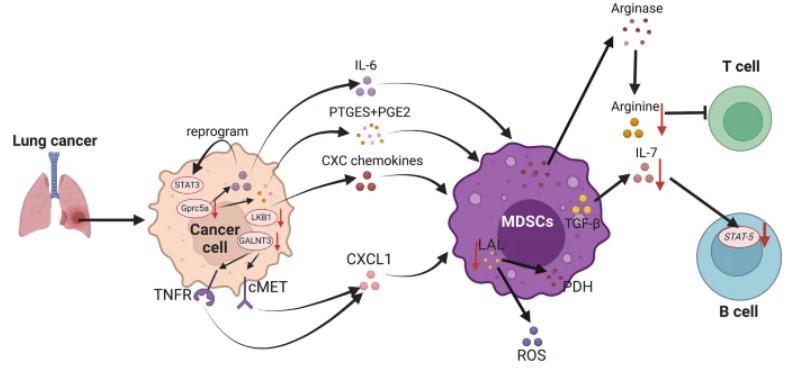 Fig.1 MDSCs revolved in lung cancer.1
Our Myeloid-Derived Suppressor Cell (MDSC) Immunophenotyping Service
Creative Biolabs stands at the forefront of specialized cellular analysis, providing an unparalleled myeloid-derived suppressor cell (MDSC) immunophenotyping service that is critical for unraveling the intricate dynamics of immune regulation in disease. Our service is meticulously designed to provide granular insights into MDSC populations, which are increasingly recognized as central players in mediating immune evasion in cancer, exacerbating autoimmune pathologies, and modulating outcomes in infectious diseases. Accurate and reproducible MDSC characterization is paramount for developing effective immunotherapies, optimizing patient stratification, and advancing our fundamental understanding of immune dysregulation.
Service Content: A Multi-Dimensional Approach to MDSC Analysis
Creative Biolabs' MDSC Immunophenotyping Service offers a multi-dimensional approach, integrating high-resolution phenotyping with robust functional assays and in-depth biochemical/molecular profiling to provide a holistic view of MDSC biology.
Comprehensive MDSC Phenotyping
The accurate identification and quantification of MDSC subsets are foundational to understanding their roles in disease. Our service utilizes advanced multi-parameter flow cytometry, allowing for the precise discernment of MDSC populations based on their distinct surface and intracellular marker expression.
-
Key Subsets and Defining Markers: Creative Biolabs' assays are optimized for the precise identification of the two major MDSC subsets:
-
Monocytic MDSCs (M-MDSCs): In human samples, these are typically characterized by a Lineage (CD3/CD19/CD56/CD123)−CD11b+CD14+CD33+CD15−HLA-DRlow/− phenotype. In murine models, M-MDSCs are identified as CD11b+Ly6G−Ly6Chi. These cells represent a differentiation stage distinct from mature monocytes, possessing a unique immunosuppressive capacity.
-
Polymorphonuclear MDSCs (PMN-MDSCs): In humans, PMN-MDSCs are commonly defined by the expression of CD11b+CD14−CD15+ or CD11b+CD14−CD66b+. Their murine counterparts are identified as CD11b+Ly6G+Ly6Clo. Creative Biolabs differentiates these cells from conventional neutrophils through additional markers and morphological considerations, acknowledging their altered buoyancy and expression profiles.
-
Emerging Markers and Advanced Gating Strategies: We integrate established and emerging markers to refine MDSC characterization. For instance, LOX-1 (lectin-type oxidized LDL receptor-1) has been established as a specific marker for human PMN-MDSCs, and CD84 has been suggested for both PMN-MDSCs and M-MDSCs. Our dedicated FACS teams apply sophisticated, multi-step gating strategies to accurately delineate MDSC populations, minimizing contamination from other myeloid cell types and ensuring high purity.
-
Early-Stage MDSCs (eMDSCs): Creative Biolabs also offers characterization of immature, early-stage MDSCs (eMDSCs), typically defined as Lin−HLA-DR−CD33+ in humans. These cells represent a progenitor population that can further differentiate into PMN-MDSC or M-MDSC subsets under pathological conditions.
-
Sample Versatility: Our robust protocols are adaptable to a wide array of biological samples, including whole blood, peripheral blood mononuclear cells (PBMCs), bone marrow, and various tissue types (e.g., tumor tissue). We employ meticulous sample handling techniques to preserve cell integrity and viability, particularly for sensitive PMN-MDSC populations which are prone to loss upon freezing.
-
Addressing Analytical Challenges: While no single marker uniquely distinguishes MDSCs from mature myeloid cells, Creative Biolabs employs a multi-marker approach combined with advanced functional testing to overcome this limitation. For example, for PMN-MDSC enrichment, we utilize density gradient centrifugation followed by phenotypic and functional validation.
Robust MDSC Functional Assays
Beyond mere enumeration, the definitive characteristic of MDSCs is their immune-suppressive function. Creative Biolabs offers comprehensive functional assays to quantitatively assess this critical activity.
-
T Cell Suppression Assays: The Gold Standard: Our primary functional readout is the MDSCs' ability to suppress T cell proliferation and function, considered the "gold standard" for MDSC assessment.
-
Co-culture Assays: Isolated MDSCs are co-cultured with target immune cells, typically CFSE-labeled T cells (autologous MDSC-depleted PBMCs from patients or homologous PBMCs from healthy controls), at titrated ratios. This allows for precise measurement of their inhibitory effect on T cell proliferation (via CFSE dilution) and cytokine production (e.g., IFN-γ).
-
Antigen-Specific vs. Non-Specific Stimulation: Creative Biolabs offers both antigen-specific (e.g., using cognate peptides or allogeneic mixed leukocyte reactions (MLR)) and non-specific (e.g., anti-CD3/CD28 antibody stimulation or lectins like PHA) T cell activation methods, with antigen-specific assays often preferred for their physiological relevance. For human MDSCs, a three-way allogeneic MLR is a reliable and frequently employed method.
-
Measurement of Suppressive Mediators: We quantify the expression and activity of key immunosuppressive molecules produced by MDSCs, providing mechanistic insights into their suppressive functions. These include:
-
Arginase-1 (ARG1) and Inducible Nitric Oxide Synthase (iNOS/NOS2): Critical enzymes in arginine metabolism that deplete L-arginine, crucial for T cell activation. We assess their expression (e.g., via RT-PCR) and, where possible, downstream metabolites (e.g., ornithine, urea, NO).
-
Transforming Growth Factor-β (TGF-β) and Prostaglandin E2 (PGE2): Immunosuppressive cytokines and lipid mediators. We measure their levels in co-culture supernatants or serum using highly sensitive ELISA assays. As demonstrated in studies of COVID-19, elevated serum TGF-β is strongly associated with disease severity, underscoring its relevance as a mediator of MDSC activity.
-
Rigorous Controls and Isolation Strategies: Creative Biolabs emphasizes the use of appropriate control groups (e.g., phenotypically similar cells from healthy donors or naive mice) to accurately attribute suppressive effects to MDSCs. We prioritize negative selection approaches for MDSC isolation whenever feasible to minimize potential functional alterations caused by antibody binding.
In-depth Biochemical and Molecular Profiling
Creative Biolabs' service extends to the molecular characterization of MDSCs, providing crucial evidence for their distinct "pathologically activated" state compared to classically activated myeloid cells. This activation stems from chronic low-strength signals from pathological environments (e.g., tumors, chronic inflammation), leading to impaired phagocytosis, high reactive species production, and an anti-inflammatory cytokine profile.
-
Molecular Signatures: We assess molecular parameters associated with MDSC immune suppression, including:
-
Transcription Factors and Apoptosis Regulators: Identifying specific transcription factor profiles that govern MDSC differentiation and survival.
-
Cytokine and Chemokine Receptor Signatures: Analyzing the expression of pro- and anti-inflammatory cytokines produced by MDSCs (e.g., IL-10, IL-6, TNF-α) and chemokine receptors influencing their trafficking.
-
Enzymes and Metabolic Pathways: Detailed analysis of ARG1, NOS2/iNOS, and components of the NADPH oxidase complex, along with their downstream metabolites, which are central to MDSC function.
-
Immune Checkpoint Ligands: Evaluation of checkpoint ligands such as PD-L1 on MDSCs, which can contribute to immune evasion, particularly in cancer.
-
Integration with Clinical Context: Creative Biolabs' comprehensive molecular profiling provides deeper insights into MDSC biology, enabling researchers to correlate specific molecular characteristics with disease progression, therapeutic response, and patient outcomes.
Our Advantages
Choosing Creative Biolabs for your MDSC research means partnering with a leader renowned for scientific excellence and translational impact. Our advantages are rooted in:
-
Unrivaled Scientific Expertise
-
State-of-the-Art Methodologies
-
Comprehensive Integrated Services
-
Translational Research Focus
-
Immunotherapy Optimization
FAQs
Q1: What are MDSCs and why are they important in disease?
A1: Myeloid-Derived Suppressor Cells (MDSCs) are a heterogeneous population of immature myeloid cells that accumulate in various pathological conditions, including cancer, chronic infections, and autoimmune diseases. They exert potent immunosuppressive effects, primarily by inhibiting T cell responses, thereby contributing to immune evasion and disease progression. Their presence often correlates with poor patient outcomes and can predict response to therapies, making their characterization crucial.
Q2: How does Creative Biolabs characterize MDSCs?
A2: Creative Biolabs employs advanced multi-parameter flow cytometry for precise MDSC phenotyping. We identify two main subsets: Monocytic MDSCs (M-MDSCs) and Polymorphonuclear MDSCs (PMN-MDSCs), using established and emerging markers (e.g., CD11b, CD14, CD15, CD33, HLA-DR, LOX-1, CD84). Our service also includes sophisticated gating strategies to ensure accurate identification and quantification across various sample types like blood, PBMCs, and tissues.
Q3: Why are functional assays critical for MDSC analysis?
A3: While phenotypic markers identify MDSC populations, functional assays are essential to confirm their immunosuppressive activity, which is their defining characteristic. Creative Biolabs performs co-culture assays to measure the MDSCs' ability to suppress T cell proliferation and cytokine production. We also analyze the expression and activity of key suppressive molecules such as arginase-1, iNOS, reactive oxygen species, and TGF-β, providing a comprehensive understanding of their functional mechanisms.
Q4: What sample types does Creative Biolabs accept for MDSC analysis?
A4: Creative Biolabs is equipped to handle a wide range of biological samples, including whole blood, peripheral blood mononuclear cells (PBMCs), bone marrow, and various fresh or frozen tissue samples. Our robust protocols and meticulous sample handling ensure optimal cell viability and integrity for accurate analysis.
Contact Us
To discuss your specific research needs or to learn more about how Creative Biolabs' Myeloid-Derived Suppressor Cell (MDSC) Immunophenotyping Service can accelerate your discoveries, please contact our expert team.
Reference
-
Lu, Junli et al. "Myeloid-derived suppressor cells in cancer: therapeutic targets to overcome tumor immune evasion." Experimental hematology & oncology vol. 13,1 39. 12 Apr. 2024, doi:10.1186/s40164-024-00505-7. Distributed under Open Access License CC BY 4.0, without modification.
 Download our brochure