We offer exceptionally high sensitivity, allowing for the precise detection and quantification of analytes in the picogram range. This capability is crucial for projects with limited sample availability, ensuring you capture even the most subtle biological changes.
T & B Cell based Radio Immuno Assay (RIA) Service
Creative Biolabs provides solutions for projects that require the highest level of sensitivity and specificity, such as vaccine efficacy studies, autoimmune disease research, and cancer immunotherapy. You can expect a direct and actionable readout of antigen-specific antibody production (humoral immunity) and cytokine secretion (cellular immunity), allowing you to build a comprehensive picture of your target's effect on the immune system. Creative Biolabs provides the data and insights necessary to propel your research forward.
Introduction What We Can Offer Workflow Why Creative Biolabs Customer Reviews FAQs Related Services Contact Us
Introduction of Radioimmunoassay
The principle of radioimmunoassay (RIA) is based on specific antibody-antigen binding reactions and the competition between analytes and standard antigens for the limited binding sites on antibodies. Two different approaches are available for measuring molecules in biological samples: one is double-antibody RIA, and another is coated-tube RIA. In the double-antibody dependent assay, a first antibody is used to capture antigens, and a second antibody is used to precipitate the first antibody and antigen-formed complex from the reaction solution, facilitating the removal of unbound labeled standards to monitor radioactivity. Another approach is to pre-coat the primary antibody on the bottom of the test tube to capture the corresponding antigens. Therefore, the unbound labeled antigens are easily separated by collecting the supernatant.
Discover how we can help - Request a consultation.
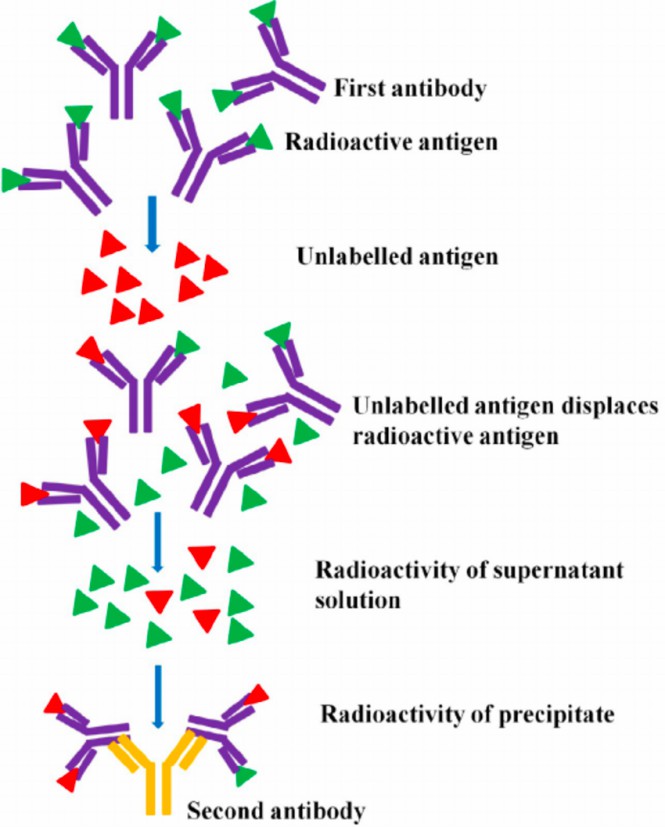 Fig.1 Principle of radioimmunoassay.1
What We Can Offer
Exceptional Sensitivity
Validated Protocols
Our validated RIA protocols deliver consistently accurate and precise data, providing a foundation for reliable and reproducible results. This rigor is essential for meeting the stringent requirements of scientific publications, building confidence in your research.
Broad Analyte Detection
Our comprehensive RIA platform can detect a wide range of T and B cell-related analytes, including various cytokines and antigen-specific antibodies. This enables a holistic view of the immune response, providing deeper insights into complex biological processes.
Radioimmunoassay Services at Creative Biolabs
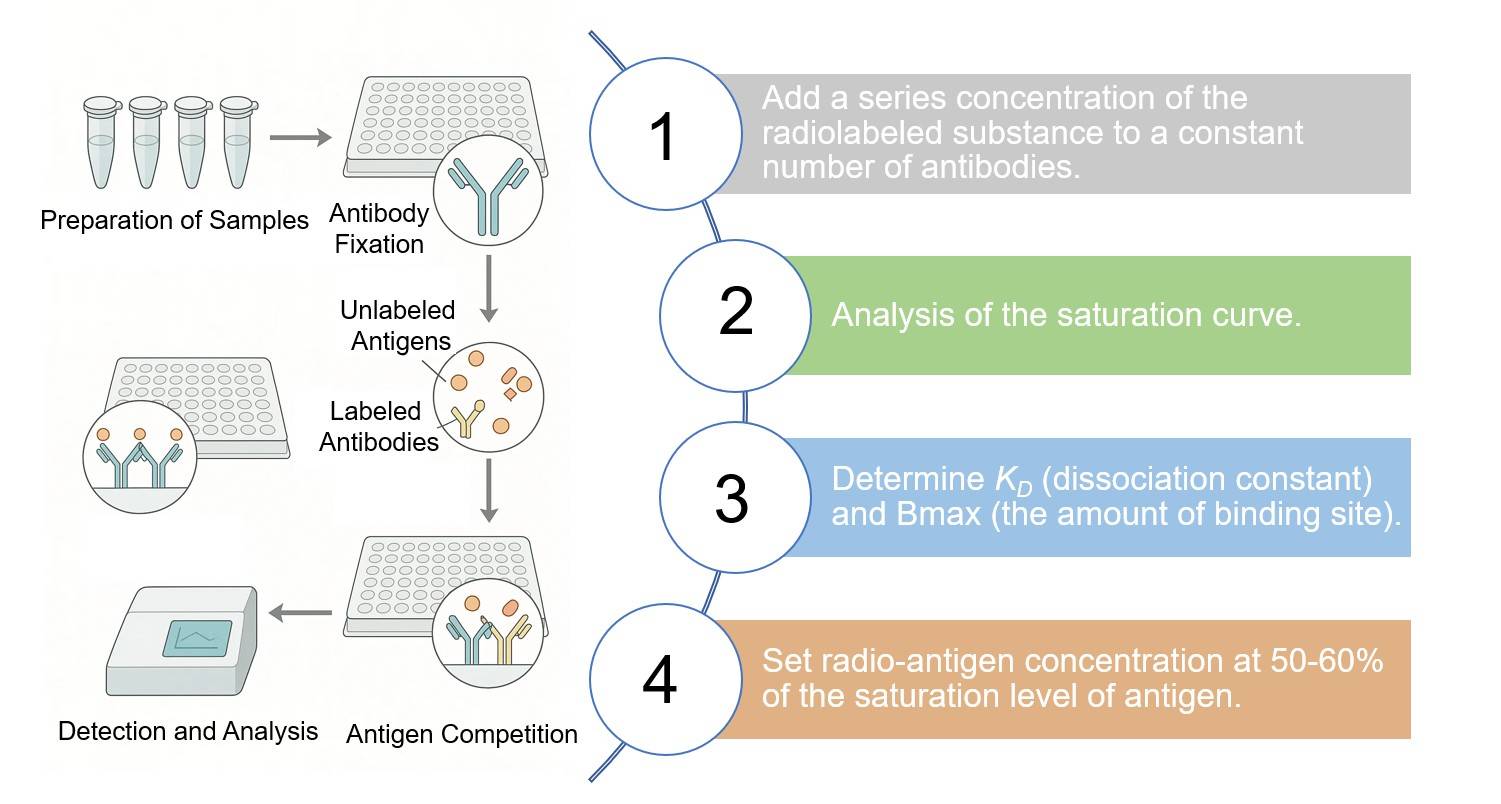
Highlights
Scientific Partnership
Our team of seasoned scientists provides expert consultation, working closely with you to design and execute a custom RIA service that perfectly fits your project's unique requirements, ensuring optimal results.
Unparalleled Sensitivity
We use optimized protocols that deliver unparalleled sensitivity, enabling the detection of even the most subtle changes in immune response. This capability is crucial for identifying key biological signals, giving you a comprehensive view of your target's effect.

Rigorous Validation
We guarantee reliable data through rigorous validation processes that ensure high inter- and intra-assay reproducibility. This meticulous attention to detail delivers consistent and trustworthy results crucial for scientific submissions.
Data Backed by Publications
Our methods and results are supported by a strong track record of published data. This public evidence confirms that our RIA services consistently meet the high standards required for peer-reviewed journals.
Discover how a partnership with us can streamline your research - Get a quote today.
Customer Reviews
-
Highly Accurate Results
Using Creative Biolabs' RIA service in our research has significantly improved our ability to quantify low-abundance cytokines. The precision and consistency of the data allowed us to confidently move forward with our downstream experiments. - H**n H**s -
Exceptional Reproducibility
We've used Creative Biolabs' service for several projects, and the intra-assay reproducibility is consistently excellent. This has been a huge advantage, as it has eliminated a lot of the variability we previously faced when comparing samples from different runs. - R**y P**r.
FAQs
How does RIA compare to ELISA in terms of sensitivity?
While both are powerful immunoassays, RIA is often considered to be more sensitive than traditional ELISA, with the ability to detect molecules at lower concentrations. For projects where absolute precision and the detection of subtle immune responses are paramount, RIA remains a preferred method.
What are the main applications of Creative Biolabs' RIA service?
Our service is primarily used for advanced immunological research, including vaccine efficacy studies, autoimmune disease research, and cancer immunotherapy. We can help you quantify antigen-specific antibody production from B cells and cytokine secretion from T cells to provide a comprehensive immune profile.
Related Services
T and B Cell-based ELISA Assay
Our ELISA services are an ideal alternative. We can precisely quantify a wide range of T and B cell-related cytokines and antigen-specific antibodies, perfect for large-scale screening and clinical trial applications.
Learn More →Cell Line Development Service
Accelerate your research by partnering with us for custom cell line creation, including the development of stable, high-yield cell lines for various biopharmaceutical applications like monoclonal antibody production.
Learn More →How to Contact Us
As a leader in the field of immunotherapy development, Creative Biolabs offers a variety of cancer epitope characterization methods according to specific T and B cell immunity. Our experts and technicians are here to make tailored assays for clients' respective studies. Please contact us or consult our experts online.
Reference
- Hao, Pan-Pan et al. "Evaluation of (131)I-anti-angiotensin II type 1 receptor monoclonal antibody as a reporter for hepatocellular carcinoma." PloS one vol. 9,1 e85002. 8 Jan. 2014. Distributed under an Open Access license CC BY 4.0, without modification. https://doi.org/10.1371/journal.pone.0085002
 Download our brochure
Loading case studies...
Online Inquiry