Introduction What Can We Offer? Workflow Published Data Why Choose Us? Applications FAQs Featured Services Featured Products
Large monoclonal antibodies are essential for cancer therapy but often struggle with solid tumor permeability, limiting their efficacy. Creative Biolabs provides cutting-edge aptamer-antibody conjugate development services, helping customers engineer hybrid molecules that combine the deep tissue penetration of aptamers with the pharmacokinetic stability of antibodies to solve these delivery challenges.
Contact our team to get an inquiry now!
Introduction of Aptamer-Antibody Conjugates
Aptamers, often termed "chemical antibodies," have garnered significant attention in oncology for their high binding affinity, lack of immunogenicity, and ease of chemical synthesis. However, their clinical translation has been hindered primarily by their small size (~10–15 kDa), which leads to rapid renal clearance and a short half-life in the bloodstream, limiting their therapeutic window.
To overcome these limitations while optimizing tissue specificity, current research has pivoted toward aptamer-antibody conjugates. By conjugating small aptamers to antibodies (or Fc fragments) targeting different antigens, scientists can create bispecific constructs that leverage the best of both worlds. The aptamer component ensures rapid tumor penetration and access to cryptic epitopes, while the antibody scaffold increases the molecular size above the renal filtration threshold, significantly extending circulation half-life. This synergy not only enhances target accessibility but also simplifies the engineering of bispecific therapeutics compared to traditional dual-antibody formats.
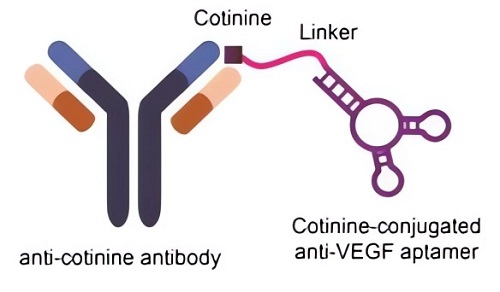 Fig.1 Schematic representation of aptamer-antibody conjugates.1,3
What Can We Offer?
At Creative Biolabs, we offer a comprehensive aptamer-antibody conjugate development service, providing a one-stop solution from aptamer selection to final conjugate characterization. We specialize in creating stable, high-purity conjugates tailored to your specific therapeutic or diagnostic targets.
Our Key Capabilities:
Custom Aptamer Selection (SELEX)
We utilize advanced SELEX (Systematic Evolution of Ligands by Exponential Enrichment) protocols to identify high-affinity DNA or RNA aptamers against your target of interest. Whether your target is a cell surface receptor or a circulating protein, we screen for sequences with optimal binding kinetics and stability.
Site-Specific Conjugation Technologies
Unlike non-specific conjugation that risks heterogeneity, we employ site-specific bioconjugation strategies. We utilize Thiol-Maleimide chemistry, Click Chemistry (DBCO/Azide), and Enzymatic labeling to attach aptamers to precise residues on the antibody (e.g., engineered cysteines or glycans). This ensures a defined Drug-to-Antibody Ratio (DAR) and preserves the antigen-binding activity of the antibody.
Linker Chemistry Optimization
The stability of the conjugate depends heavily on the linker. We provide a library of proprietary linkers, both cleavable (for intracellular payload release) and non-cleavable (for stable circulation), optimized to reduce steric hindrance and prevent premature degradation.
Multivalent Design & Engineering
Beyond simple 1:1 conjugates, we can engineer multivalent constructs where multiple aptamers are attached to a single antibody scaffold. This "avidity effect" can exponentially increase binding strength and therapeutic potency.
Cost-Effective Manufacturing
Traditional bispecific antibodies often suffer from chain mispairing and low yields. Our aptamer-antibody approach is modular; the aptamer is chemically synthesized, and the antibody is expressed separately, allowing for a highly efficient, cost-effective, and scalable conjugation process.
Workflow
01
Initial Consultation: We define the project scope, target antigens, and desired conjugate format (e.g., bispecific, payload delivery). Clients may provide their own antibodies or aptamers, or entrust the entire generation process to us.
02
Screening & Synthesis: We perform SELEX to generate specific aptamers or synthesize client-provided sequences with necessary chemical modifications (e.g., 5'-thiol, 3'-biotin).
03
Conjugation Strategy: The antibody is activated or modified, and the aptamer is conjugated using the selected linker chemistry.
04
Purification & QC: The conjugate is purified to remove free aptamers and antibodies.
05
Final Deliverables: We deliver the purified conjugate (mg to g scale) along with a comprehensive COA including Mass Spec, HPLC, and binding affinity data.
Published Data
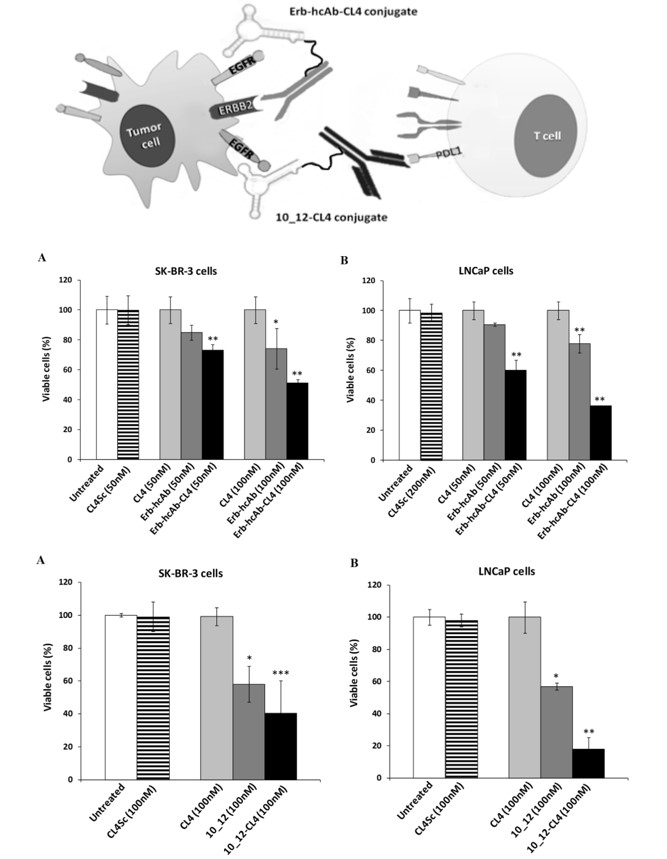 Fig.2 Schematic and cytotoxic effects on tumor cells of anti-EGFR and PD-L1 antibodies conjugated with the anti-EGFR aptamer.2,3
In this study, researchers developed novel bispecific conjugates to overcome the limitations of monospecific therapies. They conjugated an anti-EGFR aptamer to an anti-HER2 (ErbB2) antibody and an anti-PD-L1 antibody. The resulting conjugates retained the specific targeting ability of both parental moieties. The anti-EGFR aptamer linked to the anti-PD-L1 antibody demonstrated a dramatic enhancement in cytotoxicity by efficiently redirecting and activating T cells against cancer cells expressing both targets. This study highlights the conjugate's advantage: easy production, low cost, and simultaneous inhibition of two targets with enhanced pharmacokinetic properties.
Why Choose Us?
-
Deep Technical Mastery: We offer an unparalleled fusion of expertise in nucleic acid chemistry and advanced monoclonal antibody engineering to ensure functional synergy.
-
Proprietary Linker Technology: Our extensive library of specialized linkers ensures maximum serum stability and precise, controlled release of therapeutic payloads.
-
Superior Conjugate Purity: We utilize rigorous, multi-stage purification protocols and analytical verification to consistently deliver high-purity conjugates exceeding 95%.
-
Unmatched Architectural Flexibility: From customizable Drug-to-Antibody Ratios to multivalent and bispecific designs, we tailor every molecule to your biological requirements.
-
Optimized Development Timelines: We employ parallelized workflows and modular synthesis strategies to significantly accelerate your project's move from concept to lead candidate.
Applications of Aptamer-Antibody Conjugates
-
Bispecific Therapeutics: Simultaneously targeting two different tumor antigens (e.g., EGFR and HER2) to overcome resistance mechanisms or redirect immune cells (e.g., T-cell engagers) to the tumor site.
-
Targeted Drug Delivery (ApDCs): Using the conjugate as a vehicle to deliver cytotoxic payloads (chemotherapy, toxins, siRNA) specifically to cancer cells via receptor-mediated endocytosis, minimizing systemic toxicity.
-
Ultra-Sensitive Diagnostics: Applying the conjugates in assays like conjugate-ELISA or PCR-ELISA, where the aptamer component allows for signal amplification, enabling the detection of low-abundance biomarkers.
-
Bioimaging: Conjugating aptamers to antibodies labeled with imaging agents to create probes with high specificity and deep tissue penetration for in vivo tumor imaging.
FAQs
Q: Can I use my own proprietary antibody for the conjugation service?
A: Yes, absolutely. We can work with antibodies provided by you. We will first perform a feasibility assessment to determine the best conjugation site and chemistry to ensure your antibody's function is preserved.
Q: How do you ensure the aptamer does not interfere with the antibody's binding?
A: We use precise linker lengths and site-specific conjugation techniques to ensure sufficient spatial separation. We also perform binding assays (ELISA or SPR) on the final conjugate to verify that both the aptamer and antibody retain their affinity.
Q: What is the typical Drug-to-Antibody Ratio (DAR) for these conjugates?
A: The DAR can be customized based on your needs. For most applications, we aim for a DAR of 2:1 (two aptamers per antibody) to maintain homogeneity, but higher ratios are possible depending on the conjugation sites available.
Q: Are aptamer-antibody conjugates immunogenic?
A: Aptamers themselves are generally non-immunogenic. By conjugating them to humanized antibodies or Fc fragments and using biocompatible linkers, the overall risk of immunogenicity is comparable to or lower than that of traditional antibody-drug conjugates (ADCs).
Q: Can you develop a conjugate that delivers siRNA?
A: Yes. We can design the aptamer component to act as a carrier for siRNA payloads. The aptamer-antibody chimera facilitates cell entry, and utilizing a cleavable linker allows the siRNA to be released intracellularly for gene silencing.
Q: How does the production cost compare to bispecific antibodies?
A: It is generally lower. Bispecific antibodies require complex cell line engineering and purification to resolve chain mispairing. Aptamer-antibody conjugates are assembled chemically from purified components, resulting in higher yields and a more streamlined manufacturing process.
Q: Do you offer testing services for the final conjugate?
A: Yes, we provide a full suite of characterization services, including SDS-PAGE, SEC-HPLC for purity, Mass Spectrometry for identity, and cell-based uptake or cytotoxicity assays to validate biological function.
Creative Biolabs combines decades of expertise in bioconjugation with a passion for innovation. Whether you need to improve tumor penetration or create novel bispecific modalities, our team is ready to deliver high-quality aptamer-antibody conjugates to accelerate your pipeline.
Contact us today to discuss your project!
Featured Services
Featured Products
References
-
Kim, Minhee, et al. "Applications of cancer cell-specific aptamers in targeted delivery of anticancer therapeutic agents." Molecules 23.4 (2018): 830. https://doi.org/10.3390/molecules23040830
-
Passariello, Margherita, et al. "Novel Human Bispecific Aptamer–Antibody Conjugates for Efficient Cancer Cell Killing." Cancers 11.9 (2019): 1268. https://doi.org/10.3390/cancers11091268
-
Distributed under Open Access license CC BY 4.0. The image was modified by extracting and using only part of the original image.
For Research Use Only.
Related Sections: