Introduction What We Can Offer Workflow Published Data Why Choose Us? Applications FAQs Featured Services Featured Products
Creative Biolabs provides comprehensive, end-to-end aptamer-based biosensor development services tailored for diagnostic and environmental applications. We help clients bypass the limitations of traditional antibody-based assays by engineering highly stable, synthetic recognition elements that ensure superior sensitivity and cost-effective commercial scalability.
Contact our team to get an inquiry now!
Introduction of Aptamer based Biosensor
A biosensor is a sophisticated analytical device consisting of two primary components: a biological recognition element (bioreceptor) and a signal element. The bioreceptor interacts specifically with a target analyte, while the signal element converts this interaction into a measurable signal (e.g., electrical, optical, or thermal). Aptamers, single-stranded DNA or RNA oligonucleotides, have revolutionized this field. Recent research highlights their "conformational flexibility," where they undergo predictable 3D structural shifts upon binding, allowing for "signal-on" mechanisms that were previously impossible with rigid antibodies. Modern aptasensors now integrate nanomaterials like gold nanoparticles (AuNPs) and graphene, reaching femtomolar limits of detection and enabling real-time, label-free monitoring in complex matrices like whole blood or environmental wastewater.
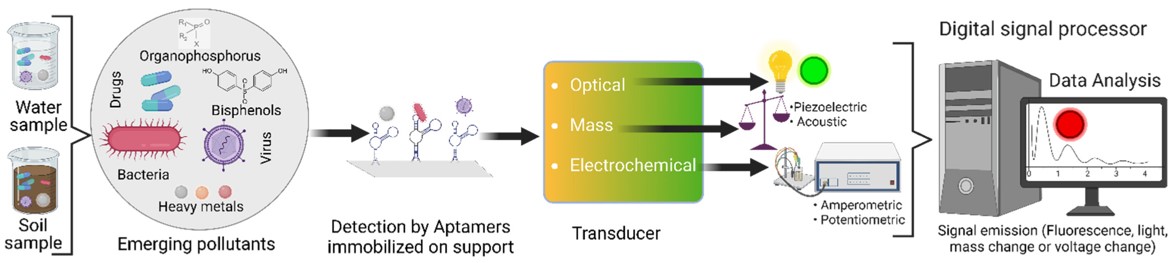 Fig.1 A representation of the operation of an aptasensor.1,3
What We Can Offer
We offer a "one-stop" solution for aptasensor development, spanning from initial target-specific SELEX screening and sequence optimization to the final integration of the aptamer into a functional sensor platform with fully validated performance metrics.
Our Development Solutions:
Custom Selection & Optimization
We perform Systematic Evolution of Ligands by Exponential Enrichment (SELEX) using custom-designed buffers that match your final application environment. This ensures the resulting aptamer maintains high affinity (Kd) in the presence of complex sample interferences.
Advanced Transduction Design
Our team specializes in multiple sensing modalities, including electrochemical (voltammetric, impedimetric), optical (fluorescence, colorimetric), and mass-sensitive (SPR, BLI) platforms. We design the optimal "folding-based" or "sandwich" architecture for your specific target.
Precision Surface Chemistry
We utilize proprietary immobilization techniques to control the orientation and density of aptamers on the sensor surface. By optimizing the spacing between ligands, we eliminate steric hindrance and maximize the effective binding capacity of the device.
Signal Amplification Strategies
To achieve ultra-low limits of detection, we incorporate nanomaterial-mediated amplification, such as using gold nanoparticles for localized surface plasmon resonance (LSPR) or redox-active polymers for enhanced electrochemical readout.
Stability & Matrix Validation
Every sensor is rigorously tested for shelf-life stability and its ability to distinguish the target from structural analogs in real-world samples, such as human serum, urine, or agricultural extracts.
Workflow
01
Technical Consultation: We discuss your target analyte (protein, small molecule, or cell), required detection limit, and final sample matrix.
02
Sample Provision: The client provides the target molecule or a representative sample. For hazardous or proprietary targets, we can utilize surrogate screening.
03
SELEX & Sequence Discovery: We perform multiple rounds of positive and negative selection to identify high-affinity sequences with minimal cross-reactivity.
04
Aptamer Synthesis & Labeling: Identified leads are chemically synthesized and modified with functional groups (e.g., Thiol, Biotin, or Fluorophores) for sensor integration.
05
Platform Integration & Testing: The aptamer is immobilized onto the chosen transducer. We optimize the buffer conditions and surface blocking to maximize the signal-to-noise ratio.
06
Final Delivery: You receive a comprehensive validation report, the optimized aptamer sequences, and the functional sensor prototype or assay protocol.
Published Data
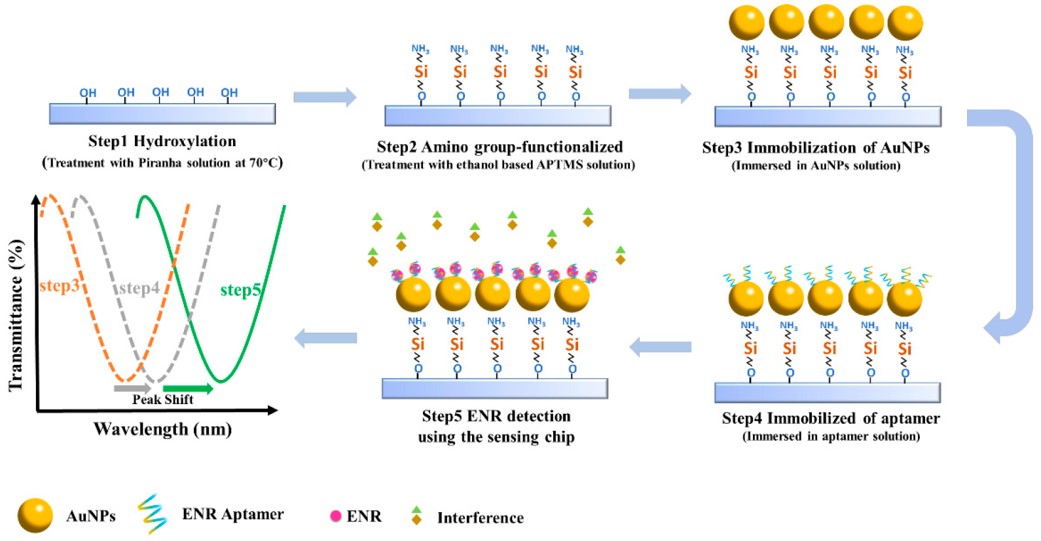 Fig.2 Schematic of the construction of the LSPR aptamer sensing chip.2,3
A notable success in this field is the development of a highly sensitive aptamer biosensor for detecting fluoroquinolone residues. In this project, an aptamer-gold nanoparticle (AuNP) complex was integrated into a Localized Surface Plasmon Resonance (LSPR) chip. The results demonstrated excellent linearity within the range of 0.01–100 ng/mL, with a remarkable detection limit of 0.001 ng/mL. This case illustrates the power of combining specific aptamer recognition with advanced optical transduction to solve real-world food safety challenges.
Why Choose Us?
-
Proven Aptamer Expertise: Over decades of extensive global experience in selecting high-affinity ligands for diverse chemical classes and biological targets.
-
Seamless Conjugation: Deep integration with our "Aptamer-based Conjugation Services" ensuring precise molecular labeling and stable probe attachment for various platforms.
-
Matrix-Specific Optimization: Specialized selection protocols conducted in actual real-world samples to prevent "lab-only" performance failures and ensure industrial-grade reliability.
-
Rapid Development Cycles: Streamlined SELEX methodologies combined with advanced in silico molecular modeling to reduce overall project timelines by up to 30%.
-
Advanced Transducer Access: In-house capability to develop high-performance sensors across electrochemical, optical, and sophisticated mass-sensitive analytical platforms.
-
Strict Quality Control: Every project delivery includes comprehensive binding kinetic data and rigorous cross-reactivity validation to ensure total scientific transparency.
Applications
-
Point-of-Care (POC) Diagnostics: Implementation of rapid, hand-held diagnostic systems enables the bedside detection of critical disease biomarkers, such as PSA and HER2, or highly infectious viral pathogens including SARS-CoV-2 and influenza strains. The high stability of DNA aptamers makes these devices particularly suitable for deployment in resource-limited settings without cold-chain requirements.
-
Environmental Monitoring: Deployment of real-time monitoring stations facilitates the continuous detection of toxic heavy metals, synthetic pesticides, and emerging pharmaceutical pollutants within municipal water supplies and sensitive industrial effluent streams. These systems provide a robust alternative to expensive laboratory-based mass spectrometry for high-frequency environmental surveying.
-
Food Safety and Quality Testing: Integration of aptasensors into the supply chain allows for the precise identification of trace-level mycotoxins, antibiotic residues, and bacterial pathogens, ensuring stringent compliance with international food safety standards. The ability to distinguish between structurally similar chemical analogs prevents false positives during high-throughput screening operations.
-
Complement System Research and Therapeutics: Specialized biosensors permit the quantification of complement components like C3 and C5, providing essential data for monitoring therapeutic efficacy, immune system modulation, and real-time patient response to complement-targeted drugs. This molecular-level monitoring is critical for optimizing dosage and evaluating systemic immune responses in clinical settings.
FAQs
Q: What is the typical affinity (Kd) we can expect for a custom aptamer?
A: For protein targets, we typically achieve Kd values in the low nanomolar to high picomolar range. Small molecules usually fall within the low micromolar to nanomolar range depending on their chemical complexity, molecular size, and functional group density.
Q: Can you develop sensors for "non-immunogenic" targets that antibodies cannot recognize?
A: Yes. Because SELEX is an entirely in vitro process, we can develop high-performance aptamers for toxins, metal ions, and other small molecules that fail to elicit a traditional immune response in animal hosts.
Q: How do you handle the "Matrix Effect" in urine or serum?
A: We incorporate specialized "negative SELEX" steps against the blank matrix and utilize advanced surface-blocking agents, such as PEG or MCH, to effectively minimize non-specific adsorption on the transducer surface and improve signal clarity.
Q: What is the difference between a "signal-on" and "signal-off" electrochemical sensor?
A: In "signal-on" sensors, target binding induces a conformational change that brings a redox label closer to the electrode surface, increasing current. In "signal-off" designs, binding causes the label to move away, decreasing the detectable current.
Q: Are DNA aptamers better than RNA aptamers for biosensors?
A: DNA aptamers are generally preferred for industrial-grade biosensors due to their higher chemical stability and lower synthesis cost, though RNA aptamers can offer more complex 3D structures for specialized or highly difficult targets.
Q: Do you provide the sequence information of the developed aptamer?
A: Yes, upon successful completion of the project, all proprietary sequence data, structural optimization results, and complete intellectual ownership rights are fully transferred to the client for their future research and proprietary records.
Creative Biolabs combines decades of biological expertise with cutting-edge sensor engineering to deliver robust, high-performance aptasensors. We invite you to contact our technical team to discuss how our specialized biosensor development services can accelerate your diagnostic or environmental monitoring projects.
Featured Services
Featured Products
References
-
Flores-Contreras, Elda A., et al. "Detection of emerging pollutants using aptamer-based biosensors: Recent advances, challenges, and outlook." Biosensors 12.12 (2022): 1078. https://doi.org/10.3390/bios12121078
-
Wang, Pan, et al. "A novel aptamer biosensor based on a localized surface plasmon resonance sensing chip for high-sensitivity and rapid enrofloxacin detection." Biosensors 13.12 (2023): 1027. https://doi.org/10.3390/bios13121027
-
Distributed under Open Access license CC BY 4.0, without modification.
For Research Use Only.
Related Sections: