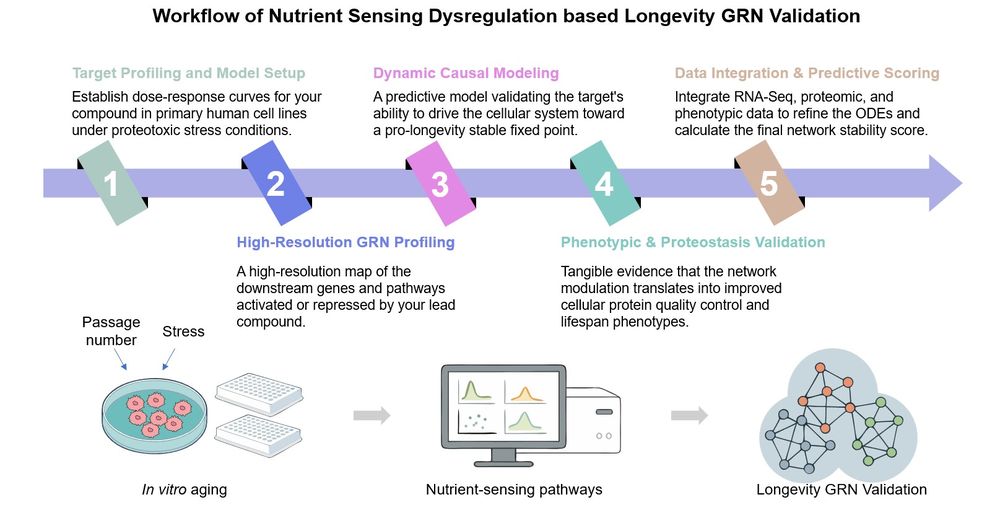
We simulate your target's effect using ordinary differential equations (ODEs) to predict whether it drives the aging GRN from an unstable, senescent state to a robust, long-lived stable fixed point. This provides a predictive efficacy profile, drastically de-risking your investment.
Nutrient Sensing Dysregulation based Longevity Gene Regulatory Network (GRN) Validation Service
Creative Biolabs provides causal validation of therapeutic leads by integrating advanced systems biology and experimental modeling. We offer comprehensive services that profile your compound's effect on the fundamental nutrient sensing gene regulatory network (GRN) in human-relevant cell systems. Clients gain a quantitative network stability score, a precise mechanism of action (MoA) statement for IP protection, and de-risked research assets with confirmed ability to shift cellular status from dysregulated aging to pro-longevity homeostasis.
Introduction What We Can Offer Workflow Why Creative Biolabs Customer Reviews FAQs Related Services Contact Us
Targeting Nutrient Sensing Network Stability for Longevity GRN Validation
Aging is defined by the progressive dysregulation of the GRN, including the IIS/mTOR (anabolic) and AMPK/Sirtuin (catabolic) pathways. This failure results in the collapse of cellular homeostasis, promoting senescence and metabolic disease. We cite the pivotal work demonstrating that even direct supplementation with NAD+ precursors, such as Nicotinamide Riboside, fails to activate SIRT1 or improve mitochondrial function in healthy human muscle, underscoring that dysregulation, not mere substrate availability, is the therapeutic bottleneck. Our service addresses this by targeting the network's stability.
Initiate a consultation to explore our capabilities.
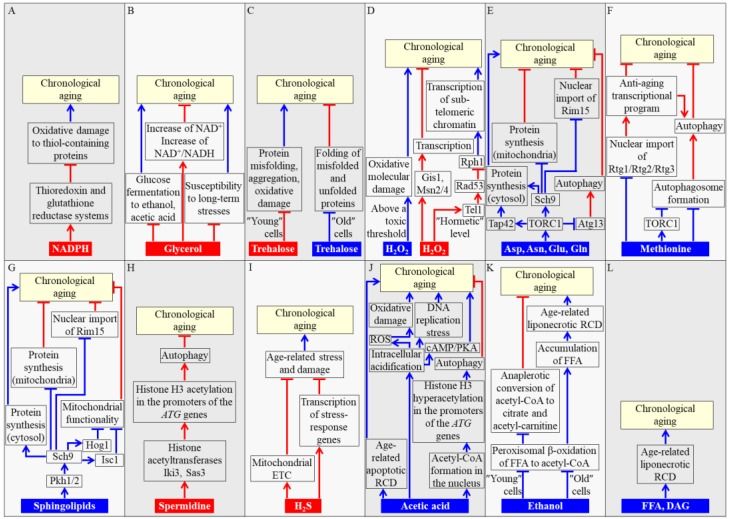 Fig.1 Linking nutrient metabolites to yeast longevity GRNs. 1
What We Can Offer
Causal Dynamic Modeling
Network Stability Score
You receive a quantifiable metric that measures your target's ability to restore homeostasis by successfully stabilizing the dysregulated IIS/mTOR and SIRT1/AMPK axes. This is a crucial, single-figure benchmark for comparing different lead compounds.
Mechanism of Action Elucidation
We provide deep mechanistic insight into how your compound rewires the GRN, clarifying its precise role in stabilizing cellular crosstalk and strengthening your intellectual property (IP) claims.
Phenotype Translation
We link molecular changes (transcriptomics, metabolomics) directly to measurable longevity phenotypes (e.g., enhanced autophagy flux, improved mitochondrial function, reduced senescence markers), proving functional relevance in human cell models.
How We Can Help
Why Choose Us?
| Output Feature | Unique Advantage |
|---|---|
| Dynamic Systems Analysis | We don't just measure molecules; we model the feedback loops that define the aging process. By confirming your target restores stability to the SIRT1/AMPK crosstalk, we ensure you are targeting the core mechanism of pathology, not just a symptom. |
| High-Resolution Profiling | Our integration of single-cell RNA-Seq with metabolic assays (measuring NAD+/acetyl-CoA ratios) provides an unprecedented depth of analysis. |
| Targeted Dysregulation Model | Our assays are specifically designed to mimic age-related nutrient stress (e.g., chronic anabolic signaling), ensuring your target's efficacy is tested in the most clinically relevant context. This approach differentiates us from simpler assays run on unstressed cells, which have demonstrated a failure to predict in vivo human outcomes. |
Request a formal quotation to maximize the Creative Biolabs advantage.
Customer Reviews
-
Predictive Confidence
Creative Biolabs provided a quantifiable network stability score that definitively predicted our lead candidate would drive the system to a pro-longevity stable fixed point, something simple expression data could never achieve. This confidence helped us secure our next round of funding. - Dr. A*med. -
Superior Cellular Relevance
We previously saw false positives in standard assays. Creative Biolabs' use of primary human myotubes under nutrient-stressed conditions, mimicking age-related dysregulation (similar to the cellular failure seen with Nicotinamide Riboside), ensured that our positive hits are truly active in a clinically relevant context. - M*tchell.
FAQs
Q: Why do you focus on "Dysregulation" instead of just measuring SIRT1 expression?
A: Static expression data is insufficient, as aging involves dynamic feedback failure in networks like SIRT1/AMPK. Our service precisely quantifies your therapeutic target's capacity to recalibrate this fundamental network dysregulation, thus addressing the etiology of the pathology.
Q: Can this service test targets for neurodegeneration or only metabolic disease?
A: Yes, these nutrient sensing pathways are conserved and crucial for neuronal viability. We utilize specific primary human cell lines to validate targets for neurodegeneration, establishing a clear link between GRN stability and endpoints such as mitochondrial function or protein aggregation.
Related Services
Mitochondrial Dysfunction
Focused screening using OCR and ECAR assays to test compound efficacy on mitochondrial respiration in diverse human cell lines (e.g., primary muscle, liver, and immune cells).
Learn More →Proteostasis Loss
Direct measurement of 20S and 26S proteasome activity and ubiquitin-chain dynamics, providing critical data on protein degradation efficiency, which is essential for proteostasis.
Learn More →How to Contact Us
Creative Biolabs provides the causal evidence, predictive modeling, and deep mechanistic insight required to transition from hypothesis to a de-risked, high-potential asset. Contact our team for more information and to discuss your project.
Reference
- Mohammad, Karamat et al. "Some Metabolites Act as Second Messengers in Yeast Chronological Aging." International journal of molecular sciences vol. 19,3 860. 15 Mar. 2018. Distributed under an Open Access license CC BY 4.0, without modification. https://doi.org/10.3390/ijms19030860
 Download our brochure
Loading case studies...
Online Inquiry