
Custom Oligonucleotide Modification Services
Introduction
Accelerate your nucleic acid research with our Custom Oligonucleotide Modification Service. We solve stability, specificity, delivery, and gene expression issues via advanced chemical modifications, enhancing research and drug development efficacy. Tailored solutions improve pharmacokinetics, address unmodified oligonucleotide flaws, and deliver stable, specific, potent products for gene therapy, diagnostics, etc.
Custom Oligonucleotide Modification Service is pivotal in molecular biology and drug development. Chemical modifications address unmodified nucleic acids' poor stability and uptake, enhancing nuclease resistance, binding affinity, and delivery. Creative Biolabs uses this expertise to provide superior modified oligonucleotides for diverse applications.
[Discover How We Can Help - Request a Consultation]
Custom Oligonucleotide Modification Service
Oligonucleotide modification is the strategic chemical alteration of DNA/RNA at phosphate, sugar, or base, aiming to improve stability, binding affinity/specificity, cellular uptake, and add functionalities.
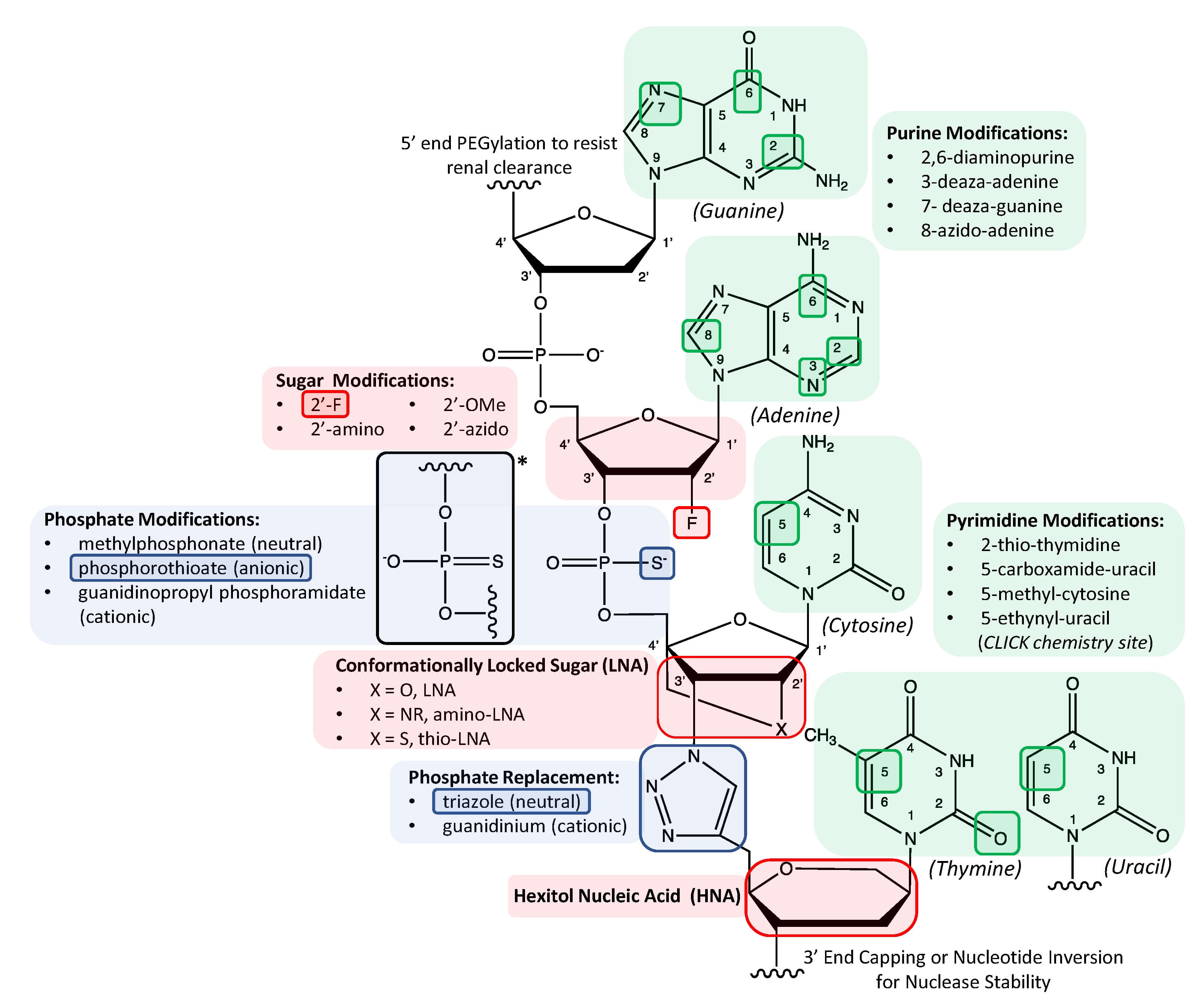 Fig.1 Various chemical modifications to the three important structural parts of deoxyribonucleic acid.1
Common modification classifications and major category introductions of oligonucleotides
- Phosphate group modification: The chemical modification of phosphodiester bonds between nucleotides mainly enhances the enzymatic stability and bioavailability of oligonucleotides.
- Sugar ring modification: By modifying the structure of ribose or deoxyribose (such as the 2' position), the targeted binding ability and stability of oligonucleotides can be optimized.
- Base modification: Chemical modification of nucleotide bases can regulate base pairing characteristics, enhance targeting specificity, or introduce special functions.
- Terminal/functional group modification: Functional chemical groups are introduced at the end or specific positions of oligonucleotides for labeling, conjugation, or subsequent reactions.
- Marking and detection modification: Introduce detectable or identifiable molecules for tracking, imaging, or signal detection.
Tab.1 Custom oligonucleotide modifications available from Creative Biolabs.
| Phosphorothioate Modification | DNA/2'-O-Methyl RNA Chimera |
| Replacement of dC with 5-Methyl-Dc | Fluorophores |
| Phosphorylation | Amino Modifiers |
| Inosine | Quenchers |
| Phosphorothioates | Biotin |
| Thiol Modifiers |
Workflow
-
Required Starting Materials
- Oligonucleotide Sequence: The precise DNA or RNA sequence requiring modification.
- Desired Modification Type(s): Specific chemical modifications (e.g., phosphorothioate, LNA, fluorescent dyes, quenchers, attachment chemistries) and their intended positions.
- Application Details: A brief description of the intended use (e.g., gene silencing, diagnostic probe) to help us optimize the modification strategy.
-
Project Consultation & Design: Our experts collaborate to understand requirements, design optimal modification strategies (selecting modifications, considering stability/specificity/delivery), outline synthesis plans, and deliver a detailed proposal with clear oligonucleotide design.
-
Custom Oligonucleotide Synthesis: State-of-the-art automated platforms precisely incorporate specified modifications at target positions, yielding raw synthesized modified oligonucleotides.
-
Deprotection & Cleavage: Post-synthesis, oligonucleotides are deprotected and cleaved from the solid support (removing protecting groups), resulting in a crude mixture.
-
Purification: Advanced techniques (desalting, PAGE, HPLC), chosen by length and required purity, remove truncations/impurities, producing highly pure, full-length modified oligonucleotides.
-
Quality Control & Analysis: Rigorous QC via MS and analytical HPLC confirms sequence integrity, modification incorporation, and purity, with a comprehensive report verifying characteristics.
-
Final Deliverables
- Purified Modified Oligonucleotide: Lyophilized in a tube or plate format, ready for your experiments.
- Detailed Quality Control Report: Including mass spectrometry data, analytical HPLC chromatograms, and purity assessments.
- Synthesis Report: Documenting the specific modifications incorporated and the synthesis parameters.
-
Estimated Timeframe: The service typically takes 3-6 weeks, depending on modification complexity, oligonucleotide length, and required purity. More complex/novel modifications may extend the timeline slightly.
What we can offer
Unparalleled Customization
Over 200 chemical modifications for DNA/RNA, enabling specific engineering to meet project needs (e.g., enhanced stability, novel functionalities).
Comprehensive Modification Expertise
Specializing in diverse modifications (PS linkages, LNA, fluorescent dyes, quenchers, conjugation chemistries) for optimal application performance.
Advanced Synthesis & Purification
State-of-the-art automated synthesis and multi-tiered purification (desalting, PAGE, HPLC) ensure high purity and integrity.
Rigorous Quality Assurance
Strict QC via Mass Spectrometry and Analytical HPLC verifies sequence accuracy, modification incorporation, and purity for reliable results.
Diverse Application Support
Expertise in designing modified oligonucleotides for gene therapy, antisense tech, diagnostics, and novel molecular ligands/catalysts.
[Experience the Creative Biolabs Advantage - Get a Quote Today]
Customer Reviews

FAQ
What types of modifications can Creative Biolabs incorporate into oligonucleotides?
A: Creative Biolabs offers over 200 modifications for DNA/RNA, including backbone, sugar, base modifications, and conjugations. Tailored for diverse applications. Contact for unlisted modifications.
How do modifications improve the performance of oligonucleotides in biological systems?
A: Modifications address natural oligonucleotide limitations: boost nuclease resistance, cellular uptake, binding affinity/specificity, and reduce off-target effects (e.g., phosphorothioates for stability, LNA for affinity), enhancing therapeutic/diagnostic potency.
What purity levels are available for modified oligonucleotides, and how do I choose?
A: Creative Biolabs provides desalting, PAGE, and HPLC purification. Choose based on application: HPLC/PAGE for sensitive uses (in vivo, drug development), desalting for less sensitive ones. Experts guide selection via consultation.
Creative Biolabs' Custom Oligonucleotide Modification Service is your premier partner for nucleic acid research and therapeutic development. Offering extensive chemical modifications, strict quality control, and expert consultation, we help overcome unmodified oligonucleotide limitations, unlock their potential, and accelerate discoveries with tailored solutions.
[Contact Our Team for More Information and to Discuss Your Project]
Reference
- Baker, Ysobel R., et al. "An LNA-amide modification that enhances the cell uptake and activity of phosphorothioate exon-skipping oligonucleotides." Nature Communications 13.1 (2022): 4036. DOI: 10.1038/s41467-022-31636-2. Distributed under Open Access license CC BY 4.0, without modification.
