Creative Biolabs provides one-stop complement-related experimental solutions for scientists all over the world. Thanks to our excellent biological research team and cutting-edge technology platform, we are confident to meet any of your entrustments and provide feasible, stable and most suitable technical support for your research plan. We are always ready to start your project.
The alternative pathway (AP) is one of the main routes of complement activation, and its biggest difference from the classical pathway is that it does not require the participation of C1, C4 and C2. The signal bypasses these complements and activates C3 directly, completing the start-up of downstream signaling. Serum components involved in this pathway include P, H, I, D, B and other key factors. Cell wall components such as lipopolysaccharides, peptide glycosides, and zymosan are used to activate the alternative pathway. The AP provides a rapid, antibody-independent route to complement activation. The functional analysis of this pathway can provide valuable data assistance and theoretical support for complement-related research. Here, we briefly summarize the hemolytic assay and ELISA-based assay workflow for functional analysis of AP to provide a reference for your experimental plan.
AH50 Assay Protocol
AH50 test based on hemolysis assay is recognized as the classic alternative complement pathway determination method.
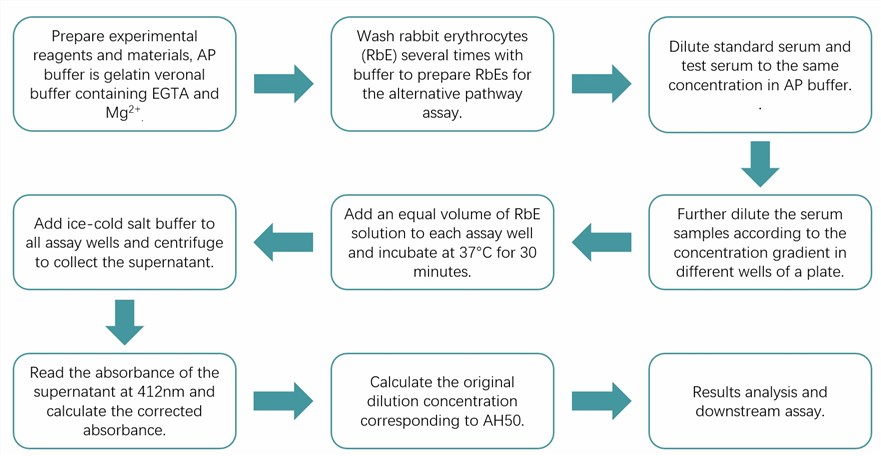 Fig 1. AH50 assay protocol.
ELISA-Based AP Analysis Protocol
Assays based on the ELISA format provide additional AP functional data.
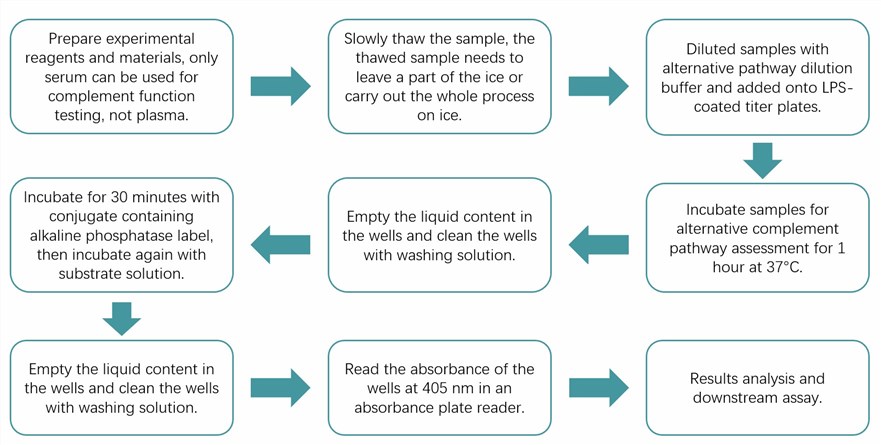 Fig 2. ELISA-based AP functional assay protocol.
Complement function testing is one of the irreplaceable steps in any complement-related research and is part of the routine protocol for immunodeficiency screening. Creative Biolabs has developed and optimized a variety of experimental protocols for detecting complement function integrity and complement cascade abnormalities, and are confident in providing a complete, stable and scalable one-stop solution service for scientists all over the world. Our excellent R&D team and advanced technical concepts make us highly innovative and professional. Whether you want to obtain rapid and repeatable data support through classic procedures, or expect to develop new methods to verify your ideas, we have the ability and confidence to provide you with perfect technical assistance, and greatly promote your research project.
Published Data
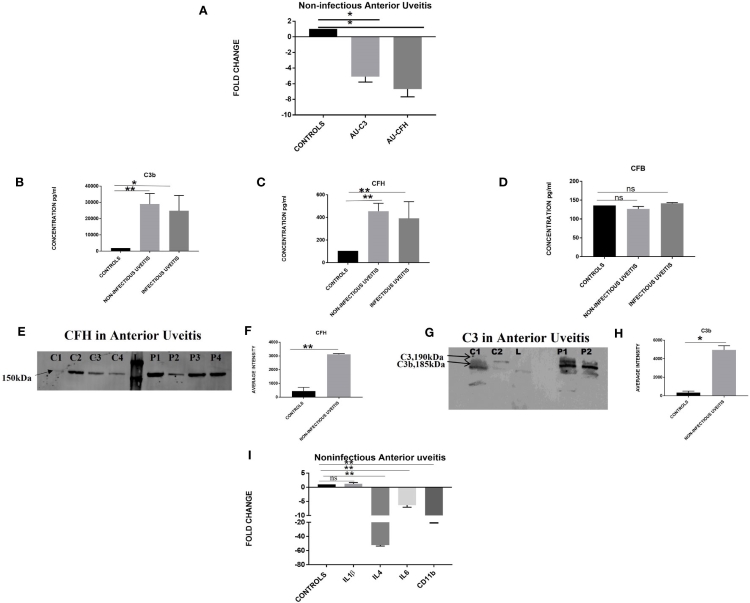 Fig.3 ELISA assays and quantitative PCR of complement C3 and CFH.1
Non-infectious uveitis is a disease caused by an abnormal autoimmune response, which can lead to visual impairment or even blindness. Non-infectious uveitis is a disease caused by an abnormal autoimmune response, which can lead to visual impairment or even blindness. It is characterized by inflammation of the intraocular uveal region. In order to study the role of the alternative complement pathway in the pathogenesis of non-infectious uveitis, the researchers used PCR and ELISA to detect the levels of C3 and CFH in peripheral blood. PCR results showed that peripheral blood C3 and CFH mRNA were downregulated in the anterior uveitis (AU) group and the posterior uveitis (PU) group. ELISA test results showed that the levels of C3b and CFH protein in the aqueous humor of infectious and non-infectious uveitis were significantly higher than those in the control group. The results of the study indicate that CFH and the alternative complement activation pathway are involved in the pathogenesis of non-infectious uveitis.
Services and Products at Creative Biolabs
For more details, please directly contact us with your specific request.
Reference
-
Kulshrestha, Prerna, et al. "Exploring the involvement of the alternative complement pathway in non-infectious uveitis pathogenesis." Frontiers in Immunology 14 (2023): 1222998. Distributed under Open Access license CC BY 4.0, without modification.
For Research Use Only.
Related Sections: