Creative Biolabs is offering the most comprehensive services for antibody development projects. With strict regulation and effective execution, we are dedicated to providing the most valuable solutions to complete your projects.
HighlightsCreative Biolabs is offering the most comprehensive services for antibody development projects. With strict regulation and effective execution, we are dedicated to providing the most valuable solutions to complete your projects.
HighlightsCreative Biolabs has established a broad range of platforms for developing novel antibodies or equivalents. These cutting-edge technologies enable our scientists to meet your demands from different aspects and tailor the most appropriate solution that contributes to the success of your projects.
HighlightsWith deep understanding in antibody-related realms and extensive project experience, Creative Biolabs offers a variety of references to help you learn more about our capacities and achievements, including infographic, flyer, case study, peer-reviewed publications, and all kinds of knowledge that can assist your projects. You are also welcome to contact us directly for more specific solutions.
HighlightsGet a real taste of Creative Biolabs, one of the most professional custom service providers in the world. We are committed to providing highly customized comprehensive solutions with the best quality to advance your projects.
Highlights Loading...
All listed services and products are For Research Use Only. Do Not use in any diagnostic or therapeutic applications.
ATP-binding cassette subfamily B member 4 (ABCB4) has been traditionally known as multidrug resistance protein 3 (MDR3), phosphatidylcholine translocator, is a large integral molecular mass membrane glycoprotein consisting of 1279 amino acids encoded by the ABCB4 gene. The protein is a full-size ABC transporter consisting of two tandem halves, each composed of a transmembrane domain (TMD) and a nucleotide-binding domain (NBD). TMD1 (helices TM1–TM6) and NBD is in the N-terminal half, while TMD2 (helices TM7–TM12) and NBD are located within the C-terminal domain. The head-to-tail dimer interface of two NBDs is responsible for binding and hydrolysis of ATP to drive the conformational cycle. Cryo-EM structure determination at 3.2 Å resolution shows the transporter in an ATP-bound nucleotide-dependent locked conformation with closed NBDs and a collapsed transmembrane architecture (TM H6 to TM9) at the lipid bilayer level, while presenting instead a large hydrophilic cavity that is completely occluded from both bulk solvent and contiguous aqueous space of substrate binding compartment but yet patent on membranes cytoplasmic side consistent with post-substrate-release pre-hydrolysis intermediate conformational assignment state37 This structural snapshot also provides support for a distinct "alternating access" mechanism of lipid extrusion, which is fundamentally different from the proposed "credit card swipe" model for other types of these lipid transporters. This expression is mainly localized at the canalicular (apical) membrane of hepatocytes, with the highest levels in liver. Variants pathogenic in ABCB4 are well established as causative of a group of cholestatic liver diseases. The extreme type is progressive familial intrahepatic cholestasis3 (PFIC3), an autosomal recessive disorder that presents in childhood with pruritus and jaundice, often accompanied by failure to thrive before progressing to cirrhosis and liver failure. Almost 300 individual disease-associated variants have been identified, including missense, nonsense and frameshift mutations as well as splice-site abnormalities. Heterozygous missense variants present as low-phospholipid-associated cholelithiasis (LPAC) syndrome—characterized by early-onset cholesterol gallstones, intrahepatic microlithiasis and recurrent biliary colic—or accompanied with symptoms of pregnancy related to a severe form of ICP often induced by estrogenic or androgenic steroids. Further presentations are drug-induced cholestasis, ductopenia in adults and the PFIC3 mouse model for cryptogenic cirrhosis with enhanced risk of hepatocellular carcinoma. The phenotypic variation correlates with the residual transport activity: null variants lead to severe pediatric disease while hypomorphic account for partial function into adulthood.
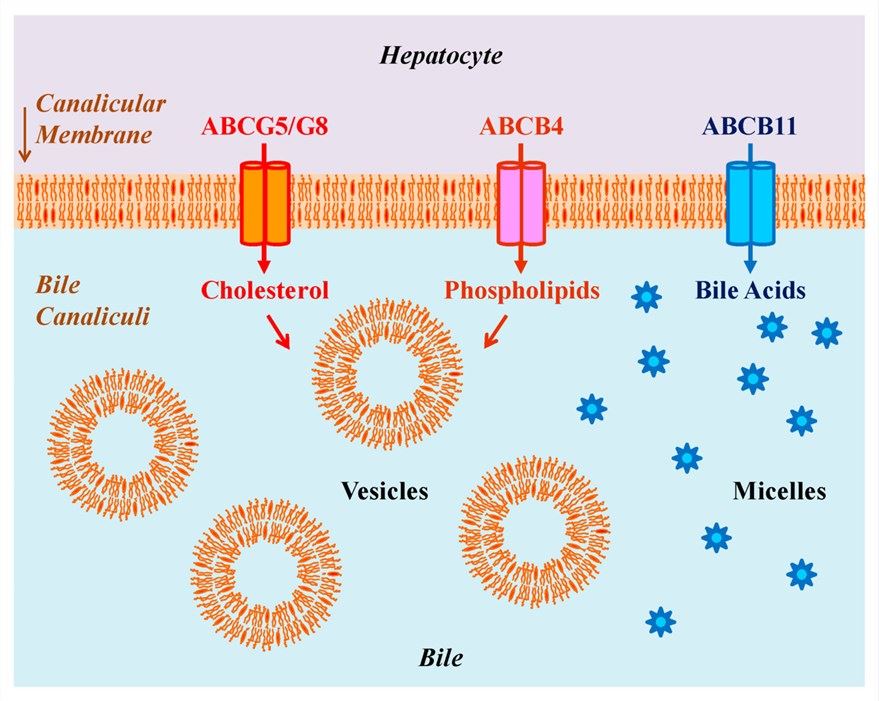 Fig.1 During bile formation, cholesterol, phospholipids, and bile acids are secreted by ABCG5/G8, ABCB4, and ABCB11 transporters, respectively, from the hepatocytes into the bile canaliculi.1
ABCB4 is broadly functional in both physiology and disease:
The structural and pharmacological research of ABCB4, however, is particularly challenging because the transporter has a high molecular mass, complex topography (TMD-NBD architecture), an ATP-dependent conformational cycle, and relies on its native lipid environment to function as a floppase. Creative Biolabs has developed a custom ABCB4 protein design platform to provide conformationally intact transporter preparations for structural biology, lipid-binding studies and research antibody development. Using structural insights from cryo-EM—most recently the ATP-bound state as a guide, along with codon-optimized gene synthesis and proprietary detergent-screening to identify constructs that preserve nucleotide-binding, lipid-interaction, and membrane-anchoring interfaces while maximizing yield is an approach used by our engineering team. Every engagement starts with an in-depth technical consultation to ensure that the protein architecture is optimally suited to your intended application, be it for crystallography, cryo-EM, or a high-throughput corrector one-screen.
Not finding the membrane protein product you need? Contact us to start your one-stop custom service!
Cell lines with properly regulated ABCB4 at the canalicular membrane are vital for conducting phosphatidylcholine floppase assays, as well as screening of chemical chaperones and other pharmaceutical correctors. Data generated from engineered, stable ABCB4 lines established in Creative Biolabs using optimized transduction and selection protocols that produce homogeneous expression of the transporter for extended periods. The platform consists of lentiviral delivery, transposon-mediated integration with fine-tuned targeted knock-in approaches for precise control at the genetic level. After rigorous monoclonal selection, each line is phenotypically validated for clonal purity.
Not finding the stable cell line product you need? Contact us to start your one-stop custom service!
Monoclonal antibodies that recognize ABCB4 with high affinity and sequence specificity are necessary for identifying the transporter in liver biopsy tissue, mapping its canalicular localization, and distinguishing it from the closely related multidrug pump ABCB1 (P-gp/MDR1). Creative Biolabs develops and provides end-to-end recombinatorial antibody discovery programs against extracellular as well as intracellular ABCB4 epitopes. The antibody development pipeline we have in place employs immunogen design, multi-platform selection and downstream engineering to provide binders with the specificity, affinity and developability profiles needed for research. In addition to eliminating batch-to-batch variability, which is inherent in classical polyclonal sera due to the high variability between different immunizations and animals used as a source of antibodies with reproducive characteristics, our recombinant expression/mass spectrometry analysis removes this restriction offering you readily available clonal sequences that can be further engineered.
Not finding the recombinant antibody product you need? Contact us to start your one-stop custom service!
In addition to a traditional catalog, Creative Biolabs offers an advanced suite of discovery services that addresses all aspects of ABCB4 research needs. These noteworthy capabilities cater to investigators seeking mechanistic insights that require custom reagents, challenging assay formats or multi-part integrated workflows:
No, all reagents and services offered are for research use only components which do not alter the activity of diagnostic or therapeutic agents.
Yes, we offer antibodies for studying ABCB4 and its phosphorylation-related regulation. ABCB4 activity can be modulated by phosphorylation. These reagents can support the analysis of ABCB4 expression and phosphorylation-related changes in fixed cells or membrane preparations.
We have now produced stable lines that retain activity of ABCB4 at the apical membrane as demonstrated in confocal microscopy and by domain-specific biotinylation. Each batch is released with documentation of phosphatidylcholine efflux into the apical compartment, resulting in a well-characterized cellular model system for continuous biliary lipid secretion studies without repeated transient transfection.
Yes, we provide recombinant proteins and stable cell lines harboring known pathogenic variants in the Walker A motif, transmembrane helices or phosphorylation sites within the R-domain. These materials allow direct comparison of ATPase activity, phosphatidylcholine binding affinity and apical trafficking efficiencies to those exhibited by wild-type controls in a well-defined cellular background.