Creative Biolabs is offering the most comprehensive services for antibody development projects. With strict regulation and effective execution, we are dedicated to providing the most valuable solutions to complete your projects.
HighlightsCreative Biolabs is offering the most comprehensive services for antibody development projects. With strict regulation and effective execution, we are dedicated to providing the most valuable solutions to complete your projects.
HighlightsCreative Biolabs has established a broad range of platforms for developing novel antibodies or equivalents. These cutting-edge technologies enable our scientists to meet your demands from different aspects and tailor the most appropriate solution that contributes to the success of your projects.
HighlightsWith deep understanding in antibody-related realms and extensive project experience, Creative Biolabs offers a variety of references to help you learn more about our capacities and achievements, including infographic, flyer, case study, peer-reviewed publications, and all kinds of knowledge that can assist your projects. You are also welcome to contact us directly for more specific solutions.
HighlightsGet a real taste of Creative Biolabs, one of the most professional custom service providers in the world. We are committed to providing highly customized comprehensive solutions with the best quality to advance your projects.
Highlights Loading...
All listed services and products are For Research Use Only. Do Not use in any diagnostic or therapeutic applications.
The CD8 subunit alpha (CD8A) is an approximately 32-34 kDa type I transmembrane glycoprotein related to the immunoglobulin superfamily. The molecule that interacts with this peptide is encoded by the CD8A gene. The extracellular domain has considerable structural homology to the immunoglobulin light chain, and the protein is heavily modified with N-linked glycosylation that contributes significantly to its mature molecular weight. The core receptor function of CD8A in relation to the T cell receptor (TCR) would form its functional architecture on cytotoxic T lymphocytes (CTLs). On the cell surface, it is found in two main forms: as a homodimer (CD8 αα) with two alpha chains, or a heterodimer (CD8 αβ) consisting of one alpha chain and one CD8B chain. CD8αβ is the main form of CTLs on mature peripheral CTLs and binds MHC class I with higher affinity than CD8αα homodimer which can be found on intraepithelial lymphocytes, thymocytes, and some natural killer (NK) cell subsets. The binding of CD8A to the invariant α3 domain of MHC class I upon engagement of peptide-MHC class I complexes coincides with recruitment of LCK to the TCR-CD3 complex. This close range and spatial approximation trigger phosphorylation cascades which results in lymphokine production, cytolytic granule release, motility and clonal expansion.
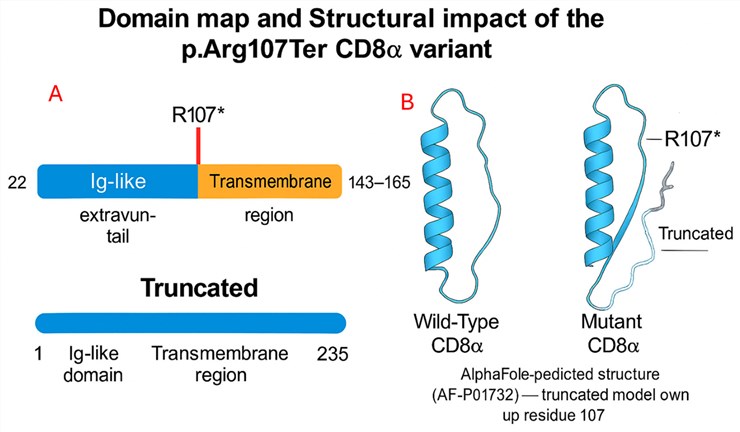 Fig.1 Comparison of the full-length and truncated CD8A protein highlighting the position of the p.Arg107Ter variant.1
The biological relevance of CD8A spans multiple linked immunological contexts:
Drive your immunology and cell biology research with our catalog of recombinant CD8A proteins. The extracellular IgV-like domain and membrane-associated organization of CD8A are important considerations for studies of its interactions and biological function. We provide CD8A protein constructs and preparations suitable for a range of research applications, including structural studies, MHC class I binding assays, antibody development and characterization, and related biochemical analyses. Available construct formats may vary according to specific experimental requirements, with appropriate quality assessment applied based on the intended research use.
Not finding the membrane protein product you need? Contact us to start your one-stop custom service!
Robust and reproducible cellular models are critical for dissecting CD8A-driven biology and assessing candidates. Our stable cell lines engineered to express wild-type or variant forms of human, mouse and rat CD8A as well as loss-of-function lines with modulated endogenous expression. These platforms are designed for superior throughput T-cell activation assays, MHC class I tetramer binding studies quantification and phenotyping of tumor-infiltrating lymphocytes between various experimental phases ensuring high consistency.
Not finding the stable cell line product you need? Contact us to start your one-stop custom service!
We provide recombinant antibodies targeting CD8A for a range of research applications. These antibodies are produced using recombinant technologies that support consistent reagent quality and batch-to-batch reproducibility. Depending on the specific product and supporting datasheet, CD8A recombinant antibodies may be suitable or available for applications including Western Blotting (WB), ELISA, Flow Cytometry (FCM), Immunofluorescence/Immunocytochemistry (IF/ICC), Immunohistochemistry (IHC), and Immunoprecipitation (IP), supporting the detection and analysis of CD8A in appropriate research samples.
Not finding the recombinant antibody product you need? Contact us to start your one-stop custom service!
In addition to our catalog products, we provide custom services for membrane protein & antibody discovery & development. With our deep knowledge of T-cell receptor biology, immuno-oncology and CD8+ T cells we can help you with:
Yes, we offer pairing-state-selective antibodies that are directed against a conformational epitope in the CD8A stalk region which is exposed after proper heterodimerization with CD8B but is sterically masked in the homodimeric form.
Yes, some clones have been validated on archival specimens following antigen retrieval and provided unique patterns of membranous staining visualized in cortical thymocytes or cytotoxic T-cell infiltrate. Peptide competition and recombinant antigen controls demonstrate the specificity of these majority of identity-based, cross-tool epitopes across heterogeneous tissue contexts.
Yes, the protein is in a buffer at defined concentration and physiologic pH with no carrier proteins or denaturants; it is also endotoxin monitored. So that means they can be diluted immediately into a coating buffer or used in an amine-coupling reaction without the need for dialysis or other intermediary buffer exchanges.
No, all CD8A products and services are only for research use and not approved for in vitro diagnostics (IVD) or clinical diagnosis, prevention, treatment, cure of any disease.