
Creative Biolabs is offering the most comprehensive services for antibody development projects. With strict regulation and effective execution, we are dedicated to providing the most valuable solutions to complete your projects.
HighlightsCreative Biolabs is offering the most comprehensive services for antibody development projects. With strict regulation and effective execution, we are dedicated to providing the most valuable solutions to complete your projects.
HighlightsCreative Biolabs has established a broad range of platforms for developing novel antibodies or equivalents. These cutting-edge technologies enable our scientists to meet your demands from different aspects and tailor the most appropriate solution that contributes to the success of your projects.
HighlightsWith deep understanding in antibody-related realms and extensive project experience, Creative Biolabs offers a variety of references to help you learn more about our capacities and achievements, including infographic, flyer, case study, peer-reviewed publications, and all kinds of knowledge that can assist your projects. You are also welcome to contact us directly for more specific solutions.
HighlightsGet a real taste of Creative Biolabs, one of the most professional custom service providers in the world. We are committed to providing highly customized comprehensive solutions with the best quality to advance your projects.
Highlights Loading...
All listed services and products are For Research Use Only. Do Not use in any diagnostic or therapeutic applications.
CYP19A1 is a steroidogenic cytochrome P450 monooxygenase which catalyse the final and rate-limiting step in Estrogens production from Androgen.genesis. This unique enzyme is the only known member of the cytochrome P450 superfamily that can catalyze a six-membered ring aromatization via three hydroxylation reaction steps—in which, initially in C19 methyl-group containing androgens it converts to its gem-diol form before dehydration taking place as an aldehyde followed by subsequent cleavage of C10–C19 bond generated at aromatic A-ring formation responsible for all estrogens. During each catalytic cycle, CYP19A1 uses three molecules of molecular oxygen and three moles of NADPH for its reaction requiring electron transfer from the obligate redox partner, NADPH-cytochrome P450 reductase (CPR), making it one of the most metabolically demanding enzymes in steroid biosynthesis. Example: Aberrant regulation of aromatase expression in endometriotic lesions results to local production oƒ estrogen, a situation that supports the growth and survival exogenous growing ectopic ovarian tissue. Endometriotic stromal cells vsendometrium Express Constitutive CYp19A1 Driving local Estrogen Synthesis independent of ovarian Function Because it does not express aromatase, normal endometrial tissue lyses. CYP19A1 is an attractive target for therapeutics of endometriosis based on this pathological aromatization, and some studies have indicated the utility with aromatase inhibitors to reduce both lesion size and pain symptoms in refractory cases.
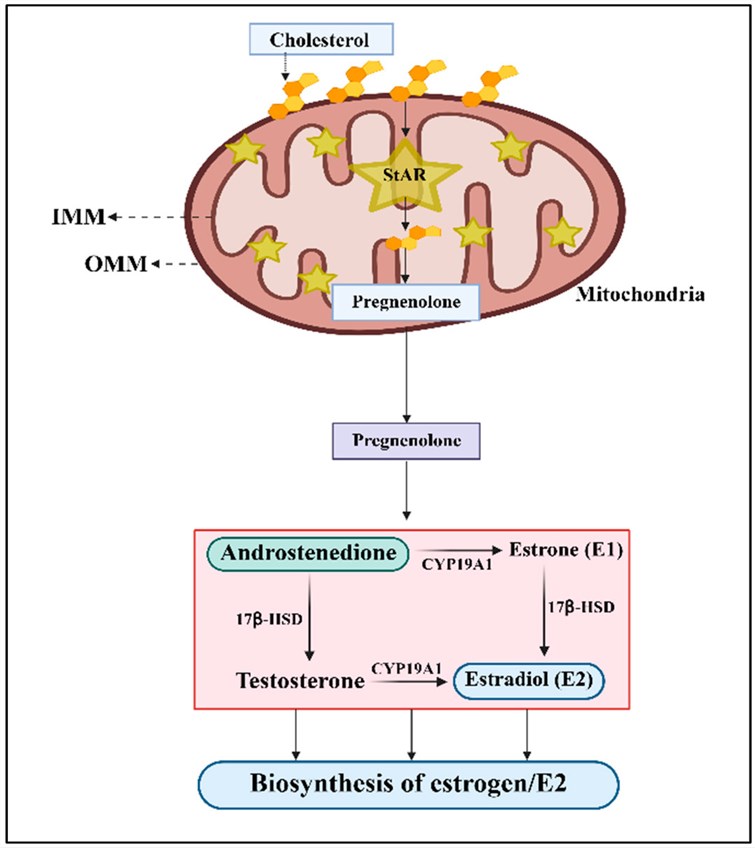 Fig.1 The steroid biosynthetic pathway that leads to the synthesis of estrogens in peripheral and/or breast tumor tissues.1
The functional repertoire of CYP19A1 spans multiple dimensions in reproductive physiology, endocrine homeostasis and disease pathogenesis:
We present a panel of potent CYP19A1 membrane protein products at top quality that could be useful in various applications including structural and functional studies as well as drug discovery for this notoriously difficult steroidogenic cytochrome P450. Abstract Our proprietary recombinant membrane protein technology harnesses the versatility of producing CYP19A1 using various expression systems, such as bacterial hosts (E. coli BL21) in conjunction with GroEL/GroES chaperone co-expression, insect cells and mammalian cell platforms (HEK293, CHO). Unsurprisingly, given its nature as an integral membrane protein whose functionality is strictly dependent on the proper incorporation of heme to exert catalytic activity, our portfolio covers full-length CYP19A1 (residues 46–503) and N-terminally truncated constructs optimized for crystallization over a traditional Cystein-type domain construct. The available formats include detergent-biased preparations, nanodisc-reconstituted proteins for native membrane environment studies and liposome-complexes reconstituted with CPR for functional assays.
Not finding the membrane protein product you need? Contact us to start your one-stop custom service!
Our stable cell lines are suitable for drug screening, aromatase inhibitor efficacy and resistance studies, estrogen production assays as well as the development of high-throughput screening campaigns. Our cell line development platform is compatible with different host backgrounds (HEK293, CHO-K1, and MCF-7 breast cancer and SK-BR-3 cells) using either an inducible or constitutive expression system. We generated lines with doxycycline-inducible CYP19A1 expression for studies of controlled estrogen production, co-expressing lines for functional reconstitution assays of CYP19A1 and CPR, and stable knockdown lines to perform loss-of-function analyses on the function. Stable cell lines were validated via flow cytometry, Western blot and immunofluorescence localization assays confirming consistent homogenous expression quantitated by functional aromatase activity readout on separate passages.
Not finding the stable cell line product you need? Contact us to start your one-stop custom service!
With a focus on high-affinity recombinant antibodies specifically targeting CYP19A1, our diverse portfolio is designed to meet the demanding requirements of all research applications. Using state-of-the-art recombinant technologies, they can show significantly greater specificity and sensitivity as well as enhanced batch-to-batch reproducibility than antibodies made in the traditional way from hybridoma cells. Anti-CYP19A1 antibodies are elicited against specific epitopes that range from the N-terminal membrane anchor, active site region, heme-binding proximal pocket and C-terminus of this ~58 kDa full-length protein. Applications: Western blot (confirmed detection in placental, MCF-7 and SK-BR-3 cell lysates), immunohistochemistry of breast tumor/ endometrial tissue sections, Immunofluorescence for ER localization studies; flow cytometry, and ELISA. Both monoclonal and polyclonalFormat: conjugated to a fluorescent dye (e.g. PE, FITC, Alexa Fluor), enzyme label (HRP or AP) or biotin according your experimental workflow.
Not finding the recombinant antibody product you need? Contact us to start your one-stop custom service!
On top of our catalog products, we offer specialized custom services for membrane protein and antibody discovery & development. With our vast experience and innovations, we are equipped to help you with:
No, all our CYP19A1 products/services are for laboratory research use only and not intended for clinical diagnosis and prevention or treatment of a disease.
Yes, we do offer conformation-selective antibodies; one a linear epitope only exposed in the correctly folded heme-loaded state and another that targets an N-terminal hydrophobic anchor found in both native and misfolded states. Combined, these reagents facilitate differential immunofluorescence and western blot quantitation of functional versus dysfunctional species together with providing direct measure of folding rather than using enzymatic activity tests or heme-staining protocols.
Yes, we developed stable lines where transcription of CYP19A1 is driven by a doxycycline responsive promoter. This approach enables the accurate timing of gene expression at defined intervals, followed by quantification of progressive estradiol accumulation together with aromatase promoter occupation and feedback inhibition dynamics over time while avoiding confounding compensatory desensitization inherent to constitutive overexpression systems.
Yes, we do provide recombinant proteins (that contain documented variants with disrupted heme-coordinating cysteine residues or deleted N-terminal transmembrane segments) and stable cell lines expressing such variants.








