Creative Biolabs is offering the most comprehensive services for antibody development projects. With strict regulation and effective execution, we are dedicated to providing the most valuable solutions to complete your projects.
HighlightsCreative Biolabs is offering the most comprehensive services for antibody development projects. With strict regulation and effective execution, we are dedicated to providing the most valuable solutions to complete your projects.
HighlightsCreative Biolabs has established a broad range of platforms for developing novel antibodies or equivalents. These cutting-edge technologies enable our scientists to meet your demands from different aspects and tailor the most appropriate solution that contributes to the success of your projects.
HighlightsWith deep understanding in antibody-related realms and extensive project experience, Creative Biolabs offers a variety of references to help you learn more about our capacities and achievements, including infographic, flyer, case study, peer-reviewed publications, and all kinds of knowledge that can assist your projects. You are also welcome to contact us directly for more specific solutions.
HighlightsGet a real taste of Creative Biolabs, one of the most professional custom service providers in the world. We are committed to providing highly customized comprehensive solutions with the best quality to advance your projects.
Highlights Loading...
All listed services and products are For Research Use Only. Do Not use in any diagnostic or therapeutic applications.
ER membrane protein complex subunit 3 (EMC3) is an integral multi-pass endoplasmic reticulum transmembrane protein encoded by EMC3 gene, serving as a core structural and functional subunit of the conserved ER membrane protein complex (EMC), an essential molecular chaperone machinery dedicated to co-translational and post-translational insertion, folding and quality control of multi-pass transmembrane polypeptides within ER lipid bilayers. EMC3 contains multiple hydrophobic transmembrane helices that form central substrate-binding pockets within the assembled EMC holocomplex, mediating recognition of nascent membrane protein hydrophobic segments, stabilizing partially folded transmembrane intermediates and preventing misfolded polypeptide aggregation during ER biogenesis. Under basal physiological proteostasis conditions, EMC3-containing EMC complexes coordinate with Sec61 translocons to integrate newly synthesized multi-pass receptors, transporters and ion channels into ER membranes, supporting normal cellular membrane protein turnover and organelle biogenesis. Upon ER proteotoxic stress, EMC3 expression is transcriptionally upregulated as part of the adaptive unfolded protein response to expand membrane folding capacity and reduce toxic aggregate accumulation. Distinct from single-subunit translocon chaperones, EMC3 functions exclusively within the multi-subunit EMC assembly to handle challenging multi-spanning membrane substrates that cannot be efficiently folded by Sec61 alone, with no single ER chaperone able to fully compensate EMC3 loss for complex transmembrane protein biogenesis. Depletion of functional EMC3 disrupts insertion and maturation of abundant multi-pass membrane proteins, triggers severe ER stress and activates pro-apoptotic UPR signaling, while sustained EMC3 upregulation enhances cellular tolerance to membrane protein misfolding stress, establishing EMC3 as a core research target for ER membrane chaperone biology and proteostasis therapeutic screening.
EMC3 executes core holocomplex scaffolding and substrate chaperone function embedded within ER lipid bilayers; its transmembrane helices assemble with EMC1/2/4/5/6/7/8/9 subunits to form a large membrane-embedded chamber that accommodates nascent multi-pass polypeptide intermediates. Conserved polar intramembrane residues within EMC3's substrate pocket shield hydrophobic transmembrane segments from unfavorable aqueous ER luminal environments during folding, preventing premature aggregation and enabling sequential integration of helical spans into the lipid bilayer. EMC3 also mediates physical contact between the EMC complex and Sec61 translocon to streamline co-translational membrane protein delivery from ribosomes to ER membranes. EMC3-dependent membrane protein folding sustains balanced cellular ER proteostasis, covering efficient biogenesis of nutrient transporters, cell surface receptors and ion channels while limiting toxic misfolded membrane protein buildup. EMC3 participates in a broad spectrum of cellular physiological processes including developmental organelle membrane expansion, multi-pass receptor maturation and adaptive ER stress resistance. Loss of EMC3 function blocks complex membrane protein biogenesis and triggers sustained cytotoxic unfolded protein response signaling. Therefore, EMC3 represents a pivotal research target for ER multi-subunit chaperone complex study and protein misfolding disorder modulator discovery.
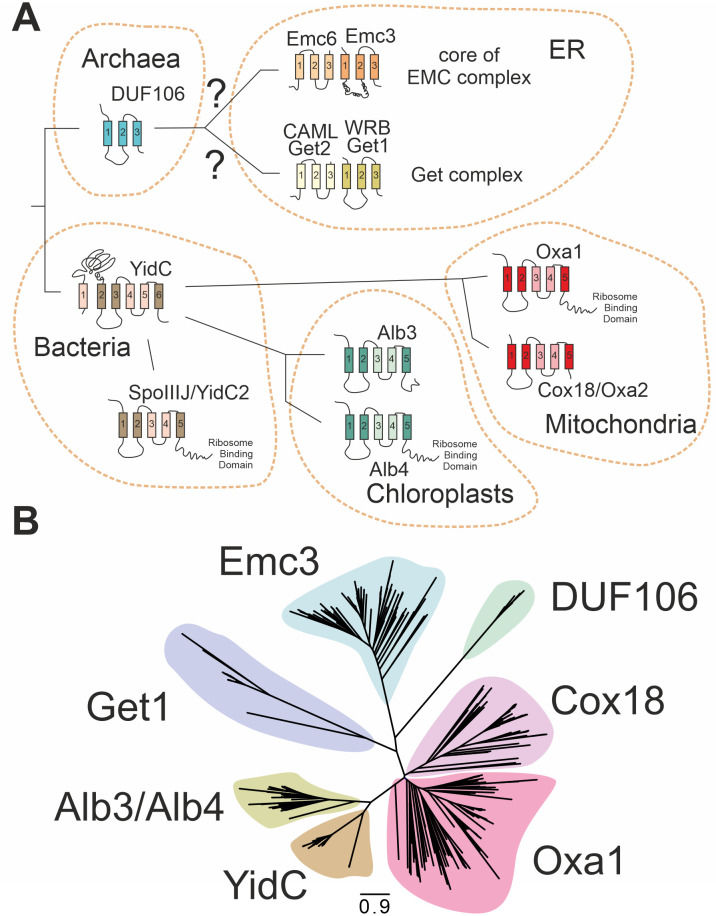 Fig. 1 Panel A outlines the compartment distribution of Emc3 homologous membrane insertases across diverse kingdoms; Panel B interprets evolutionary divergence via phylogenetic clustering.1
The biological functions of EMC3 are focused on ER membrane complex scaffolding, nascent transmembrane polypeptide stabilization and proteotoxic stress buffering:
Creative Biolabs offers high-quality EMC3 proteins through optimized expression systems, including full-length multi-pass ER transmembrane subunit and isolated intramembrane substrate pocket domain variants. These products retain native conformational characteristics and EMC complex assembly plus polypeptide chaperone biological activity, suitable for ER chaperone holocomplex interaction assays and proteostasis stress protective compound screening. All EMC3 proteins undergo strict quality control to ensure consistent performance and reliable application across diverse research platforms.
Not finding the membrane protein product you need? Contact us to start your one-stop custom service!
Creative Biolabs provides custom-engineered EMC3 stable cell lines, including wild-type and knockdown/mutant loss-of-function control models. These cell lines are optimized for multi-pass membrane protein maturation profiling and ER unfolded protein response functional analysis. Each cell line undergoes stringent validation to ensure stable expression profiles and consistent functional performance in diverse experimental contexts.
Not finding the stable cell line product you need? Contact us to start your one-stop custom service!
High-specificity recombinant antibodies targeting EMC3 are developed via advanced antibody engineering technologies, with no cross-reactivity with other EMC family subunits. These antibodies are validated for ER membrane subcellular localization detection and proteotoxic stress tissue expression profiling, and can be paired with EMC1/Sec61 detection reagents to characterize complete ER membrane chaperone assembly complexes in protein folding stress cell models.
Not finding the recombinant antibody product you need? Contact us to start your one-stop custom service!
Beyond catalog products, Creative Biolabs offers specialized custom services for EMC3 research:
EMC3 is a core ER membrane protein complex subunit that assembles the EMC chaperone chamber to fold and integrate multi-pass transmembrane proteins into ER lipid bilayers.
EMC3 is indispensable for biogenesis of most multi-spanning receptors and transporters; its dysfunction triggers severe ER proteotoxic stress linked to degenerative disease pathways.
No, all EMC3 products and services are strictly for research use only, not intended for clinical diagnosis or treatment.
Offerings include full-length EMC3 ER transmembrane proteins, subunit-specific detection antibodies and custom stable cell lines for ER membrane protein biogenesis research.
EMC3 proteins are validated via EMC holocomplex co-assembly and multi-pass substrate polypeptide stabilizing functional testing.