Creative Biolabs is offering the most comprehensive services for antibody development projects. With strict regulation and effective execution, we are dedicated to providing the most valuable solutions to complete your projects.
HighlightsCreative Biolabs is offering the most comprehensive services for antibody development projects. With strict regulation and effective execution, we are dedicated to providing the most valuable solutions to complete your projects.
HighlightsCreative Biolabs has established a broad range of platforms for developing novel antibodies or equivalents. These cutting-edge technologies enable our scientists to meet your demands from different aspects and tailor the most appropriate solution that contributes to the success of your projects.
HighlightsWith deep understanding in antibody-related realms and extensive project experience, Creative Biolabs offers a variety of references to help you learn more about our capacities and achievements, including infographic, flyer, case study, peer-reviewed publications, and all kinds of knowledge that can assist your projects. You are also welcome to contact us directly for more specific solutions.
HighlightsGet a real taste of Creative Biolabs, one of the most professional custom service providers in the world. We are committed to providing highly customized comprehensive solutions with the best quality to advance your projects.
Highlights Loading...
All listed services and products are For Research Use Only. Do Not use in any diagnostic or therapeutic applications.
Fatty acyl-CoA reductase 1 (FAR1) is an integral peroxisomal membrane enzyme encoded by FAR1 gene, serving as the rate-limiting catalytic enzyme for fatty alcohol biosynthesis via NADPH-dependent reduction of fatty acyl-CoA substrates into primary fatty alcohols, core building blocks for wax esters, ether lipids and epidermal barrier lipids across epithelial tissues. The polypeptide contains conserved N-terminal catalytic domains exposed to the peroxisomal cytosol, with binding pockets accommodating long-chain saturated and unsaturated acyl-CoA substrates and coordinating NADPH cofactors to execute two-step reductive conversion without intermediate aldehyde release. Under physiological epithelial homeostasis, basal FAR1 enzymatic activity sustains continuous production of barrier lipid precursors to assemble intercellular lipid lamellar layers in skin keratinocytes, preventing transepidermal water loss and maintaining cutaneous tissue integrity. Distinct from paralogous FAR2 with substrate preference for very long-chain acyl-CoAs, FAR1 exhibits broad medium-to-long chain fatty acyl substrate selectivity and dominates epidermal lipid synthetic pathways; no other cellular reductase can fully compensate FAR1 loss for cutaneous barrier lipid generation. Functional FAR1 deficiency abolishes skin lipid alcohol synthesis, disrupts epidermal lamellar layer assembly and triggers severe dry skin barrier dysfunction, while excessive FAR1 catalytic activity promotes aberrant sebaceous lipid overproduction linked to inflammatory skin disorders, establishing FAR1 as a core research target for peroxisomal lipid reductase enzymology and skin barrier lipid modulator screening for research applications.
FAR1 executes core reductive lipid biosynthetic function anchored to peroxisomal membranes, relying on tightly coordinated NADPH cofactor binding and acyl-CoA substrate recognition within cytosolic catalytic domains. Each catalytic cycle sequentially reduces acyl-CoA thioester carbonyl groups to generate primary fatty alcohols. Newly synthesized fatty alcohols exit peroxisomes and serve as precursors supporting downstream wax ester and ether lipid assembly. FAR1 participates in a broad spectrum of lipid metabolic processes including cutaneous barrier formation, sebaceous gland lipid synthesis, ether lipid precursor generation and adipogenic lipid droplet maturation. Disrupted FAR1 catalytic activity impairs skin lipid homeostasis and induces barrier-deficient inflammatory skin phenotypes. Therefore, FAR1 represents a pivotal research target for peroxisomal membrane lipid reductase study and skin barrier lipid metabolism research.
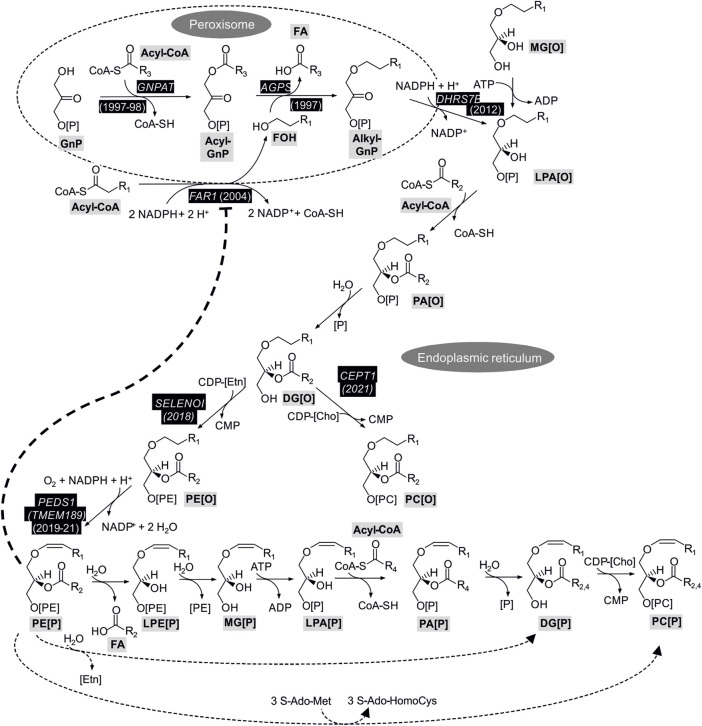 Fig. 1 Mammalian plasmalogen biosynthesis. Peroxisomal FAR1 generates fatty alcohol precursors required for ether lipid formation; subsequent lipid processing occurs in the endoplasmic reticulum.1
The biological functions of FAR1 are focused on NADPH-dependent lipid reduction, barrier lipid precursor generation and epithelial tissue protection:
Creative Biolabs offers high-quality FAR1 proteins through optimized expression systems. These products retain native conformational characteristics and NADPH-dependent acyl-CoA reductive biological activity, suitable for lipid metabolic enzyme interaction assays and skin barrier lipid modulator screening. All FAR1 proteins undergo strict quality control to ensure consistent performance and reliable application across diverse research platforms.
Not finding the membrane protein product you need? Contact us to start your one-stop custom service!
Creative Biolabs provides custom-engineered FAR1 stable cell lines, including wild-type and catalytic inactive mutant control models. These cell lines are optimized for fatty alcohol biosynthesis profiling and epidermal barrier lipid functional analysis. Each cell line undergoes stringent validation to ensure stable expression profiles and consistent functional performance in diverse experimental contexts.
Not finding the stable cell line product you need? Contact us to start your one-stop custom service!
High-specificity recombinant antibodies targeting FAR1 are developed via advanced antibody engineering technologies, with no cross-reactivity with FAR2 and other cellular acyl reductase paralogs. These antibodies are validated for peroxisomal membrane subcellular localization detection and epidermal/sebaceous tissue expression profiling, and can be paired with lipid droplet marker detection reagents to characterize complete lipid biosynthetic complexes in cutaneous cell research models.
Not finding the recombinant antibody product you need? Contact us to start your one-stop custom service!
Beyond catalog products, Creative Biolabs offers specialized custom services for FAR1 research:
FAR1 is an ER integral peroxisomal membrane reductase that uses NADPH to reduce fatty acyl-CoA into primary fatty alcohols, the key precursors for skin barrier wax and ether lipids.
FAR1 is the master enzyme governing epidermal barrier lipid biosynthesis; its dysfunction directly causes skin barrier deficiency and inflammatory cutaneous disorders.
No, all FAR1 products and services are strictly for research use only, not intended for clinical diagnosis or treatment.
Offerings include full-length peroxisomal FAR1 lipid reductase proteins, isoform-specific detection antibodies and custom stable cell lines for skin lipid and ether lipid plasmalogen research.
FAR1 proteins are validated via NADPH-dependent long-chain fatty acyl-CoA reductive conversion functional testing.