Creative Biolabs is offering the most comprehensive services for antibody development projects. With strict regulation and effective execution, we are dedicated to providing the most valuable solutions to complete your projects.
HighlightsCreative Biolabs is offering the most comprehensive services for antibody development projects. With strict regulation and effective execution, we are dedicated to providing the most valuable solutions to complete your projects.
HighlightsCreative Biolabs has established a broad range of platforms for developing novel antibodies or equivalents. These cutting-edge technologies enable our scientists to meet your demands from different aspects and tailor the most appropriate solution that contributes to the success of your projects.
HighlightsWith deep understanding in antibody-related realms and extensive project experience, Creative Biolabs offers a variety of references to help you learn more about our capacities and achievements, including infographic, flyer, case study, peer-reviewed publications, and all kinds of knowledge that can assist your projects. You are also welcome to contact us directly for more specific solutions.
HighlightsGet a real taste of Creative Biolabs, one of the most professional custom service providers in the world. We are committed to providing highly customized comprehensive solutions with the best quality to advance your projects.
Highlights Loading...
All listed services and products are For Research Use Only. Do Not use in any diagnostic or therapeutic applications.
Fc fragment of IgG receptor IIIa (FCGR3A, CD16a) is a type I transmembrane Fc gamma receptor encoded by FCGR3A gene, selectively expressed on NK cells, monocytes and tissue macrophages with polymorphic extracellular IgG binding domains. FCGR3A crosslinks IgG-opsonized target cell surfaces to trigger intracellular cytotoxic kinase cascades that mediate antibody-dependent cellular cytotoxicity (ADCC) and phagocytosis of antibody-coated pathogens or tumor cells. Distinct from the secreted isoform FCGR3B, membrane-bound FCGR3A transmits full intracellular effector signals upon Fc binding.
FCGR3A exerts immune effector functions via extracellular IgG constant domain binding pockets that crosslink multiple receptor molecules to initiate intracellular tyrosine phosphorylation signaling. Genetic single-nucleotide polymorphisms alter IgG binding affinity and directly determine the potency of therapeutic antibody-mediated ADCC responses. Loss of functional FCGR3A severely blunts anti-tumor myeloid killing activity, uncoupling therapeutic antibody targeting from tumor cell clearance. This regulatory characteristic is central to humoral effector immunity, while FCGR3A low-affinity variants correlate with poor immunotherapy clinical outcomes. FCGR3 participates in anti-cancer immunity, infectious phagocytosis and autoantibody-mediated inflammatory lesions, making it a core translational research marker for antibody drug development.
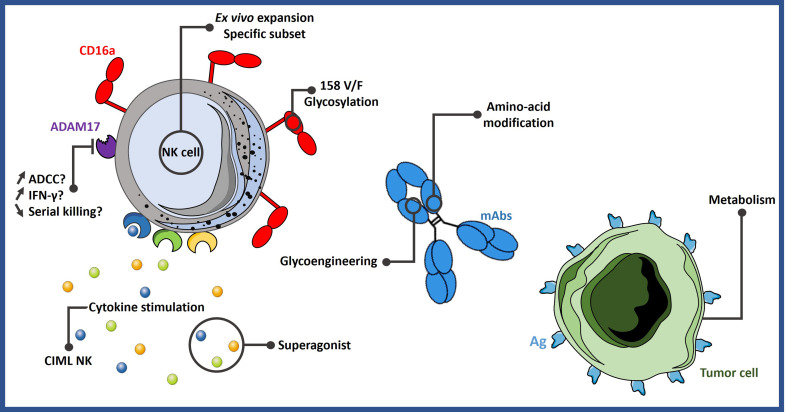 Fig. 1 NK cell surface FCGR3A (CD16a) activity is regulated by V158/F polymorphism, glycosylation and ADAM17-mediated ectodomain shedding. Multiple engineering strategies including NK ex vivo expansion, cytokine priming, antibody glycoengineering and Fc amino acid modification are applied to boost CD16a-dependent ADCC against antigen-positive tumor cells.1
The biological functions of FCGR3A are focused on IgG Fc recognition and effector kinase signal activation:
Creative Biolabs offers high-quality FCGR3A proteins through optimized heterologous expression systems, including wild-type and polymorphic extracellular binding domain variants with modified IgG pocket affinity. These products retain native Fc binding capacity and full cytotoxic signal triggering activity, suitable for ADCC mechanism assays and therapeutic antibody potency screening workflows. All FCGR3A batches undergo strict quality control to ensure consistent performance and reliable application across immune cell research platforms.
Not finding the membrane protein product you need? Contact us to start your one-stop custom service!
Creative Biolabs provides custom-engineered FCGR3A stable cell lines, including polymorphic variant overexpression and knockdown immune cell models. These cell lines are optimized for ADCC signaling research and therapeutic antibody potency testing. Each cell line undergoes stringent validation to ensure stable receptor expression profiles and consistent cytotoxic functional performance in diverse experimental contexts.
Not finding the stable cell line product you need? Contact us to start your one-stop custom service!
High-specificity recombinant antibodies targeting FCGR3A are developed via advanced antibody engineering technologies, with no cross-reactivity to FCGR3B isoforms. These antibodies are validated for multiple applications, including NK cell surface immunofluorescence localization detection, Western blot expression quantification and co-immunoprecipitation analysis of FCGR3A-IgG complexes, enabling precise characterization of FCGR3A expression and binding affinity differences across polymorphic variants.
Not finding the recombinant antibody product you need? Contact us to start your one-stop custom service!
Beyond catalog products, Creative Biolabs offers specialized custom services for FCGR3A research:
FCGR3A is a myeloid Fc receptor regulatory protein that binds IgG Fc domains to trigger ADCC cytotoxic signaling, fine-tuning antibody-dependent anti-tumor and anti-pathogen immune clearance.
FCGR3A polymorphism directly alters therapeutic antibody efficacy, and its loss eliminates myeloid anti-tumor cytotoxicity. It is a critical translational research target for tumor immunotherapy.
No, all FCGR3A products and services are strictly for research use only, not intended for clinical diagnosis or treatment.
Offerings including polymorphic FCGR3A recombinant proteins, high-specificity recombinant antibodies, and custom ADCC reporter cell lines, supporting translational antibody drug research projects.
FCGR3A proteins are validated by IgG binding and cell-based ADCC cytotoxicity assays to retain native effector signal regulatory function.