Creative Biolabs is offering the most comprehensive services for antibody development projects. With strict regulation and effective execution, we are dedicated to providing the most valuable solutions to complete your projects.
HighlightsCreative Biolabs is offering the most comprehensive services for antibody development projects. With strict regulation and effective execution, we are dedicated to providing the most valuable solutions to complete your projects.
HighlightsCreative Biolabs has established a broad range of platforms for developing novel antibodies or equivalents. These cutting-edge technologies enable our scientists to meet your demands from different aspects and tailor the most appropriate solution that contributes to the success of your projects.
HighlightsWith deep understanding in antibody-related realms and extensive project experience, Creative Biolabs offers a variety of references to help you learn more about our capacities and achievements, including infographic, flyer, case study, peer-reviewed publications, and all kinds of knowledge that can assist your projects. You are also welcome to contact us directly for more specific solutions.
HighlightsGet a real taste of Creative Biolabs, one of the most professional custom service providers in the world. We are committed to providing highly customized comprehensive solutions with the best quality to advance your projects.
Highlights Loading...
All listed services and products are For Research Use Only. Do Not use in any diagnostic or therapeutic applications.
Guanylate cyclase 2C (GUCY2C) is a type-I transmembrane receptor, which is primarily localized to the apical brush border membrane of intestinal epithelial cells throughout the GI tract (duodenum through rectum). Additionally, it is localized to the salivary gland, hypothalamus, and substantia nigra pars compacta (SNpc), where it has been blonged a role in leptin signaling, control of satiety and dopaminergic neuron viability. Pathologically, germline gain-of-function mutations in GUCY2C lead to familial chronic diarrhea syndromes that are associated with dysfunctional cGMP signaling, CFTR overactivation and secretory diarrhea. In contrast, loss-of-function mutations lead to meconium ileus, a neonatal intestinal obstruction syndrome. In colorectal cancer, silencing of the GUCY2C signaling axis occurs not through receptor mutation but by widespread loss of its ligands guanylin and uroguanylin early in tumor development. In retaining and overexpressing the GUCY2C receptor on >95% of colorectal tumors, ligand loss renders an extraordinarily specific tumor antigen. This ligand-receptor disconnect converts GUCY2C from a tumor suppressor to a silent targetable state and its restricted normal tissue expression (limited exclusively to the luminal-facing apical membrane) allows for on-target off-tumor toxicity sparing for systemically administered therapeutics.
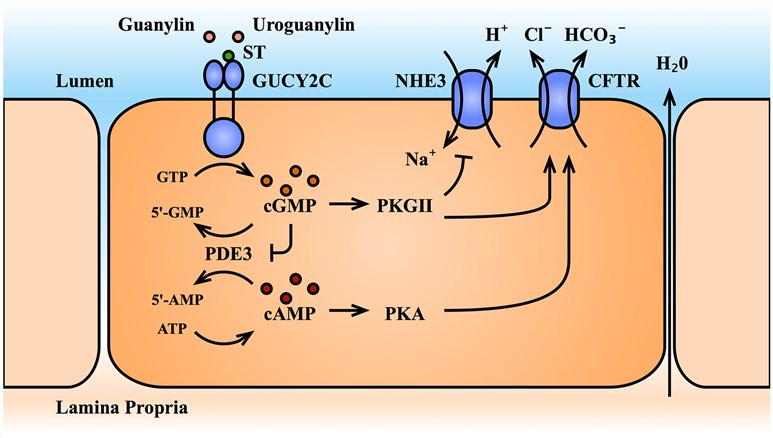 Fig. 1 The GUCY2C-cGMP signaling axis and intestinal fluid secretion.1
GUCY2C functions in diverse physiological and pathophysiological settings:
The structural and pharmacological studies of GUCY2C are confounded by the receptor's large extracellular domain, type-I membrane topology, ligand-dependent dimerization requirement for catalysis and glycosylation-dependent trafficking. Therefore, Creative Biolabs has developed an innovative custom novel GUCY2C protein design platform to provide structural biology-grade, conformationally intact receptor preparations for drug discovery studies including ligand-binding and therapeutic antibody development. Combining structural data with codon optimization and proprietary expression protocols, our engineering team develops constructs to enhance yield while preserving the guanylin/uroguanylin binding pocket, ST enterotoxin recognition site, and intracellular catalytic domain. All of your projects starts with a comprehensive technical consultation, to refine the protein construction to suit your ends whether that involves crystallography, cGMP assay development or high-throughput agonist/antagonist screening.
Not finding the membrane protein product you need? Contact us to start your one-stop custom service!
Cellular models that stably co-express functionally active GUCY2C at the plasma membrane and lead to high-level cGMP production are critical for ligand-binding assays, agonist/antagonist screening and for coupling studies with CFTR. The engineers at Creative Biolabs go on to develop their own GUCY2C stable cell lines, following transduction and selection protocols to ensure a homogeneous receptor expression that is sustained. We harness a systematic approach to achieve precision in genetic control through the following methodologies utilizing lentiviral delivery, transposon-mediated integration and targeted knock-in. Each line is subject to rigorous monoclonal selection directing clonal purity and extensive phenotypic validation demonstrating both surface receptor density as well as functional cGMP responsiveness to guanylin, uroguanylin and ST enterotoxin stimulation.
Not finding the stable cell line product you need? Contact us to start your one-stop custom service!
Detection of GUCY2C in research samples, mapping its localization at the apical membrane of intestinal epithelial cells, studying ligand binding, and investigating receptor internalization and related mechanisms require suitable sequence-defined GUCY2C antibodies. Creative Biolabs offers end-to-end recombinant antibody discovery programs directed against extracellular epitopes of GUCY2C according to specific research requirements. The integration of immunogen design, multi-platform selection, and downstream engineering in our pipeline supports the development of recombinant binders for GUCY2C detection, binding, localization, internalization, and other mechanistic research applications. Antibody specificity, affinity, epitope accessibility, and application suitability are determined based on the characteristics and supporting data of individual clones.
Not finding the recombinant antibody product you need? Contact us to start your one-stop custom service!
In addition to standard catalog offerings, Creative Biolabs provides high-end discovery services that address the full range of GUCY2C research needs. These cutting-edge capabilities are ideal for researchers who desire mechanistic insight and require bespoke reagents, complex assay architectures, or multi-component integrated workflows:
No, all reagents and services can be only for research purpose generation or testing and should not be implemented in diagnostic testing or therapeutic.
Yes, we have developed stable cell lines that preserve strong GUCY2C expression at the apical surface in a polarized epithelial monolayer, which was confirmed using confocal Z-stack imaging and domain-specific biotinylation. The ligands are included in each released batch with documented information regarding its ability to stimulate transepithelial chloride current and cGMP-dependent CFTR activation, providing a consistent cellular platform for unperturbed investigation into secretory physiology without the need for transient transfection between experiments.
Yes, recombinant proteins and stable lines expressing clinically validated pathogenic substitutions in the extracellular ligand-binding domain, transmembrane regions or catalytic cyclase core are provided. These competing materials allow you to compare enterotoxin affinity, cGMP production rate, and apical membrane retention directly against relevant wild-type background competitors in a controlled cellular context.
Yes, this immunogen is a highly conserved region between different mammalian species and thus provides consistent detection in human, mouse and rat GI preparations as well as epithelial cell lysates without requiring multiple reagents from other species.