Creative Biolabs is offering the most comprehensive services for antibody development projects. With strict regulation and effective execution, we are dedicated to providing the most valuable solutions to complete your projects.
HighlightsCreative Biolabs is offering the most comprehensive services for antibody development projects. With strict regulation and effective execution, we are dedicated to providing the most valuable solutions to complete your projects.
HighlightsCreative Biolabs has established a broad range of platforms for developing novel antibodies or equivalents. These cutting-edge technologies enable our scientists to meet your demands from different aspects and tailor the most appropriate solution that contributes to the success of your projects.
HighlightsWith deep understanding in antibody-related realms and extensive project experience, Creative Biolabs offers a variety of references to help you learn more about our capacities and achievements, including infographic, flyer, case study, peer-reviewed publications, and all kinds of knowledge that can assist your projects. You are also welcome to contact us directly for more specific solutions.
HighlightsGet a real taste of Creative Biolabs, one of the most professional custom service providers in the world. We are committed to providing highly customized comprehensive solutions with the best quality to advance your projects.
Highlights Loading...
All listed services and products are For Research Use Only. Do Not use in any diagnostic or therapeutic applications.
A member 1A of heat shock protein 70 family (HSPA1A, classical HSP70) is a stress-induced cytoplasmic molecular chaperone without intron encoded by HSPA 1A gene. The protein exists widely in the cytoplasm and nucleus of almost all cells in human body, and its expression level will be significantly increased under the conditions of heat shock, oxidative damage, endoplasmic reticulum protein toxic stress and chemotherapy stimulation. Different from the continuous expression of housekeeper molecular chaperone HSC70, the transcription process of HSPA1A is strictly regulated by heat shock transcription factor 1(HSF1) under stress stimulation. Its protein structure contains N-terminal ATPase domain and C-terminal hydrophobic peptide binding pocket, which can mediate polypeptide folding, misfolded protein renaturation and toxic protein aggregation removal in ATP-dependent manner. In the physiological state without stress, the basic expression level of HSPA1A is extremely low to avoid unnecessary energy loss of cells. When cells encounter protein toxic damage or chemotherapy intervention, HSPA1A will induce a large number of expressions, inhibit the activation of apoptosis cascade, stabilize the signal proteins that promote survival, and reduce the accumulation of toxic protein aggregates. Tumor cells can maintain a high level of HSPA1A to resist cell death caused by radiotherapy and chemotherapy, which is one of the core mechanisms of tumor drug resistance. The stress-specific cytoprotective molecular chaperone function of HSPA1A cannot be completely compensated by other constitutively expressed Hsp70 subtypes. Blocking the function of HSPA1A by gene knockout or drug inhibition can significantly enhance the sensitivity of cells to protein toxicity damage and enhance the response effect of tumor cells against tumor therapy, which also makes HSPA1A an important research target for cell stress protein homeostasis research and molecular chaperone targeted anti-tumor compound screening.
HSPA1A can play the role of ATP-driven circulating molecular chaperone in cytoplasm and nucleus, and dynamically regulate the binding affinity with substrate polypeptide in the process of nucleotide exchange cycle by relying on the allosteric interaction between ATPase domain and substrate binding domain. Its stress-triggered expression feature clearly distinguishes it from constitutive HSC70, granting exclusive injury protective effects to damaged cells. HSPA1A-mediated protein quality control balances cellular stress tolerance and tumor apoptotic threshold based on external toxic stimulus intensity. HSPA1A participates in nascent polypeptide maturation, misfolded protein clearance and carcinoma chemoresistance regulation. Deficient HSPA1A expression completely eliminates endogenous proteotoxic stress buffering capacity. Therefore, HSPA1A represents a pivotal research target for stress chaperone biology and tumor compound screening.
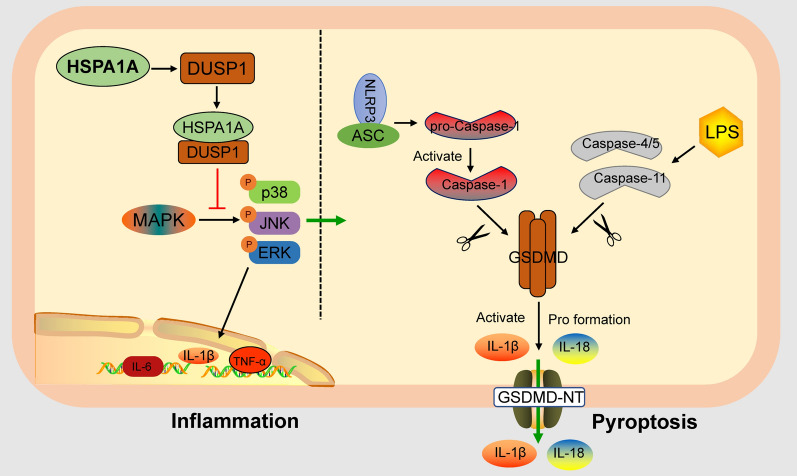 Fig. 1 Schematic diagram of HSPA1A-DUSP1 axis inhibiting MAPK cascade to suppress LPS-triggered inflammation and NLRP3/GSDMD-dependent pyroptosis.1
The biological functions of HSPA1A are focused on polypeptide chaperoning and cytoprotection:
Creative Biolabs offers high-quality HSPA1A proteins through optimized expression systems, including full-length chaperone and isolated ATPase/substrate binding domain variants. These products retain native ATP-dependent refolding chaperone activity, suitable for proteostasis and anti-tumor chaperone inhibitor screening assays. All HSPA1A proteins undergo strict quality control to ensure consistent performance across diverse research platforms.
Not finding the membrane protein product you need? Contact us to start your one-stop custom service!
Creative Biolabs provides custom-engineered HSPA1A stable cell lines, including overexpression and blank control models. These cell lines are optimized for stress chaperone profiling and apoptotic signal functional analysis. Each cell line undergoes stringent validation to ensure stable expression profiles after repeated stress induction.
Not finding the stable cell line product you need? Contact us to start your one-stop custom service!
High-specificity recombinant antibodies targeting HSPA1A are developed via advanced antibody engineering technologies, with no cross-reactivity with constitutive HSC70 homologs. These antibodies are validated for cytoplasmic/nuclear stress expression profiling, and can be combined with misfolded protein markers to analyze HSPA1A chaperone complexes in stressed cell models.
Not finding the recombinant antibody product you need? Contact us to start your one-stop custom service!
Beyond catalog products, Creative Biolabs offers specialized custom services for HSPA1A research:
HSPA1A is stress-inducible HSP70 chaperone that uses ATP energy to refold misfolded proteins and suppress cell apoptosis.
HSPA1A mediates cellular stress resistance and drives tumor chemoresistance, a key target for chaperone-targeted anti-cancer therapy.
No, all HSPA1A products and services are strictly for research use only, not intended for clinical diagnosis or treatment.
Offerings include full-length HSPA1A chaperone proteins, isoform-specific antibodies and custom stable cell lines for stress research.
HSPA1A proteins are validated via ATP-dependent polypeptide refolding functional testing.