
Creative Biolabs is offering the most comprehensive services for antibody development projects. With strict regulation and effective execution, we are dedicated to providing the most valuable solutions to complete your projects.
HighlightsCreative Biolabs is offering the most comprehensive services for antibody development projects. With strict regulation and effective execution, we are dedicated to providing the most valuable solutions to complete your projects.
HighlightsCreative Biolabs has established a broad range of platforms for developing novel antibodies or equivalents. These cutting-edge technologies enable our scientists to meet your demands from different aspects and tailor the most appropriate solution that contributes to the success of your projects.
HighlightsWith deep understanding in antibody-related realms and extensive project experience, Creative Biolabs offers a variety of references to help you learn more about our capacities and achievements, including infographic, flyer, case study, peer-reviewed publications, and all kinds of knowledge that can assist your projects. You are also welcome to contact us directly for more specific solutions.
HighlightsGet a real taste of Creative Biolabs, one of the most professional custom service providers in the world. We are committed to providing highly customized comprehensive solutions with the best quality to advance your projects.
Highlights Loading...
All listed services and products are For Research Use Only. Do Not use in any diagnostic or therapeutic applications.
Metabotropic glutamate receptor 5 (mGluR5) is a prototypical metabotropic glutamate receptor: GRM5 gene on human chromosome 11q14. Expression of mGluR5 is highest in the cerebral cortex, hippocampus, striatum, nucleus accumbens and amygdala but is also low in cerebellum, thalamus and spinal cord. Super-resolution microscopy has demonstrated that mGluR5 is enriched at dendritic spines while largely excluded from the core postsynaptic density, instead localizing to peripheral perisynaptic nanodomains, where it can be activated by glutamatergic spillover without requiring close proximity to synapses. Studies show that mGluR5 aberrant signalling can be involved in a remarkably large number of CNS diseases in pathological context.
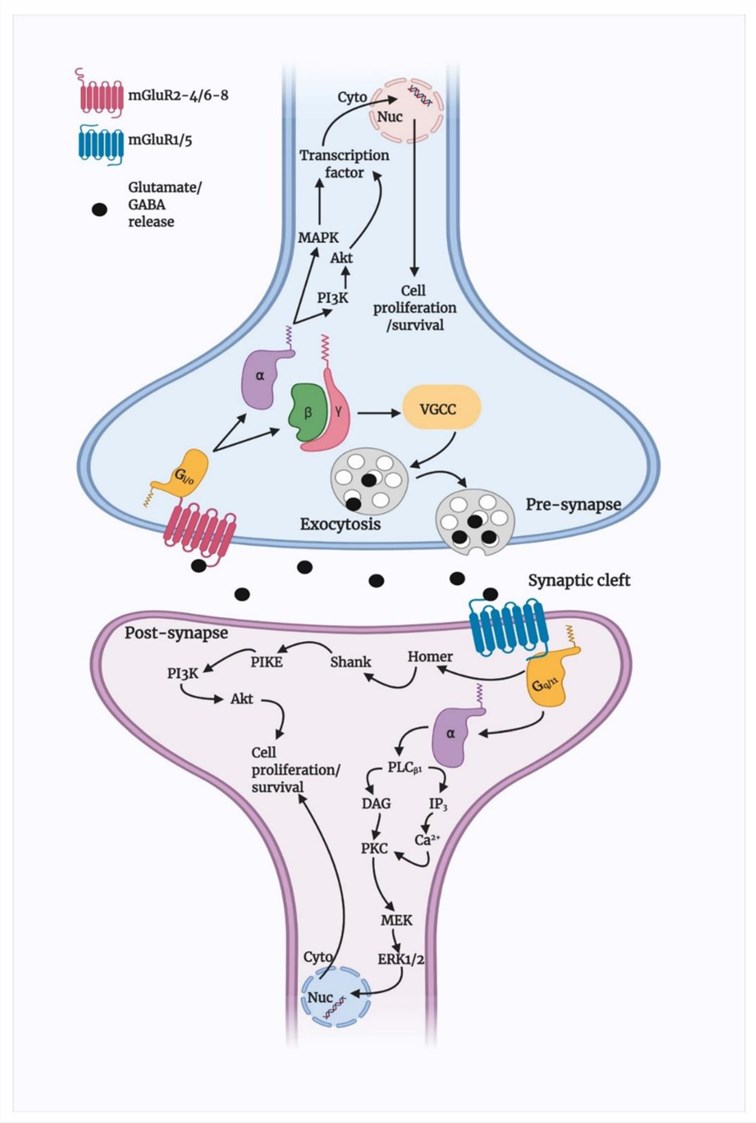 Fig.1 Schematic presentation of mGluRs cell signalling pathways.1
mGluR5 functional spectrum spans multiple domains of neurophysiology and neuropathology:
Biophysical characterization of mGluR5 faces unique challenges due to its obligate dimerization, large extracellular domain and conformational flexibility along the VFT–CRD–7TM axis. To this end, Creative Biolabs has developed a proprietary custom mGluR5 protein design platform that provides conformationally intact receptor preparations for structural biology, ligand-binding studies and therapeutic antibody development. We utilize cryo-EM–guided structural insights as well as codon-optimized gene synthesis, and proprietary detergent-screening protocols in our engineering work to identify constructs that provide maximal yield while retaining the glutamate-binding cleft along with the dimerization interface and allosteric pockets. Each project starts with a detailed science briefing to match protein design with your desired application.
Not finding the membrane protein product you need? Contact us to start your one-stop custom service!
Cellular steady-state models expressing correctly-dimerized, functional mGluR5 at the plasma membrane are essential for significant calcium flux assays, allosteric modulator screening and validation of therapeutic antibodies. Creative Biolabs designs custom mGluR5 stable cell lines utilizing optimized transduction and selection protocols to obtain homogeneous, maintained receptor expression. With our cell engineering platform, we use lentiviral delivery combined with transposon-mediated integration and targeted knock-in methods to ensure precise regulation of gene expression. All lines go through a monoclonal selection on single cells for clonal purity and are phenotyped.
Not finding the stable cell line product you need? Contact us to start your one-stop custom service!
Antibodies with high-affinity and defined sequence against mGluR5 are critical for the detection of the receptor in native brain tissue, separation of intracellular from surface pools, and modulation of receptor trafficking. Creative Biolabs provides end-to-end programs for the discovery of recombinant antibodies directed against mGluR5 (the VFT domain, extracellular loops or intracellular C-terminal). Our antibody discovery pipeline combines immunogen design, multi-platform selection and downstream engineering to provide binders with right specificity, affinity and developability profiles for research. With recombinant expression and clonal sequencing we remove the batch-to-batch variability that is associated with traditional polyclonal sera providing you a renewable, fully characterized reagent.
Not finding the recombinant antibody product you need? Contact us to start your one-stop custom service!
More than a standard catalog, Creative Biolabs provides powerful discovery services across the entire mGluR5 research continuum. Our scientists work actively with clients to convert experimental hypotheses into projects that can be done:
No. All the mGluR5 proteins, cell lines, antibodies and custom services from Creative Biolabs are for research use only. They have not yet been validated, cleared or approved for human diagnostic, therapeutic or prophylactic use.
We can provide or develop antibodies for mGluR5 research according to specific experimental requirements. Antibody epitope recognition, application suitability, and any ability to distinguish receptor conformational states should be determined based on clone-specific validation data. These reagents may support mGluR5 detection and localization studies in appropriate research systems.
We can develop customized mGluR5 stable expression or signaling cell models according to specific research requirements. The appropriate G-protein background, reporter or signaling readout, and functional characterization strategy can be selected based on the intended study, including research on agonists, antagonists, and allosteric modulators.
Yes, we produce recombinant proteins and stable cell lines expressing known variants that affect allosteric modulator sensitivity or G-protein coupling selectivity.








