Creative Biolabs is offering the most comprehensive services for antibody development projects. With strict regulation and effective execution, we are dedicated to providing the most valuable solutions to complete your projects.
HighlightsCreative Biolabs is offering the most comprehensive services for antibody development projects. With strict regulation and effective execution, we are dedicated to providing the most valuable solutions to complete your projects.
HighlightsCreative Biolabs has established a broad range of platforms for developing novel antibodies or equivalents. These cutting-edge technologies enable our scientists to meet your demands from different aspects and tailor the most appropriate solution that contributes to the success of your projects.
HighlightsWith deep understanding in antibody-related realms and extensive project experience, Creative Biolabs offers a variety of references to help you learn more about our capacities and achievements, including infographic, flyer, case study, peer-reviewed publications, and all kinds of knowledge that can assist your projects. You are also welcome to contact us directly for more specific solutions.
HighlightsGet a real taste of Creative Biolabs, one of the most professional custom service providers in the world. We are committed to providing highly customized comprehensive solutions with the best quality to advance your projects.
Highlights Loading...
All listed services and products are For Research Use Only. Do Not use in any diagnostic or therapeutic applications.
Mitochondrial ribosome recycling factor (MRRF) is a soluble matrix polypeptide encoded by the MRRF gene, exclusively localized within mitochondrial matrix compartments and categorized as a dedicated rescue protein for post-termination mitoribosome assemblies. MRRF carries conserved ribosome-binding structural motifs and is ubiquitously expressed in all aerobic cell populations with intact mitochondrial organelles, acting as an irreplaceable regulator that separates large and small ribosomal subunits after mRNA translation termination or ribosome stalling. MRRF-mediated subunit dissociation is a prerequisite for cyclic mitochondrial peptide synthesis, without which respiratory chain precursor production will be severely suppressed and cellular energy metabolism disrupted.
MRRF exerts full translational recycling regulatory effects through high-affinity docking on the inter-subunit cleft of finished mitoribosome complexes, a structural binding mode that disrupts ribosomal contact surfaces without additional cofactor consumption. Unlike cytoplasmic ribosome recycling proteins with broad mRNA substrate compatibility, MRRF only recognizes mitochondria-encoded transcript ribosomal assemblies; loss of functional MRRF leads to persistent trapped ribosome-mRNA complexes inside matrix, uncoupling cyclic organelle translation from continuous supply of oxidative phosphorylation subunits. This dual regulatory characteristic precisely controls mitochondrial translational turnover under physiological energy demands, while MRRF downregulation or structural mutation impairs organelle peptide synthesis and weakens cellular ATP generation capacity. MRRF participates in a broad range of physiological and pathological processes including cyclic mitoribosome recycling, respiratory complex biogenesis and mitochondrial dysfunction-associated degenerative lesions. Defective MRRF ribosome dissociation activity correlates with tissue hypoxic injury and energy deficiency syndromes, making MRRF an essential research target for mitochondrial translational biology.
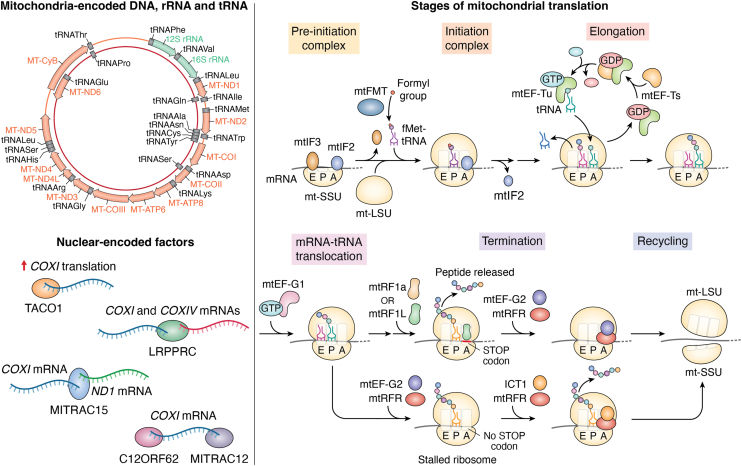 Fig. 1 Complete mitochondrial translation cycle covering initiation, elongation, termination and recycling; mtRFR (MRRF) disassembles both post-termination and stalled mitoribosomal subunits to regenerate ribosome pools for sustained OXPHOS subunit synthesis.1
The biological functions of MRRF are focused on post-termination ribosome disassembly and sustained organelle translational cycling:
Creative Biolabs offers high-quality MRRF proteins through optimized heterologous expression systems, including full-length wild-type MRRF and ribosome-binding motif mutant variants with customized structural modifications. These products retain native mitoribosome docking and dissociation activity, suitable for mitochondrial translation mechanistic research, ribosome-protein interaction detection and energy metabolism regulatory compound screening workflows. All MRRF batches undergo strict quality control to ensure consistent performance and reliable application across diverse mitochondrial research platforms.
Not finding the membrane protein product you need? Contact us to start your one-stop custom service!
Creative Biolabs provides custom-engineered MRRF stable cell lines, including overexpressing and knockdown research models. These cell lines are optimized for investigating mitoribosome disassembly mechanisms and mitochondrial energy metabolism compound potency testing. Each cell line undergoes stringent validation to ensure stable MRRF expression profiles and consistent ribosome recycling functional performance in diverse experimental contexts.
Not finding the stable cell line product you need? Contact us to start your one-stop custom service!
High-specificity recombinant antibodies targeting MRRF are developed via advanced antibody engineering technologies. These antibodies are validated for multiple applications, including mitochondrial matrix immunofluorescence localization detection, Western blot expression quantification and co-immunoprecipitation analysis of mitoribosome complexes, enabling precise characterization of MRRF expression levels and organelle subcellular distribution under physiological and pathological conditions.
Not finding the recombinant antibody product you need? Contact us to start your one-stop custom service!
Beyond catalog products, Creative Biolabs offers specialized custom services for MRRF research:
MRRF is a mitochondrial ribosome recycling regulatory factor that docks post-termination ribosomal assemblies to dissociate subunits, fine-tunes cyclic mitochondrial translation dynamics, and maintains steady synthesis of oxidative phosphorylation subunits.
MRRF is the sole dedicated mitoribosome rescue factor, and its deficiency disrupts organelle peptide synthesis and cellular energy production. It is a critical core research target for mitochondrial translational biology.
No, all MRRF products and services are strictly for research use only, not intended for clinical diagnosis or treatment.
Offerings include full-length MRRF proteins, high-specificity recombinant antibodies, and custom stable mitochondrial translation reporter cell lines, supporting comprehensive mitochondrial metabolism research projects.
MRRF proteins are validated by mitoribosome subunit dissociation assays to retain native translational recycling regulatory function.