Creative Biolabs is offering the most comprehensive services for antibody development projects. With strict regulation and effective execution, we are dedicated to providing the most valuable solutions to complete your projects.
HighlightsCreative Biolabs is offering the most comprehensive services for antibody development projects. With strict regulation and effective execution, we are dedicated to providing the most valuable solutions to complete your projects.
HighlightsCreative Biolabs has established a broad range of platforms for developing novel antibodies or equivalents. These cutting-edge technologies enable our scientists to meet your demands from different aspects and tailor the most appropriate solution that contributes to the success of your projects.
HighlightsWith deep understanding in antibody-related realms and extensive project experience, Creative Biolabs offers a variety of references to help you learn more about our capacities and achievements, including infographic, flyer, case study, peer-reviewed publications, and all kinds of knowledge that can assist your projects. You are also welcome to contact us directly for more specific solutions.
HighlightsGet a real taste of Creative Biolabs, one of the most professional custom service providers in the world. We are committed to providing highly customized comprehensive solutions with the best quality to advance your projects.
Highlights Loading...
All listed services and products are For Research Use Only. Do Not use in any diagnostic or therapeutic applications.
Protein tyrosine phosphatase receptor D(PTPRD) is a single transmembrane receptor tyrosine phosphatase of LAR subfamily encoded by PTPRD gene, which is mainly enriched in central nervous system neurons and liver parenchymal cells. The protein contains three immunoglobulin domains and eight fibronectin repeats, and the D1 catalytic domain and D2 pseudophosphatase domain are arranged in series in the cell, forming a unique receptor functional framework. Compared with homologous receptor phosphatases such as PTPRF and PTPRS in the same family, PTPRD has dual core regulation ability, which can not only regulate the structural maturation before and after synapse by combining synaptic ligands IL-1Rapl1 and Slitrk family molecules, but also inactivate the oncogene transcription factor STAT3 by specific dephosphorylation, thus playing a key role in cancer suppression. In the physiological stage of neural development, the stable expression of PTPRD can maintain the integrity of synaptic adhesion complex, ensure the orderly construction of neural circuit connection and maintain the steady state of neural behavior. However, in glioblastoma and liver metabolic diseases, the epigenetic silence or truncated mutation of PTPRD will directly lose phosphatase activity, resulting in persistent over-activation of STAT3 signal, which will drive abnormal tumor proliferation and promote the progress of liver steatosis. Other members of LAR subfamily can't compensate PTPRD for its functions of synapse regulation and STAT3 inhibition. Loss of PTPRD can induce neural development defects and spontaneous liver metabolic damage, while overexpression of PTPRD can significantly inhibit STAT3-mediated malignant proliferation of glioma, which is an irreplaceable core target for receptor phosphatase signal regulation and targeted screening of neurotumors and liver metabolic diseases.
PTPRD is anchored on the surface of lipid bilayer of neurons and hepatocytes, and has dual functions of synaptic adhesion regulation and tyrosine dephosphorylation. It relies on extracellular multi-domain combination to achieve cross-synaptic ligand binding and intercellular connection, and relies on intracellular D1 catalytic domain to accurately remove tyrosine phosphorylation residues of STAT3, thus blocking downstream carcinogenesis signal transmission. Its unique STAT3 substrate recognition specificity distinguishes it from other receptor phosphatases, forming a dual regulatory pathway integrating neural development homeostasis and tumor inhibition. PTPRD-mediated dephosphorylation can dynamically balance the synaptic stability of neurons and the carcinogenic transcription activity of cells according to the stress state of cells, and regulate the construction of brain neural circuits and the steady state of liver lipid metabolism as a whole. This molecule is widely involved in physiological and pathological processes such as embryonic synapsis, adult neuroplasticity maintenance and malignant progression of STAT3-dependent glioma. The loss of PTPRD function will relieve the persistent inhibition of STAT3 carcinogenic signal and destroy the orderly construction and remodeling of neural circuits. To sum up, PTPRD is the key target for the study of receptor phosphatase mechanism and the exploration of targeted therapy for glioma and liver diseases.
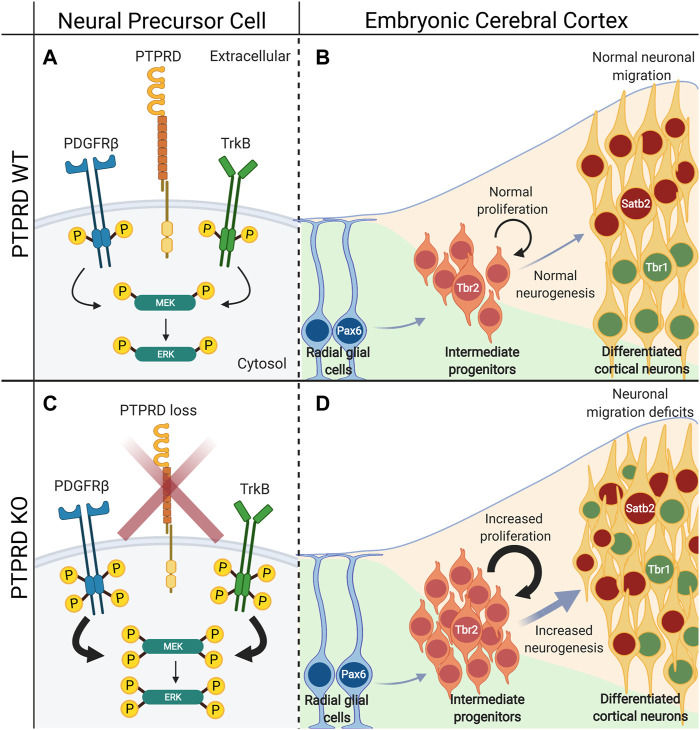 Fig. 1 Four-panel comparative schematic for studying PTPRD phosphatase regulatory function in embryonic cerebral cortical neural progenitor proliferation and neuronal migration.1
The biological functions of multi-domain receptor phosphatase PTPRD are fully focused on trans-synaptic ligand binding and STAT3 dephosphorylation inhibition:
Creative Biolabs offers high-quality PTPRD proteins through optimized neuronal eukaryotic expression systems, including full-length receptor and isolated catalytic D1 domain variants. These products retain native IL1RAPL binding and STAT3 phosphatase dual activity, suitable for glioma and metabolic liver inhibitor screening assays. All PTPRD proteins undergo strict quality control to ensure consistent performance and reliable application across neuroscience research platforms.
Not finding the membrane protein product you need? Contact us to start your one-stop custom service!
Creative Biolabs provides custom-engineered PTPRD stable cell lines, including glioma wild-type re-expression and blank empty vector control models. These cell lines are optimized for RPTP receptor profiling and STAT3 oncogenic signal functional analysis. Each cell line undergoes stringent validation to ensure stable expression profiles during long-term glioma cell culture, and can be widely deployed for large-scale anti-glioma compound screening experiments.
Not finding the stable cell line product you need? Contact us to start your one-stop custom service!
High-specificity recombinant antibodies targeting PTPRD are developed via advanced antibody engineering technologies. These antibodies are validated for neuronal membrane localization detection and glioma/liver tissue expression profiling, and can be combined with STAT3 detection reagents to analyze complete PTPRD inhibitory complexes in neural cell models.
Not finding the recombinant antibody product you need? Contact us to start your one-stop custom service!
Beyond catalog products, Creative Biolabs offers specialized custom services for PTPRD research:
PTPRD is a LAR receptor phosphatase that stabilizes neuronal synapses and dephosphorylates STAT3 to suppress glioma growth.
Epigenetic silencing of PTPRD activates oncogenic STAT3, a key driver of malignant glioma and metabolic liver disease.
No, all PTPRD products and services are strictly for research use only, not intended for clinical diagnosis or human therapeutic trials.
Offerings include full-length receptor phosphatase proteins, isoform-specific detection antibodies and custom stable cell lines for neural tumor research.
PTPRD proteins are validated via STAT3 dephosphorylation and IL1RAPL binding functional testing.