Creative Biolabs is offering the most comprehensive services for antibody development projects. With strict regulation and effective execution, we are dedicated to providing the most valuable solutions to complete your projects.
HighlightsCreative Biolabs is offering the most comprehensive services for antibody development projects. With strict regulation and effective execution, we are dedicated to providing the most valuable solutions to complete your projects.
HighlightsCreative Biolabs has established a broad range of platforms for developing novel antibodies or equivalents. These cutting-edge technologies enable our scientists to meet your demands from different aspects and tailor the most appropriate solution that contributes to the success of your projects.
HighlightsWith deep understanding in antibody-related realms and extensive project experience, Creative Biolabs offers a variety of references to help you learn more about our capacities and achievements, including infographic, flyer, case study, peer-reviewed publications, and all kinds of knowledge that can assist your projects. You are also welcome to contact us directly for more specific solutions.
HighlightsGet a real taste of Creative Biolabs, one of the most professional custom service providers in the world. We are committed to providing highly customized comprehensive solutions with the best quality to advance your projects.
Highlights Loading...
All listed services and products are For Research Use Only. Do Not use in any diagnostic or therapeutic applications.
Receptor transporter 2(RTP2) is an endoplasmic reticulum-resident transmembrane chaperone encoded by RTP2 gene, which is mainly enriched in olfactory sensory neurons and only slightly expressed in taste chemosensory cells. Its core function is to regulate the membrane transport efficiency of G protein-coupled olfactory receptors. Unlike the cofactor RTP1S, which has the function of activating transport, RTP2 can form a heterogeneous complex with RTP1S in endoplasmic reticulum cavity, and partially inhibit and regulate the membrane surface delivery process of olfactory receptor through competitive action. During the normal development of olfactory epithelium, the expression ratio of RTP1S and RTP2 in cells maintains a dynamic balance, which precisely regulates the diversity of olfactory receptors transported to the cilia of neurons, and ensures the body to have broad-spectrum odor recognition and resolution. When RTP2 is abnormally over-expressed, a large number of new olfactory receptor peptides will be retained in the endoplasmic reticulum cavity, which will significantly reduce the receptor abundance on the cilia surface of neurons and directly weaken the olfactory signal transmission efficiency. However, RTP2 knockout can improve the sensitivity of olfactory neurons, but it will greatly reduce the spectrum of volatile chemicals that the body can recognize. Conventional GPCR molecular chaperones can not compensate for the specific transport regulation function of RTP2 in chemosensory cells. The disorder of RTP2 expression is closely related to congenital olfactory hypofunction and age-related olfactory dysfunction, and it is an irreplaceable core target for the study of olfactory GPCR transport mechanism and targeted screening of sensory dysfunction.
RTP2 is anchored on the lipid bilayer of endoplasmic reticulum membrane, which plays an exclusive role as a molecular chaperone of olfactory receptor, forms a heterodimer with RTP1S by virtue of short cytoplasmic interaction motifs, and regulates its intracellular transport process by combining immature olfactory receptor peptides. Its unique competitive inhibition regulation mode and RTP1S, which positively promote receptor transport, form a bimolecular chaperone regulation system for chemoreceptor output. The olfactory receptor retention mechanism mediated by RTP2 can dynamically balance the range of body odor detection and signal perception sensitivity according to the development and differentiation of neurons, and adapt to the physiological development needs of olfactory system. This molecule is mainly involved in the process of maturation and remodeling of olfactory epithelium and fine tuning of peripheral chemical sensory signals. The loss of RTP2 function will break the dynamic balance of olfactory receptor transport and disturb the odor recognition mode and perception spectrum of the body. To sum up, RTP2 is the key core target for the research of olfactory molecular chaperone mechanism and the research and development of targeted therapy for olfactory dysfunction diseases.
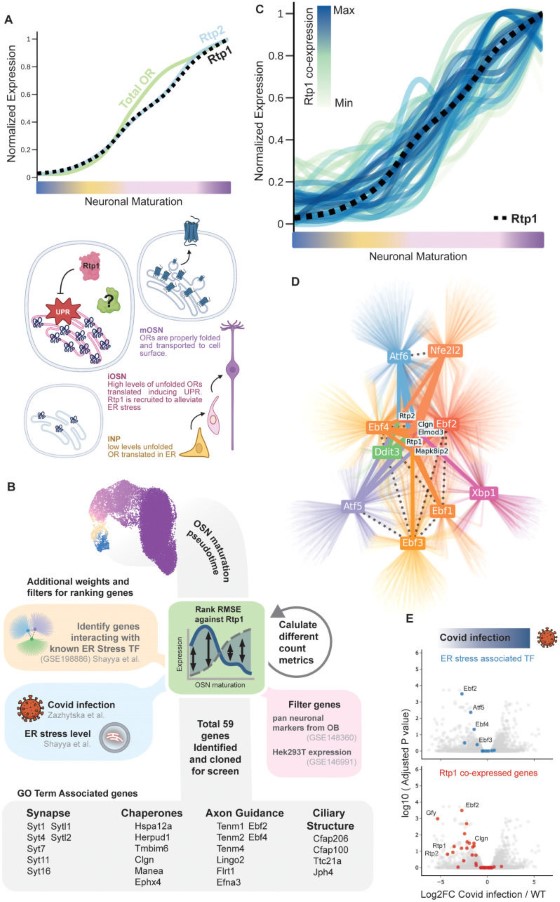 Fig. 1 Multi-omics and signaling schematic of Rtp1/Rtp2 balancing ER stress and olfactory receptor trafficking during OSN maturation.1
The biological functions of RTP2 are fully focused on ER OR binding and competitive trafficking suppression:
Creative Biolabs offers high-quality RTP2 proteins through optimized eukaryotic expression systems, including full-length ER chaperone and isolated OR-binding domain variants. These products retain native odorant receptor interaction activity, suitable for olfactory GPCR trafficking and hyposmia modulator screening assays. All RTP2 proteins undergo strict quality control to ensure consistent performance and reliable application across chemosensory research platforms.
Not finding the membrane protein product you need? Contact us to start your one-stop custom service!
Creative Biolabs provides custom-engineered RTP2 stable cell lines, including overexpression and blank empty vector control models. These cell lines are optimized for olfactory chaperone profiling and odorant signal functional analysis. Each cell line undergoes stringent validation to ensure stable expression profiles during long-term OSN-like cell culture, and can be deployed for olfactory recovery compound screening workflows.
Not finding the stable cell line product you need? Contact us to start your one-stop custom service!
High-specificity recombinant antibodies targeting RTP2 are developed via advanced antibody engineering technologies, with no cross-reactivity with RTP1S co-chaperone protein. These antibodies are validated for olfactory neuron ER localization detection and nasal epithelial tissue expression profiling, and can be combined with odorant receptor marker reagents to analyze intracellular trafficking complexes in chemosensory cell models.
Not finding the recombinant antibody product you need? Contact us to start your one-stop custom service!
Beyond catalog products, Creative Biolabs offers specialized custom services for RTP2 research:
RTP2 is an ER olfactory chaperone that competitively inhibits RTP1S to limit odorant receptor surface trafficking.
RTP2 balances odor detection breadth and sensitivity, its dysregulation directly causes partial loss of smell.
No, all RTP2 products and services are strictly for research use only, not intended for clinical diagnosis or treatment.
Offerings include full-length ER RTP2 chaperones, isoform-specific detection antibodies and custom stable cell lines for olfactory research.
RTP2 proteins are validated via odorant receptor co-binding trafficking functional testing.