
Creative Biolabs is offering the most comprehensive services for antibody development projects. With strict regulation and effective execution, we are dedicated to providing the most valuable solutions to complete your projects.
HighlightsCreative Biolabs is offering the most comprehensive services for antibody development projects. With strict regulation and effective execution, we are dedicated to providing the most valuable solutions to complete your projects.
HighlightsCreative Biolabs has established a broad range of platforms for developing novel antibodies or equivalents. These cutting-edge technologies enable our scientists to meet your demands from different aspects and tailor the most appropriate solution that contributes to the success of your projects.
HighlightsWith deep understanding in antibody-related realms and extensive project experience, Creative Biolabs offers a variety of references to help you learn more about our capacities and achievements, including infographic, flyer, case study, peer-reviewed publications, and all kinds of knowledge that can assist your projects. You are also welcome to contact us directly for more specific solutions.
HighlightsGet a real taste of Creative Biolabs, one of the most professional custom service providers in the world. We are committed to providing highly customized comprehensive solutions with the best quality to advance your projects.
Highlights Loading...
All listed services and products are For Research Use Only. Do Not use in any diagnostic or therapeutic applications.
Solute carrier family 26 member 4 (SLC26A4) is a multi-pass integral membrane anion exchanger encoded by the SLC26A4 gene, constructed with multiple transmembrane helices and cytoplasmic STAS regulatory domain, serving as core transport subunit of epithelial bicarbonate-chloride exchange complexes. SLC26A4 is predominantly expressed in inner ear sensory epithelium, thyroid and renal epithelial cell populations, acting as membrane scaffold to assemble ion exchange complexes and recruit sensory regulatory kinases upon luminal anion gradient stimulation.
SLC26A4 exerts biological activity through oligomeric assembly of membrane transport units, a mechanism stabilizing transepithelial anion gradients and adjusting intracellular sensory signal cascade efficiency. Unlike auxiliary transport subunits, SLC26A4 cannot sustain complete anion exchange flux without intact oligomer conformation and relies on membrane complex assembly for full signal output; it recruits cytoplasmic signal mediators to transporter assemblies, separating luminal anion exchange activity from intracellular sensory epithelial transcription factor activation and maintaining steady sensory tissue homeostatic signals. This dual regulatory mode modulates epithelial sensory responses driven by anion exchange, fine-tunes luminal pH and sensory mediator secretion levels, while persistent defective SLC26A4 transport function disrupts inner ear fluid equilibrium and induces sensory epithelial degenerative lesions. SLC26A4 participates in key physiological and pathological processes covering transepithelial bicarbonate transport, inner ear endolymph homeostasis, thyroid hormone precursor processing and hereditary sensorineural deafness disorders. Impaired SLC26A4 expression or anion exchange capacity disrupts epithelial ion balance and damages sensory cell function, rendering SLC26A4 a core research target for SLC anion transport, inner ear physiology and hereditary hearing loss research.
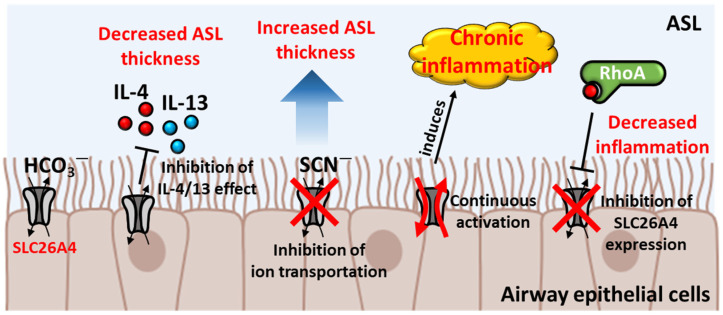 Fig. 1 Regulatory network of SLC26A4 anion transport mediated by IL-4/IL-13 and RhoA in airway epithelium linked to chronic inflammation.1
The biological functions of SLC26A4 are focused on SLC transporter oligomerization, transepithelial anion signal propagation and inner ear epithelial balance:
Creative Biolabs offers high-purity SLC26A4 proteins via optimized heterologous expression workflows, including full-length transporters and isolated STAS cytoplasmic domain variants with adjusted glycosylation profiles. These products retain native membrane folding, suitable for transepithelial anion transport research, transporter complex interaction detection and small molecule sensory protective compound screening. All SLC26A4 proteins pass rigorous quality control including purity profiling and anion exchange functional validation to guarantee intact biological activity.
Not finding the membrane protein product you need? Contact us to start your one-stop custom service!
Creative Biolabs provides custom SLC26A4 stable cell models with overexpression and knockdown phenotypes in sensory, thyroid and renal epithelial cell backgrounds. These cell lines are engineered for research on anion exchanger oligomer assembly, endolymph homeostatic signal cascades and sensory protective compound responsiveness. Each cell model undergoes strict validation of stable expression and complete transport functionality.
Not finding the stable cell line product you need? Contact us to start your one-stop custom service!
High-specificity recombinant antibodies targeting SLC26A4 are generated through optimized antibody engineering pipelines, without cross-reactivity with other SLC26 transporter family subunits. These reagents are validated for immunofluorescence epithelial membrane localization, Western blot expression quantification and co-immunoprecipitation of oligomeric anion exchanger complexes, enabling precise analysis of SLC26A4 expression, subcellular localization and transport function regulation.
Not finding the recombinant antibody product you need? Contact us to start your one-stop custom service!
Beyond catalog products, Creative Biolabs offers specialized custom services for SLC26A4 research:
SLC26A4 is an epithelial SLC26 anion exchanger forming membrane oligomers to mediate bidirectional chloride-bicarbonate exchange, regulate endolymph ionic gradient magnitude, balance inner ear sensory epithelial homeostasis and maintain hair cell function under luminal anion stimulation.
SLC26A4 is the core transporter maintaining inner ear endolymph equilibrium; its functional defects induce sensory hair cell degeneration and hereditary deafness, making it an essential research object for SLC anion transport and hearing loss pathology.
No, all SLC26A4 products and supporting services are developed purely for laboratory research, prohibited for clinical diagnosis or therapeutic application.
The lineup includes full-length and truncated STAS-domain SLC26A4 proteins, target-specific recombinant antibodies, and custom stable epithelial cell lines supporting anion transport and inner ear sensory research.
SLC26A4 proteins undergo oligomeric transporter binding assays and transepithelial anion exchange functional verification to retain native homeostatic regulatory activity in epithelial research.








