Creative Biolabs is offering the most comprehensive services for antibody development projects. With strict regulation and effective execution, we are dedicated to providing the most valuable solutions to complete your projects.
HighlightsCreative Biolabs is offering the most comprehensive services for antibody development projects. With strict regulation and effective execution, we are dedicated to providing the most valuable solutions to complete your projects.
HighlightsCreative Biolabs has established a broad range of platforms for developing novel antibodies or equivalents. These cutting-edge technologies enable our scientists to meet your demands from different aspects and tailor the most appropriate solution that contributes to the success of your projects.
HighlightsWith deep understanding in antibody-related realms and extensive project experience, Creative Biolabs offers a variety of references to help you learn more about our capacities and achievements, including infographic, flyer, case study, peer-reviewed publications, and all kinds of knowledge that can assist your projects. You are also welcome to contact us directly for more specific solutions.
HighlightsGet a real taste of Creative Biolabs, one of the most professional custom service providers in the world. We are committed to providing highly customized comprehensive solutions with the best quality to advance your projects.
Highlights Loading...
All listed services and products are For Research Use Only. Do Not use in any diagnostic or therapeutic applications.
Solute carrier family 6 member 3 (SLC6A3), previously reported as the dopamine transporter (DAT) or DAT1, is a transmembrane protein of approximately 620 amino acids. SLC6A3 expression is restricted to dopaminergic nerve terminals in various regions of the brain including striatum (caudate nucleus, putamen), nucleus accumbens, substantia nigra pars compacta and ventral tegmental area. It is also identified in the retina, where it contributes to hyaloid vascular plexus regression through OPN5-dependent light signaling (cellular and genomic) as well as hypothalamic pituitary and peripheral blood cells. We established pathogenic variants in the dopamine transporter expressed by SLC6A3 as a cause of the autosomal recessive dopaminergic disease, also known as infantile parkinsonism-dystonia. Outside of this unique, monogenic disorder circumstance that can lead to SLC6A3 deficiency in humans, genetic variations at the level of SLC6A3—including well-characterized 40-bp variable number tandem repeat (VNTR) variation within its downstream 3' UTR region—show strong associations with ADHD risk and substance use disorders (cocaine and alcohol dependence), nicotine/tobacco smoking behavior across a wide spectrum of additional psychiatric co-morbidity. The transporter is the primary molecular target of currently available psychostimulant treatments (including methylphenidate, amphetamine and lisdexamfetamine), as well as many drugs of abuse (e.g., cocaine and methamphetamine) making it one of most pharmacologically tractable membrane protein targets in neuropsychiatry.
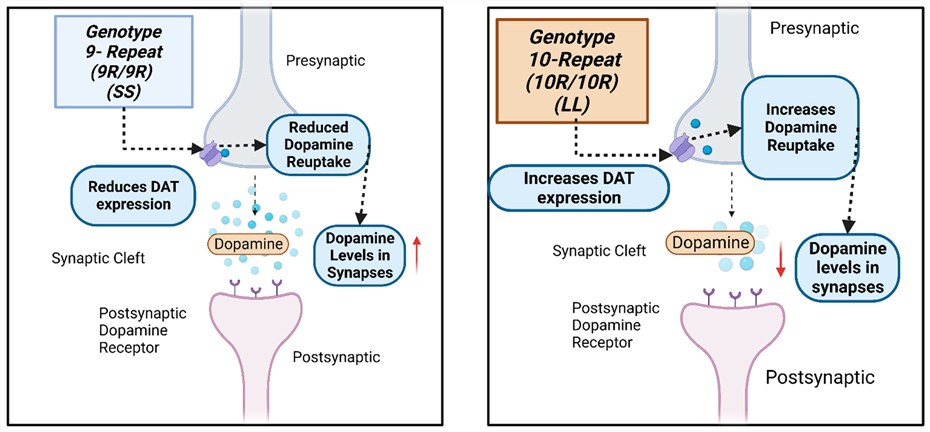 Fig.1 A schematic drawing of the how the SLC6A3 3′UTR VNTR (rs28363170) genetic variant influences dopamine levels at the dopaminergic neuron's postsynaptic and presynaptic regions.1
SLC6A3 exhibits functional diversity over a range of physiological and pathological conditions:
The conformational flexibility of the transporter, as well dependence on native lipid environment to achieve folded state and tendency for aggregation when heterologously expressed all conspire to complicate structural/photopharmacological investigations of SLC6A3. Our purpose-built custom SLC6A3 protein design platform effectively addresses these challenges by providing a security of conformationally intact transporter preparations designed for structural biology, ligand-binding studies, and therapeutic antibody development. Our engineering team incorporates structural insights, along with codon-optimized gene synthesis and proprietary detergent-screening protocols to develop constructs that optimize yield while maintaining sodium-binding, chloride-binding and substrate-binding interfaces. Every engagement starts with a deep technical consultation that matches the protein architecture to your specific application.
Not finding the membrane protein product you need? Contact us to start your one-stop custom service!
For the performance of dopamine uptake and into psychostimulant mechanism-of-action screening and inhibitor studies, reliable cellular models that express functional SLC6A3 at the plasma membrane are essential. Using optimized transduction and selection protocols that produce homogeneous stable lines with sustained transporter expression, Creative Biolabs engineers custom SLC6A3 stable cell lines. It uses lentiviral delivery, transposon ubiquitous integration from stochastic epigenetic modification with functional genomics to achieve precise and targeted genetic regulation. After extensive monoclonal selection to ensure clonal purity, each line is validated phenotypically with robust data confirming both surface transporter densities.
Not finding the stable cell line product you need? Contact us to start your one-stop custom service!
To localize the transporter in native brain tissue and characterize it relative to related monoamine transporters (SERT, SLC6A4; NET, SLC6A2) requires high-affinity sequence-defined antibodies specific for rodent SLC6A3. End-to-end recombinant antibody discovery programs against SLC6A3 mediated by company A for both extracellular and intracellular epitopes. By joining together the pieces of antibody development, from immunogen design to multi-platform selection and finally downstream engineering, delivering binders with the necessary specificity, affinity and developability profiles for R&D/dx/therapeutics. Dispositional variability with traditional polyclonal sera is eliminated by the application of recombinant expression and clonal sequencing to provide you with this fully characterized, renewable reagent.
Not finding the recombinant antibody product you need? Contact us to start your one-stop custom service!
Creative Biolabs goes beyond standard catalog offerings by providing new-age discovery services for all SLC6A3 research needs:
Yes. We develop and implement customized biochemical (dopamine uptake, sodium dependence, psychostimulant competition) and cell-based functional assays (trafficking/ endocytosis/phosphorylation/reverse transport /etc.) according to your specific screening or mechanistic goals.
Yes, we have obtained stable lines with robust surface SLC6A3 expression as shown by flow cytometry. Dose-response analyses from a batch are released with documentation of both dopamine uptake velocity as well as cocaine-inhibitable transport, offering a stable platform for continuous pharmacological evaluation without the need to transiently transfect each time.
Membranous punctate staining along striatal fibers and perikaryal membranes in lightly fixed brain cryosections after antigen retrieval from some selected clones have been validated on archival specimens. The specificity of epitopes across diverse neural tissue contexts is validated by peptide competition and recombinant antigen controls.
Yes, the immunogen targets a highly conserved region across mammalian species ensuring no multiple reagents are required to detect in human as well as mouse and rat brain preparations/cell lysates.