Creative Biolabs is offering the most comprehensive services for antibody development projects. With strict regulation and effective execution, we are dedicated to providing the most valuable solutions to complete your projects.
HighlightsCreative Biolabs is offering the most comprehensive services for antibody development projects. With strict regulation and effective execution, we are dedicated to providing the most valuable solutions to complete your projects.
HighlightsCreative Biolabs has established a broad range of platforms for developing novel antibodies or equivalents. These cutting-edge technologies enable our scientists to meet your demands from different aspects and tailor the most appropriate solution that contributes to the success of your projects.
HighlightsWith deep understanding in antibody-related realms and extensive project experience, Creative Biolabs offers a variety of references to help you learn more about our capacities and achievements, including infographic, flyer, case study, peer-reviewed publications, and all kinds of knowledge that can assist your projects. You are also welcome to contact us directly for more specific solutions.
HighlightsGet a real taste of Creative Biolabs, one of the most professional custom service providers in the world. We are committed to providing highly customized comprehensive solutions with the best quality to advance your projects.
Highlights Loading...
All listed services and products are For Research Use Only. Do Not use in any diagnostic or therapeutic applications.
Solute carrier family 7 member 5 (SLC7A5, also named LAT1) is a light-chain integral amino acid antiporter encoded by SLC7A5 gene, requiring mandatory disulfide linkage with SLC3A2/4F2hc heavy chain to form functional plasma membrane large neutral amino acid transport complexes, widely upregulated in rapidly dividing embryonic, immune and malignant cell populations. SLC7A5 mediates bidirectional exchange antiport: importing essential large neutral amino acids including leucine, phenylalanine and tryptophan from extracellular microenvironments while exporting intracellular small amino acids in a 1:1 exchange stoichiometry independent of ion gradients. Intracellular leucine imported via SLC7A5 acts as a core nutrient ligand to activate mTORC1 kinase signaling, the master regulator of cell cycle progression, protein synthesis and proliferative metabolic reprogramming. Under normal tissue physiological conditions, moderate SLC7A5 expression sustains basal essential amino acid supply to support controlled cell division during tissue repair and immune cell expansion. In tumor microenvironments, SLC7A5 transcription is drastically elevated to satisfy the high amino acid demand of rapidly proliferating malignant clones, continuously fueling mTOR-driven growth and biosynthetic metabolism. Distinct from other SLC7 light chains with narrow tissue distribution, SLC7A5 exhibits broad proliferative cell selectivity and serves as the primary leucine transporter linking nutrient uptake to mTOR nutrient sensing pathways, with no alternative transporter capable of fully replacing its high-capacity large neutral amino acid exchange function. Suppressed SLC7A5 transport activity depletes intracellular leucine pools and inhibits mTOR proliferative signaling to slow tumor growth, while sustained SLC7A5 overexpression accelerates malignant cell division and tumor progression, establishing SLC7A5 as a core research target for amino acid transporter biology and tumor metabolic therapeutic screening.
SLC7A5 executes core heterodimeric antiport function only after forming stable disulfide-bonded complexes with SLC3A2 heavy chain chaperones at cell surface membranes; without SLC3A2 association, SLC7A5 fails to traffic to plasma membranes and remains retained within intracellular endoplasmic reticulum compartments. Conserved transmembrane helical substrate pockets selectively accommodate large neutral hydrophobic amino acid substrates to execute exchange antiport without co-transport of inorganic cations or anions. SLC7A5-mediated leucine influx directly shapes intracellular amino acid availability to tune mTORC1 signal intensity, balancing anabolic protein synthesis and cell cycle progression matching extracellular nutrient abundance. SLC7A5 participates in extensive physiological processes including essential amino acid uptake, mTOR nutrient sensing, lymphocyte proliferation and embryonic tissue growth. Dysregulated SLC7A5 overexpression sustains unrestrained mTOR activation and drives hyper-proliferative malignant phenotypes. Therefore, SLC7A5 represents a pivotal research target for heterodimeric amino acid antiporter study and metabolism-targeted anti-tumor compound discovery.
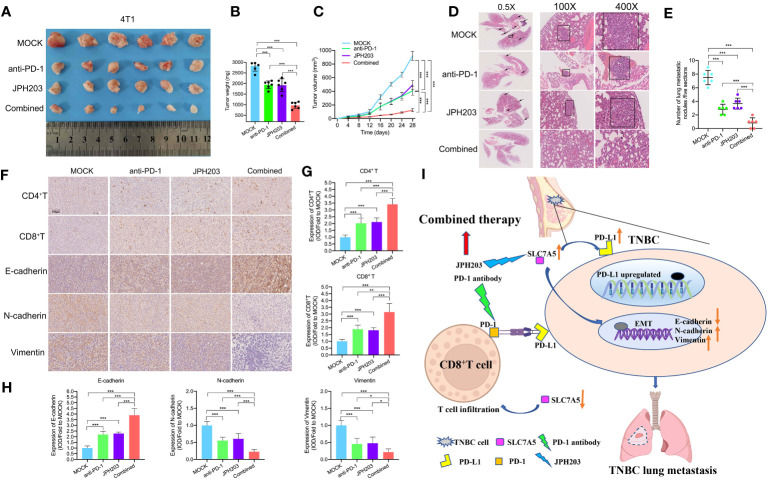 Fig. 1 SLC7A5 inhibitor plus PD‑1 antibody restrains TNBC metastasis via EMT remodeling and enhanced T‑cell infiltration.1
The biological functions of SLC7A5 are focused on SLC3A2 heterodimerization, large neutral amino acid exchange and mTOR proliferative signal tuning:
Creative Biolabs offers high-quality SLC7A5 proteins through optimized expression systems, including full-length light chain transporter and isolated transmembrane substrate pocket variants. These products retain native conformational characteristics and SLC3A2 heterodimerization amino acid antiport biological activity, suitable for amino acid transporter interaction assays and mTOR metabolic modulator screening for oncology research. All SLC7A5 proteins undergo strict quality control to ensure consistent performance and reliable application across diverse research platforms.
Not finding the membrane protein product you need? Contact us to start your one-stop custom service!
Creative Biolabs provides custom-engineered SLC7A5 stable cell lines, including overexpression and blank control models. These cell lines are optimized for large neutral amino acid transport profiling and mTOR nutrient signal functional analysis. Each cell line undergoes stringent validation to ensure stable expression profiles and consistent functional performance in diverse experimental contexts.
Not finding the stable cell line product you need? Contact us to start your one-stop custom service!
High-specificity recombinant antibodies targeting SLC7A5 are developed via advanced antibody engineering technologies, with no cross-reactivity with other SLC7 family light-chain antiporters. These antibodies are validated for cell surface membrane localization detection and proliferative tissue expression profiling, and can be paired with SLC3A2 detection reagents to characterize complete functional amino acid transport heterodimers in tumor and immune cell research models.
Not finding the recombinant antibody product you need? Contact us to start your one-stop custom service!
Beyond catalog products, Creative Biolabs offers specialized custom services for SLC7A5 research:
SLC7A5 is a light-chain antiporter that heterodimerizes with SLC3A2 to support large neutral amino-acid exchange and may influence mTORC1 signaling depending on cellular context.
Tumor-selective upregulation of SLC7A5 sustains anabolic mTOR activity, making it a core metabolic target for anti-proliferative therapeutic screening.
No, all SLC7A5 products and services are strictly for research use only, not intended for clinical diagnosis or treatment.
Offerings include SLC7A5 light chain transporter proteins, isoform-specific detection antibodies and custom stable cell lines for tumor amino acid metabolism research.
SLC7A5 proteins are validated via SLC3A2 heterodimer binding and leucine antiport functional testing.