Creative Biolabs is offering the most comprehensive services for antibody development projects. With strict regulation and effective execution, we are dedicated to providing the most valuable solutions to complete your projects.
HighlightsCreative Biolabs is offering the most comprehensive services for antibody development projects. With strict regulation and effective execution, we are dedicated to providing the most valuable solutions to complete your projects.
HighlightsCreative Biolabs has established a broad range of platforms for developing novel antibodies or equivalents. These cutting-edge technologies enable our scientists to meet your demands from different aspects and tailor the most appropriate solution that contributes to the success of your projects.
HighlightsWith deep understanding in antibody-related realms and extensive project experience, Creative Biolabs offers a variety of references to help you learn more about our capacities and achievements, including infographic, flyer, case study, peer-reviewed publications, and all kinds of knowledge that can assist your projects. You are also welcome to contact us directly for more specific solutions.
HighlightsGet a real taste of Creative Biolabs, one of the most professional custom service providers in the world. We are committed to providing highly customized comprehensive solutions with the best quality to advance your projects.
Highlights Loading...
All listed services and products are For Research Use Only. Do Not use in any diagnostic or therapeutic applications.
SUN domain protein 1(SUN1) is an inner nuclear membrane integration protein encoded by SUN1 gene, which is widely expressed in somatic cells and meiotic germ cells, firmly anchored on the lipid bilayer of the inner nuclear membrane, and its conserved C-terminal SUN domain extends into the perinuclear space to function. Different from the homologous protein SUN2 with biased tissue expression, SUN1 is the core scaffold component of the nuclear skeleton-cytoskeleton junction complex (LINC), which can physically bridge the nuclear fiber layer skeleton with cytosolic actin and microtubule network through the homotrimer structure combined with the outer nuclear membrane KASH domain protein. Under the physiological homeostasis of somatic cells, the basic expression of SUN1 can maintain the morphological stability of the nucleus, transmit mechanical signals across the nuclear envelope, and help the adaptive adjustment of cell migration and tissue tension. In the process of mammalian spermatogenesis and oogenesis, the expression of SUN1 is significantly up-regulated, which specifically anchors meiotic telomeres to the surface of the inner nuclear membrane, ensuring the accurate pairing of homologous chromosomes and the orderly progress of synapsis. SUN2 can't compensate the function of LINC complex assembly and telomere anchoring in meiosis led by SUN1. SUN1 knockout will completely destroy nuclear mechanical signal conduction, cause meiosis arrest and lead to reproductive infertility. SUN1 gene mutation can also induce tissue degeneration of fibromatoid disease, making it the core research target for targeted screening of nuclear envelope biology and reproductive development diseases.
SUN1 is anchored in the inner nuclear membrane structure system, which mainly plays the role of LINC complex-mediated nuclear-skeleton coupling regulation, and forms a high affinity binding with KASH domain protein of outer nuclear membrane by virtue of the conserved SUN trimerization motif at the C-terminal. Its unique meiotic telomere binding ability forms a clear functional differentiation with SUN2, which endows it with exclusive germ cell chromosome regulation function. The perinuclear bridging pathway mediated by SUN1 can link the stability of nuclear fiber layer with the dynamic changes of cytoplasmic cytoskeleton, and dynamically regulate the morphological structure of nuclear and the arrangement order of meiotic chromosomes according to the process of cell cycle. This protein is widely involved in somatic mechanical signal transduction, meiosis of gametes and degenerative injury of tissues related to fibrotic disease. The loss of SUN1 function will completely block the assembly of LINC complex and inhibit the meiotic association process of homologous chromosomes. To sum up, SUN1 is the key target of nuclear envelope protein mechanism research and infertility targeted therapy exploration.
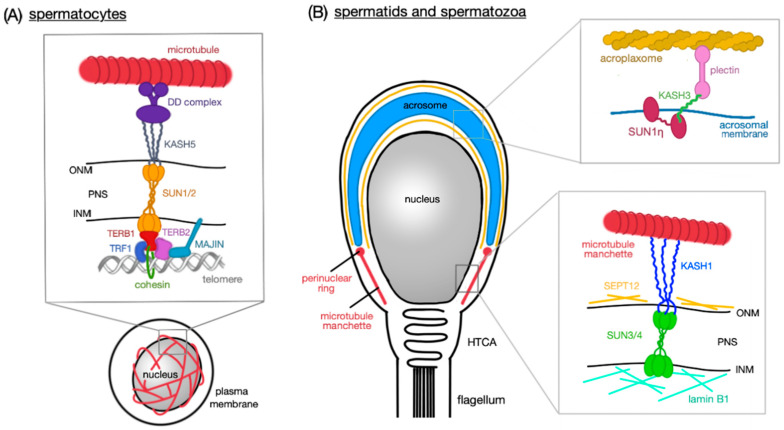 Fig. 1 Graphical Abstract Schematic (A-B): Stage-specific SUN1-containing LINC complexes regulating meiotic telomere bouquet formation in spermatocytes and acrosome-nucleus linkage during spermiogenesis.1
The biological functions of SUN1 are fully focused on LINC trimer assembly and meiotic chromosome tethering:
Creative Biolabs offers high-quality SUN1 proteins through optimized eukaryotic expression systems, including full-length inner membrane protein and isolated SUN domain trimerization variants. These products retain native KASH-binding and telomere-interacting biological activity, suitable for LINC complex and meiotic functional screening assays. All SUN1 proteins undergo strict quality control to ensure consistent performance and reliable application across diverse research platforms.
Not finding the membrane protein product you need? Contact us to start your one-stop custom service!
Creative Biolabs provides custom-engineered SUN1 stable cell lines, including overexpression and blank empty vector control models. These cell lines are optimized for nuclear envelope scaffold profiling and meiotic signal functional analysis. Each cell line undergoes stringent validation to ensure stable expression profiles during long-term continuous cell culture, and can be utilized for mechanotransduction high-throughput compound screening.
Not finding the stable cell line product you need? Contact us to start your one-stop custom service!
High-specificity recombinant antibodies targeting SUN1 are developed via advanced antibody engineering technologies, with no cross-reactivity with SUN2 paralogous nuclear envelope proteins. These antibodies are validated for inner nuclear membrane localization detection and gonadal/somatic tissue expression profiling, and can be combined with lamin/KASH marker reagents to analyze intact LINC complexes in cell models.
Not finding the recombinant antibody product you need? Contact us to start your one-stop custom service!
Beyond catalog products, Creative Biolabs offers specialized custom services for SUN1 research:
A1: SUN1 is an inner nuclear membrane SUN-domain protein that trimerizes to bind KASH proteins, forming LINC complexes and anchoring meiotic telomeres.
A2: SUN1 governs nuclear mechanical stability and gamete meiosis, its loss directly causes mammalian infertility and laminopathic tissue damage.
A3: No, all SUN1 products and services are strictly for research use only, not intended for clinical diagnosis or human therapeutic trials.
A4: Offerings include full-length nuclear SUN1 proteins, isoform-specific detection antibodies and custom stable cell lines for nuclear envelope and germ cell research.
A5: SUN1 proteins are validated via KASH protein co-binding and SUN homotrimerization functional testing.