Creative Biolabs is offering the most comprehensive services for antibody development projects. With strict regulation and effective execution, we are dedicated to providing the most valuable solutions to complete your projects.
HighlightsCreative Biolabs is offering the most comprehensive services for antibody development projects. With strict regulation and effective execution, we are dedicated to providing the most valuable solutions to complete your projects.
HighlightsCreative Biolabs has established a broad range of platforms for developing novel antibodies or equivalents. These cutting-edge technologies enable our scientists to meet your demands from different aspects and tailor the most appropriate solution that contributes to the success of your projects.
HighlightsWith deep understanding in antibody-related realms and extensive project experience, Creative Biolabs offers a variety of references to help you learn more about our capacities and achievements, including infographic, flyer, case study, peer-reviewed publications, and all kinds of knowledge that can assist your projects. You are also welcome to contact us directly for more specific solutions.
HighlightsGet a real taste of Creative Biolabs, one of the most professional custom service providers in the world. We are committed to providing highly customized comprehensive solutions with the best quality to advance your projects.
Highlights Loading...
All listed services and products are For Research Use Only. Do Not use in any diagnostic or therapeutic applications.
Uridine diphosphate glucuronosyltransferase 1A4 (ugt1a4) is an endoplasmic reticulum II detoxification metabolic enzyme encoded by the UGT1A gene cluster. Located in the membrane structure of liver microsomes, it is a key functional subtype that specifically mediates the glucuronidation modification of nitrogen-containing substrates. Different from UGT1A1 and UGT1A9 subtypes, which mainly catalyze o-glucuronidation reaction, ugt1a4 has a unique substrate preference and mediates N-glucuronidation modification of tertiary amines, nitrogen-containing drugs and endogenous steroids. The enzyme uses UDP glucuronic acid as a common co substrate, which can catalyze the conversion of fat soluble exogenous substances into water-soluble derivatives, greatly improving the efficiency of bile and urine excretion of substances. Under the physiological homeostasis of liver, the basic expression of UGT1A4 can continuously eliminate nitrogen-containing drugs and endogenous hormones in the body, avoid the accumulation of toxic substances, and maintain the metabolic homeostasis of the body. However, in the state of liver cirrhosis or inflammatory liver injury, the catalytic activity of UGT1A4 is significantly decreased, which leads to the slow rate of drug metabolism clearance and greatly increases the risk of adverse drug reactions. At the same time, the abnormal expression of UGT1A4 in tumor tissue can change the metabolic bioavailability of targeted drugs such as tamoxifen, and directly affect the clinical therapeutic effect of breast cancer. Other subtypes of UGT1A4 can't compensate the unique catalytic function of N- glucuronidation, and the polymorphism of UGT1A4 gene can directly cause individual drug metabolism phenotypes differences, which is an irreplaceable core target for drug metabolism enzymology research, screening of hepatoprotective compounds and clinical pharmacokinetics research.
UGT1A4 is anchored on the lipid bilayer of liver endoplasmic reticulum microsomes, which specifically plays the role of amine substrate glucuronosyltransferase, and accurately catalyzes the specific N- conjugate modification reaction by relying on the conservative co-substrate binding pocket and nitrogen-containing substrate recognition domain. Its unique substrate pocket structure determines its catalytic characteristics of favoring nitrogen-containing substrates, and forms a clear functional differentiation with other UGT family enzymes modified by targeted oxygen atoms, thus constructing a branch pathway for detoxification and metabolism of amine foreign bodies. The N- glucuronidation process mediated by UGT1A4 can effectively link the drug intake of liver with the subsequent bile and urine excretion process, and can dynamically regulate the toxic load of exogenous poisons and endogenous hormones according to the functional status of liver, thus maintaining the systemic metabolic balance. This molecule is widely involved in clinical drug biotransformation, endogenous steroid clearance and metabolic disorder mediated by liver injury. The functional activity defect of UGT1A4 will significantly block the detoxification and metabolism process of nitrogen-containing drugs and increase the risk of chemical toxicity accumulation. To sum up, UGT1A4 is the key target for studying the mechanism of drug metabolizing enzymes and exploring clinical drug targeted therapy.
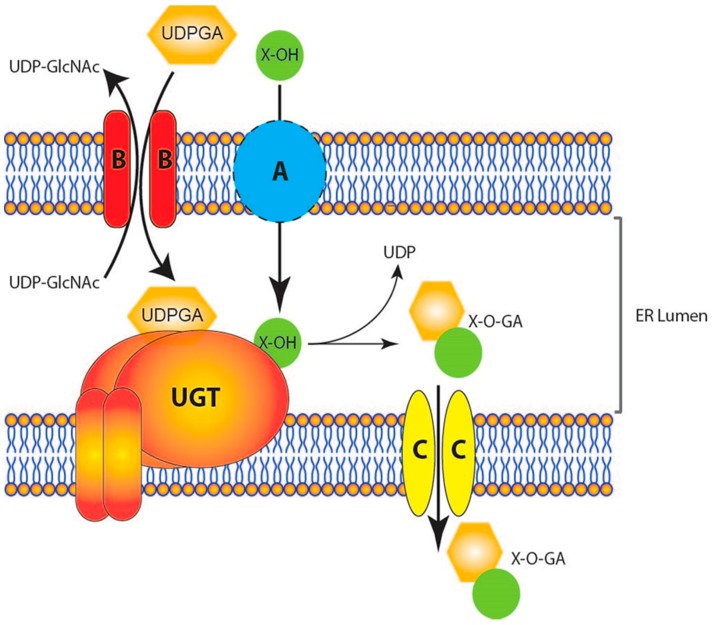 Fig. 1 Schematic of endoplasmic reticulum-resident UGT-mediated glucuronidation. Lipophilic substrates enter the ER lumen and undergo conjugation with UDPGA. While this diagram illustrates typical O-glucuronidation, UGT1A4 possesses a unique substrate pocket enabling selective N-glucuronidation of nitrogen-containing compounds to facilitate systemic clearance.1
The biological functions of UGT1A4 are fully focused on tertiary amine selective N-glucuronide conjugation:
Creative Biolabs offers high-quality UGT1A4 proteins through optimized hepatic eukaryotic expression systems, including full-length microsomal detox enzyme and isolated substrate binding domain variants. These products retain native N-glucuronidation catalytic activity, suitable for drug metabolic interaction and hepatoprotective screening assays. All UGT1A4 proteins undergo strict quality control to ensure consistent performance across pharmacology research platforms.
Not finding the membrane protein product you need? Contact us to start your one-stop custom service!
Creative Biolabs provides custom-engineered UGT1A4 stable cell lines, including hepatic mimic overexpression and blank empty vector control models. These cell lines are optimized for microsomal drug-metabolizing enzyme profiling and amine clearance functional analysis. Each cell line undergoes stringent validation to ensure stable expression profiles during long-term hepatocyte culture, and can be deployed for new drug metabolic screening workflows.
Not finding the stable cell line product you need? Contact us to start your one-stop custom service!
High-specificity recombinant antibodies targeting UGT1A4 are developed via advanced antibody engineering technologies, with no cross-reactivity with O-conjugating UGT1A1/UGT1A9 isoforms. These antibodies are validated for liver ER microsome localization detection and hepatic tissue expression profiling, and can be combined with cytochrome P450 marker reagents to analyze full phase I/II drug metabolic complexes in hepatocyte models.
Not finding the recombinant antibody product you need? Contact us to start your one-stop custom service!
Beyond catalog products, Creative Biolabs offers specialized custom services for UGT1A4 research:
UGT1A4 is hepatic ER phase II enzyme that selectively catalyzes N-glucuronidation of amine drugs and endogenous steroid molecules.
UGT1A4 governs clearance of numerous clinical psychotropic/anti-tumor drugs, critical for preclinical ADME and liver disease research.
No, all UGT1A4 products and services are strictly for research use only, not intended for clinical diagnosis or treatment.
Offerings include full-length UGT1A4 metabolic enzymes, isoform-specific detection antibodies and custom stable cell lines for drug metabolism research.
UGT1A4 proteins are validated via midazolam N-glucuronidation catalytic functional testing.