Photoaffinity Labeling (PAL) Service for Target Screening
PAL Introduction PAL Application Our PAL Services Why Choose Us? Request a quotation FAQs Related Services
The inherent complexities of the drug discovery process, including prolonged development timelines, imprecise protein target identification, and the imperative for interaction validation, represent significant challenges within the biopharmaceutical sector. At Creative Biolabs, we are confident in unlocking hidden protein interactions and accelerating your research with our photoaffinity labeling expertise. Our PAL service helps you accelerate drug discovery by precisely and unequivocally identifying and validating small molecule-protein interactions. We achieve this through the application of advanced photoaffinity labeling technology combined with cutting-edge mass spectrometry platforms, offering a robust and reliable solution for target deconvolution and mechanism of action studies.
Introduction to Photoaffinity Labeling Technology
PAL is a powerful biochemical proteomics technique used to investigate and map the interactions between a small molecule and its biological targets directly within a native cellular environment. Unlike traditional affinity chromatography, which can suffer from non-specific interactions, PAL employs a photoreactive probe that, upon exposure to ultraviolet (UV) light, forms a stable covalent bond with nearby proteins. This "capture" method allows for the robust identification of both high-affinity and transient interactions, offering a more accurate snapshot of a compound's true protein targets.
This technique is particularly valuable in drug discovery as it can deconvolute the targets of bioactive molecules discovered through phenotypic screens, where the mechanism of action is unknown. By covalently tagging the binding partners, PAL provides a direct link between a small molecule's biological effect and its molecular targets. The integration of PAL with advanced mass spectrometry has transformed the field, enabling the comprehensive and quantitative analysis of the entire cellular proteome, leading to the precise screening and identification of drug targets, which is critical for understanding efficacy and toxicity.
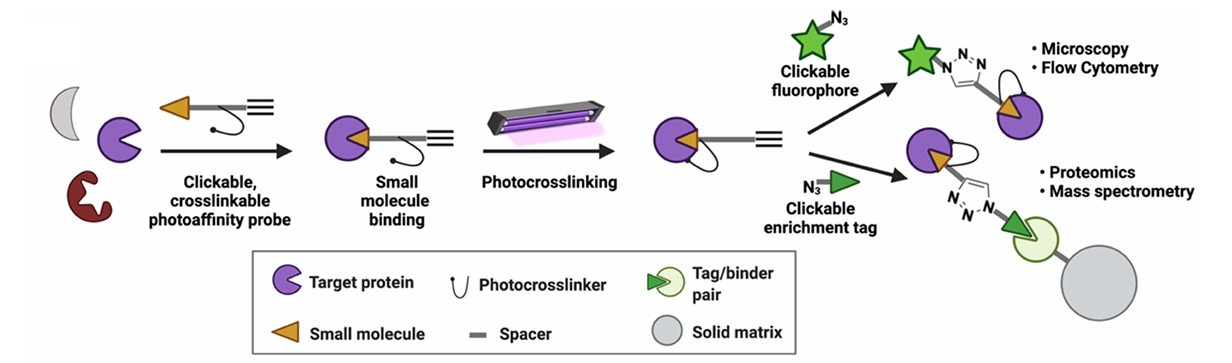 Fig.1 PAL for the detection of protein targets.1
Main Applications of Photoaffinity Labeling
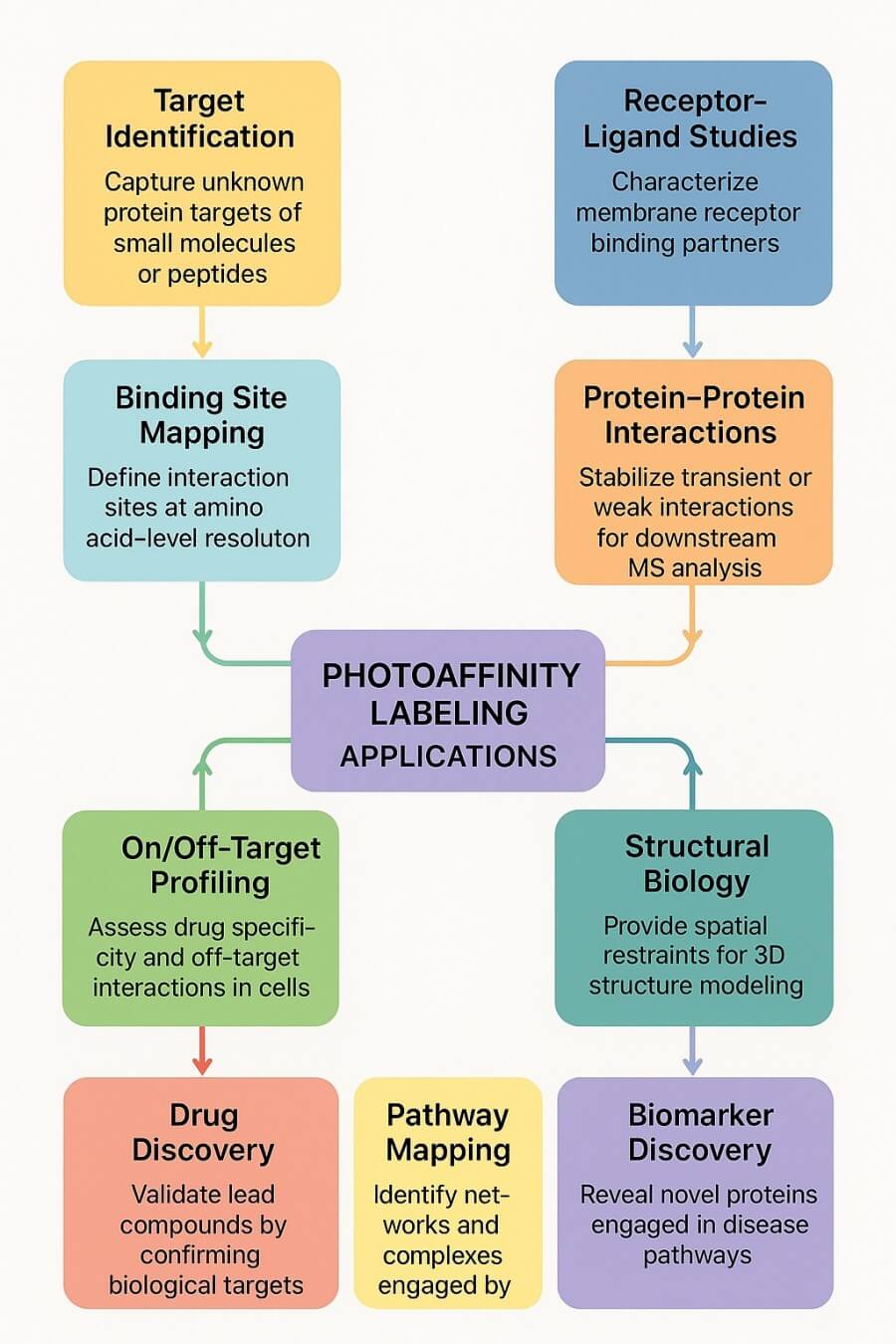
Identify unknown protein targets: Use a photoaffinity probe based on a small molecule of interest (e.g., a drug candidate) to "fish" for its unknown protein targets in a complex biological mixture.
Map binding sites: By using a photoaffinity probe, you can identify the specific amino acid residues on a protein that are in close proximity to the ligand's binding site.
Investigate protein-protein interactions (PPIs): PAL can be used to capture transient or weak PPIs by incorporating a photoreactive unnatural amino acid into one of the proteins.
Elucidate drug mechanisms of action: By labeling the actual target of a drug, you can gain a deeper understanding of how the drug works.
Discover How Creative Biolabs' Photoaffinity Labeling Service Can Help - Request a Consultation
Our Photoaffinity Labeling Service provides a clear path to identifying the on- and off-targets of your small molecule drug candidates. This service is designed to deliver unambiguous, high-confidence data, empowering you to make informed decisions and accelerate your research pipeline. We provide a definitive solution for target deconvolution, even in complex biological systems, allowing you to move from phenotypic screens to validated drug-target pairs with efficiency and confidence.
01Probe Synthesis & Optimization
Custom-synthesize a photoaffinity probe by incorporating a photoreactive group (e.g., diazirine or benzophenone) with/without a reporter tag onto your small molecule. This stage includes rigorous internal validation to ensure the probe retains the parent compound's biological activity and exhibits optimal photoreactivity.
02In Situ Covalent Labeling
The optimized probe is incubated with the provided biological samples (mainly cultured cells or cell lysis). The reaction system is then exposed to UV light, which triggers the photoreactive group to form a stable covalent bond with proteins in close proximity. This process effectively "traps" non-covalent interactions, and can be executed in live cells to preserve native protein-protein interactions and conformational states.
03Target Enrichment
Subsequent to photocross-linking, the samples are lysed, and the probe-labeled proteins are enriched via affinity chromatography. This step efficiently isolates the targets from the complex cellular proteome.
04Mass Spectrometry Analysis
The enriched protein complexes are enzymatically digested into peptides, which are then analyzed using state-of-the-art high-resolution mass spectrometry. This procedure facilitates the accurate identification of proteins that were covalently labeled by the probe.
05Bioinformatic Analysis and Reporting
The raw mass spectrometry data will be exported and analyzed to generate a comprehensive report detailing the identified protein targets, their relative abundance, and the confidence level for each interaction. This includes comparative analysis between treated and control groups to mitigate non-specific binding.
Our PAL Service Highlights
Integrated End-to-End Service
We offer a complete, end-to-end PAL service that covers every phase of your project. From the initial photoaffinity probe design and synthesis to in vitro/in-cell target enrichment and labeling, and finally to mass spectrometry analysis and data interpretation.
Versatile Sample Compatibility
Our PAL services are applicable to purified proteins, cell lysates, live cells, supporting multiple species and complex biological matrices.
Precise Target Identification
Beyond validating known targets, our PAL service excels at identifying new targets and potential off-target effects within complex biological systems.
Flexible and Customized Solutions
Our PAL services are highly customized to meet your specific needs. Whether you're targeting a specific protein for screening or exploring a complex signaling pathway, we will work closely with you to develop the most suitable experimental strategy.
Inquire with Us Now for Your Photoaffinity Labeling Research
Our workflow is designed for transparency and is structured to provide a comprehensive, step-by-step approach to small molecule-target interaction analysis. To provide comprehensive and high-quality PAL services, we kindly ask you to provide detailed information about your project. Specifically, please include:
-
Small molecule details: chemical structure (or CAS No.), molecular weight, solubility, bioactivity data, and any available functional groups for probe modification.
-
Photoreactive probe requirements: preferred photo-crosslinker (e.g., diazirine, aryl azide) and affinity tag (e.g., biotin, alkyne).
-
Samples and biological system: type of sample (purified protein, cell lysate, live cells), source species, and relevant conditions.
-
Experimental goals: target identification, binding site mapping, off-target profiling, or mechanism-of-action studies.
-
Controls and references: availability of negative controls, reference compounds, or inactive analogs.
-
Other considerations: expected protein abundance, cell treatment conditions, MS conditions, and downstream analysis requirements (e.g., LC-MS/MS, Western blot validation).
Providing this information will help us prepare a tailored formal quotation and PAL workflow and ensure optimal data quality for your study.
Q&A
-
Q1: How does your Photoaffinity Labeling service compare with traditional methods such as pull-down assays?
A1: Our PAL service offers superior specificity and sensitivity. Unlike pull-down assays, which rely on the stability of non-covalent bonds during washing procedures, our service employs a light-activated probe to create a permanent covalent bond. This ensures that only genuine, proximal binders are captured, providing higher-confidence data and minimizing false positives. We invite you to request a consultation for a detailed discussion of the advantages.
-
Q2: Is your service compatible with my specific small molecule?
A2: Our team possesses extensive experience in synthesizing custom photoaffinity probes for a wide range of small molecules. During our initial consultation, we will conduct a thorough assessment of your compound's structure and properties to formulate an optimal strategy that maintains biological activity while ensuring effective labeling. We encourage you to reach out to discuss your specific requirements.
-
Q3: What if my compound exhibits low binding affinity?
A3: Photoaffinity labeling is uniquely suited for capturing both high- and low-affinity interactions. Since the covalent bond is formed instantaneously upon UV irradiation, it can capture transient or weak interactions that might otherwise be missed by alternative techniques. This renders our service ideal for identifying all potential targets, regardless of binding strength. We would be pleased to provide specific examples of our methodology at your request.
-
Q4: What information is provided upon project completion?
A4: We are committed to complete transparency. Our final deliverables include a comprehensive report, raw mass spectrometry data, and a curated list of validated protein targets with detailed information. This empowers you to confidently advance your research with a clear understanding of your compound's mechanism of action. Please contact us to learn more about our deliverables.
Discover Our More Related Interaction Offerings
Creative Biolabs stands apart as a leader in interaction screening and analysis, distinguished by our robust technological platforms, profound scientific expertise, and commitment to delivering actionable insights. The foundation of our services rests upon rigorous scientific principles and a dedicated focus on accelerating client success. To further support your drug discovery and development efforts, we offer a series of Biomolecular Interaction services designed to provide an end-to-end solution, including but not limited to:
References
-
Kim, Spencer T et al. "Developing Photoaffinity Probes for Dopamine Receptor D2 to Determine Targets of Parkinson's Disease Drugs." ACS chemical neuroscience vol. 13,20 (2022): 3008-3022. doi:10.1021/acschemneuro.2c00544
-
Distributed under an Open Access license CC BY 4.0, only a portion of the original image.
All listed services and products are For Research Use Only. Do Not use in any diagnostic or therapeutic applications.









