Among the non-integrating approaches, episomal plasmid-based reprogramming has emerged as a leading strategy for generating induced pluripotent stem cells (iPSCs) with high efficiency and safety. At Creative Biolabs, we combine years of stem cell expertise with advanced CRO capabilities to deliver precise, reproducible, and regulatory-aligned solutions for our partners worldwide.
In this protocol, we outline every step—from principle to troubleshooting—to help researchers understand how episomal vectors powerfully drive stem cell reprogramming while preserving genomic integrity.
The ability to generate iPSCs from somatic cells has unlocked new opportunities in regenerative medicine, disease modeling, and drug discovery. Traditional viral-based methods, while efficient, raise concerns about insertional mutagenesis and long-term safety. Episomal plasmid reprogramming offers a non-viral, integration-free alternative that preserves the genetic integrity of the host cells while delivering high reprogramming efficiency.
Episomal vectors replicate extrachromosomally and do not integrate into the host genome. This approach offers:
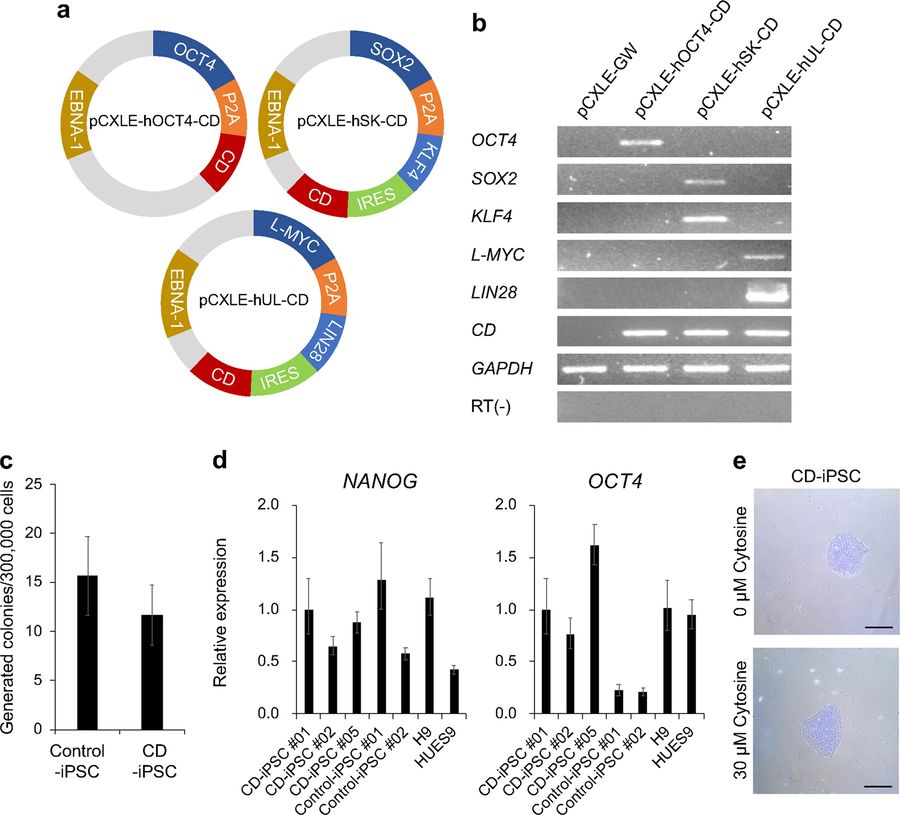 Fig.1 iPSC reprogramming with episomal vectors.1,2
Episomal plasmids are designed to transiently express a set of transcription factors that reprogram somatic cells into iPSCs. The most widely used factors include OCT4, SOX2, KLF4, L-MYC, and LIN28, often supplemented with p53 suppression to enhance efficiency.
| Category | Reagents |
|---|---|
| Somatic cells | Human dermal fibroblasts or PBMCs |
| Episomal plasmids | OCT4, SOX2, KLF4, L-MYC, LIN28, p53 shRNA plasmids |
| Transfection reagent | Nucleofection kit or electroporation buffer |
| Culture medium | Essential 8 (E8) medium or mTeSR1 |
| Substrate | Matrigel or vitronectin-coated plates |
| Antibiotics and supplements | Penicillin-streptomycin, GlutaMAX, non-essential amino acids |
Expand somatic cells to ~70–80% confluency. Ensure cells are healthy, with low passage numbers (<P6 recommended). Detach and count cells, adjusting density for transfection.

Use endotoxin-free plasmid preparations. Confirm plasmid integrity by restriction enzyme digestion and sequencing.
Resuspend ~1 × 10⁶ cells in electroporation buffer. Add episomal plasmids. Electroporate using optimized settings (programs vary by nucleofection system). Immediately transfer cells to vitronectin-coated plates with medium containing ROCK inhibitor.
Maintain cells in E8 medium, changing daily. After ~7–10 days, emerging colonies with ESC-like morphology should appear. Continue culture for 21–28 days until colonies are large enough for picking.
Select colonies with defined borders and high nuclear-to-cytoplasmic ratios. Expand into feeder-free conditions. Validate pluripotency by alkaline phosphatase (AP) staining, immunocytochemistry (ICC) for OCT4, NANOG, TRA-1-60, SSEA4, qPCR for pluripotency markers, and karyotyping to confirm genomic stability.
Below are detailed troubleshooting insights and optimization strategies that we at Creative Biolabs have refined through years of practical experience.
| Problem | Possible Cause | Solution |
|---|---|---|
| Low reprogramming efficiency |
|
|
| High cell death after transfection |
|
|
| Few or abnormal Colonies |
|
|
| Slow growth of emerging colonies |
|
|
| Persistent episome retention beyond passage 15 |
|
|
To truly support our partners, we offer an integrated portfolio of stem cell reprogramming, characterization, and downstream application services. Each service has been carefully designed to help researchers generate high-quality iPSCs.
By partnering with us, you gain more than just a reprogramming service, you access a complete ecosystem of stem cell innovation, regulatory expertise, and customized CRO support.
A: Most colonies begin to emerge within 10–14 days, and stable iPSC lines are typically established in 4–6 weeks. At Creative Biolabs, our optimized workflow ensures predictable timelines and higher reproducibility compared with standard methods.
A: Fibroblasts are the traditional choice, but PBMCs and keratinocytes are now widely used due to accessibility and lower culture adaptation requirements. Creative Biolabs supports reprogramming from multiple primary and immortalized sources.
A: Efficiency varies depending on cell type, plasmid quality, and culture conditions. Fibroblasts usually yield 0.01–0.1% efficiency, while PBMCs often achieve higher rates. Our optimized protocols significantly improve baseline performance.
A: Yes. We provide bespoke episomal vector design, including custom promoters, reporter genes, selection markers, or lineage-specific factors to match unique research goals.
References
Created September 2025
For Research Use Only. Not For Clinical Use.