
Creative Biolabs is offering the most comprehensive services for antibody development projects. With strict regulation and effective execution, we are dedicated to providing the most valuable solutions to complete your projects.
HighlightsCreative Biolabs is offering the most comprehensive services for antibody development projects. With strict regulation and effective execution, we are dedicated to providing the most valuable solutions to complete your projects.
HighlightsCreative Biolabs has established a broad range of platforms for developing novel antibodies or equivalents. These cutting-edge technologies enable our scientists to meet your demands from different aspects and tailor the most appropriate solution that contributes to the success of your projects.
HighlightsWith deep understanding in antibody-related realms and extensive project experience, Creative Biolabs offers a variety of references to help you learn more about our capacities and achievements, including infographic, flyer, case study, peer-reviewed publications, and all kinds of knowledge that can assist your projects. You are also welcome to contact us directly for more specific solutions.
HighlightsGet a real taste of Creative Biolabs, one of the most professional custom service providers in the world. We are committed to providing highly customized comprehensive solutions with the best quality to advance your projects.
Highlights Loading...
All listed services and products are For Research Use Only. Do Not use in any diagnostic or therapeutic applications.
ATP binding cassette subfamily C member 1 (ABCC1), which has long been widely known as MRP1, is a transporter protein responsible for pumping substances out of cells. Its discovery completely broke the previous academic cognitive boundaries of cellular efflux functions, opened up a brand-new direction for research on cellular substance export, and pulled the entire research field into an unexplored new dimension. It was successfully cloned from drug-resistant tumor cell lines in the early 1990s, and was the second core multidrug transporter discovered in humans. Yet as soon as it emerged, it upended the academic community's original understanding of cellular molecular excretion. The established research thread that scholars had managed to piece together based on the first discovered transporter was suddenly broken, and related research became unexpectedly complicated. The first discovered transporter of the same category mainly handled most unmodified hydrophobic substances—molecules that had not undergone any chemical modification inside cells, and which were inherently hydrophobic and more soluble in lipid-like substances. ABCC1 is different: an important class of its substrates is organic anions conjugated with glutathione, glucuronic acid, or sulfate groups. It can also mediate glutathione-dependent transport of some unconjugated substrates. Together, these substrate classes broaden the range of compounds that ABCC1 can recognize and export from cells. ABCC1 can transport a very wide range of physiologically relevant substances: lipid mediators, bile acid derivatives, heavy metal conjugates, and a large number of exogenous xenobiotics—substances not produced endogenously by the human body are all on its transport list. It has long been a core participant in the detoxification processes of protective structures including the liver, kidneys, intestines, and the blood-brain barrier, and it plays a key role in the body's core work of clearing foreign and harmful substances out of cells.
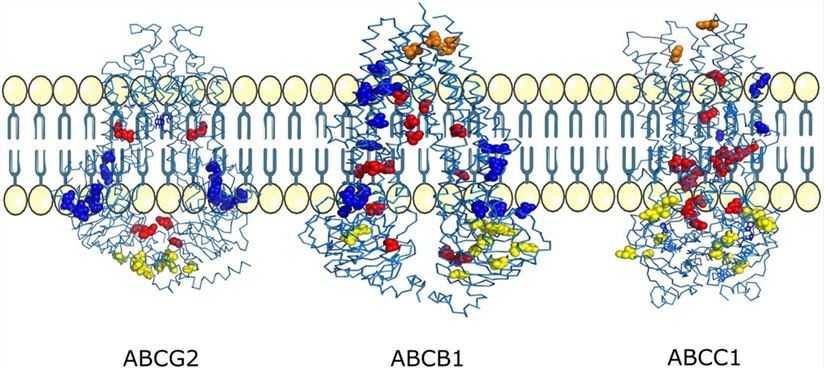 Fig.1 Mutations mapped onto 3D structures of the ABCG2, ABCB1, and ABCC1 transporters.1
Several research currents keep flowing through this transporter:
To reliably prepare ABCC1, you must first acknowledge its complex scale—there are no shortcuts. This protein itself has 17 transmembrane helices and 2 nucleotide-binding domains, and its complex structure means a simplified workflow is entirely unfeasible. If you cut corners to only produce a partial fragment of it, that incomplete protein cannot complete its inherent functional cycle. If the prepared protein misfolds, even if it passes basic size-based detection, it will fail all core functional experiments that generate valid data.We use a specifically optimized eukaryotic expression platform to produce full-length ABCC1. This platform is custom-built for large ABC transporters: it provides exclusive support for the correct folding of ABCC1, matches its unique structural requirements, and sets up corresponding quality checkpoints. Our company also offers engineered ABCC1 variants, enabling researchers to dissect its working mechanism and study its operational logic one link at a time. Every batch of protein products undergoes two rounds of rigorous testing before leaving the facility: SDS-PAGE is used to assess purity and confirm that impurity levels meet requirements; analytical-size exclusion chromatography is used to verify dispersion uniformity, ensuring the protein does not aggregate. If your experiment requires a specific ABCC1 variant background, defined nucleotide conditions, or a preparation format adapted to a particular transport assay, we can adjust the construction scheme to fully align with your experimental workflow—this protein is designed to serve your research.
Not finding the membrane protein product you need? Contact us to start your one-stop custom service!
Cell models used for ABCC1-related research must meet two strict requirements simultaneously: ABCC1 must be expressed at an appropriate level, and it must correctly localize to the cell membrane. ABCC1 is an efflux transporter protein, and a core prerequisite for it to function is that it must successfully reach the cell surface and complete its entire functional cycle normally. Only then can the experimental data generated from it be valid; otherwise, all research will be in vain. Our Wild-type overexpression cell line provides a stable, controllable density of the ABCC1 transporter, which is perfectly suited for studying cellular drug resistance phenotypes or conducting various transport assays. Our engineered ABCC1 variants also allow you to study the separate process of nucleotide binding, isolated from the overall transport cycle, eliminating the trouble of being unable to distinguish the two intertwined processes. Every cell line clone undergoes comprehensive testing before leaving the facility: first, a calibrated standard is used to quantify expression levels on the cell surface, then imaging is used to confirm that ABCC1 is correctly localized and does not mislocalize. If your project requires a specific variant background, a specific protein density level, or a customized expression timeline tocooperate with an exposure experiment protocol, we can customize the cell line to match all your experimental needs—this cell model is built to support the research data you aim to generate.
Not finding the stable cell line product you need? Contact us to start your one-stop custom service!
Developing and using antibodies targeting ABCC1 presents a specificity challenge within the C-branch ABC transporter family because members share conserved regions, particularly within nucleotide-binding domains and portions of membrane domains. If multiple transporters coexist in a sample, antibody cross-reactivity can interfere with quantitative detection. Our recombinant antibody panel includes sequence-defined clones selected for ABCC1 recognition and can be evaluated for applications such as cell lysate detection, cell-surface staining, or localization studies, depending on the clone and sample context. Recombinant production supports consistent reagent identity across batches. If your project requires different antibody conjugates, validation for a specific sample type, or adjustments to the antibody format, these options can be customized to the experimental workflow.
Not finding the recombinant antibody product you need? Contact us to start your one-stop custom service!
Extending well beyond our standard catalog, we deliver fully customizable discovery and manufacturing solutions meticulously tailored to the sophisticated demands of ABCC1-targeted research and precompound development:
Catalog items work well for standard detection or activity workflows. Custom production makes sense when constructs, formats, or quality attributes step beyond routine specifications. A short consultation is usually enough to decide.
Yes. Custom formats and integrated multi-component engagements are routine, with unified quality frameworks keeping specifications aligned across components.
All ABCC1 products and services are provided strictly for preclinical research. They are not designed, validated, or authorized for any use involving human subjects.
Yes. The scientific team stays reachable for assay guidance and troubleshooting for as long as the materials are in use.









