
Creative Biolabs is offering the most comprehensive services for antibody development projects. With strict regulation and effective execution, we are dedicated to providing the most valuable solutions to complete your projects.
HighlightsCreative Biolabs is offering the most comprehensive services for antibody development projects. With strict regulation and effective execution, we are dedicated to providing the most valuable solutions to complete your projects.
HighlightsCreative Biolabs has established a broad range of platforms for developing novel antibodies or equivalents. These cutting-edge technologies enable our scientists to meet your demands from different aspects and tailor the most appropriate solution that contributes to the success of your projects.
HighlightsWith deep understanding in antibody-related realms and extensive project experience, Creative Biolabs offers a variety of references to help you learn more about our capacities and achievements, including infographic, flyer, case study, peer-reviewed publications, and all kinds of knowledge that can assist your projects. You are also welcome to contact us directly for more specific solutions.
HighlightsGet a real taste of Creative Biolabs, one of the most professional custom service providers in the world. We are committed to providing highly customized comprehensive solutions with the best quality to advance your projects.
Highlights Loading...
All listed services and products are For Research Use Only. Do Not use in any diagnostic or therapeutic applications.
ABCC2's alias, "MRP2," may be one of the most informative aliases in membrane transporter history. Researchers assigned this name to the protein after realizing that it was part of a branch of ABC transporters initially identified as being responsible for transporting toxic materials from cells. This alias described the protein as a resistance mechanism, however, its daily role is significantly less complicated. ABCC2 is at the last stage of a large-scale cleaning pathway. It pumps conjugated organic anions from cells into either bile or urine, using energy derived from ATP hydrolysis. It is a large protein, even by membrane-protein standards, a single chain containing approximately 180 kDa of amino acids arranged in an intricate three-part structure. The initial portion of the protein contains an extra transmembrane module that is only present in some members of the ABC family. Next are two transport half-modules, each consisting of a six-helix membrane domain and a nucleotide-binding engine. Between these two half-modules lies a flexible regulatory region that serves as much more than just a passive filler. Of the two nucleotide-binding domains, one is degenerate and cannot hydrolyze ATP. The second domain is active and hydrolyzes ATP. This asymmetry is important for the way in which the entire protein operates. Localization is the other half of the story. ABCC2 is located on the apical surface of polarized epithelial cells: the canalicular membrane of hepatocytes where it pumps conjugated pigments and bile components into bile; the proximal tubule of the kidney; and the brush border of the intestine where it controls the amount of a given compound that can pass through. Additional locations for ABCC2 include the placenta and the luminal surface of the blood-brain barrier. The substrate specificity is wide-ranging: conjugated bilirubin, inflammatory lipid mediators, bile salt sulfates, and numerous xenobiotics. There are naturally occurring loss-of-function variants that cause a well-documented hereditary disorder characterized by abnormal excretion of biliary pigments. Also, there are numerous cataloged variants throughout ABCC2, making it one of the most thoroughly mapped transporters for studying structure/function relationships. Cryo-electron microscopy studies conducted recently were successful in imaging the complete ABCC2 structure in several conformations and provided answers to a long-standing question regarding how one protein can accommodate so many different types of substrates without becoming clogged.
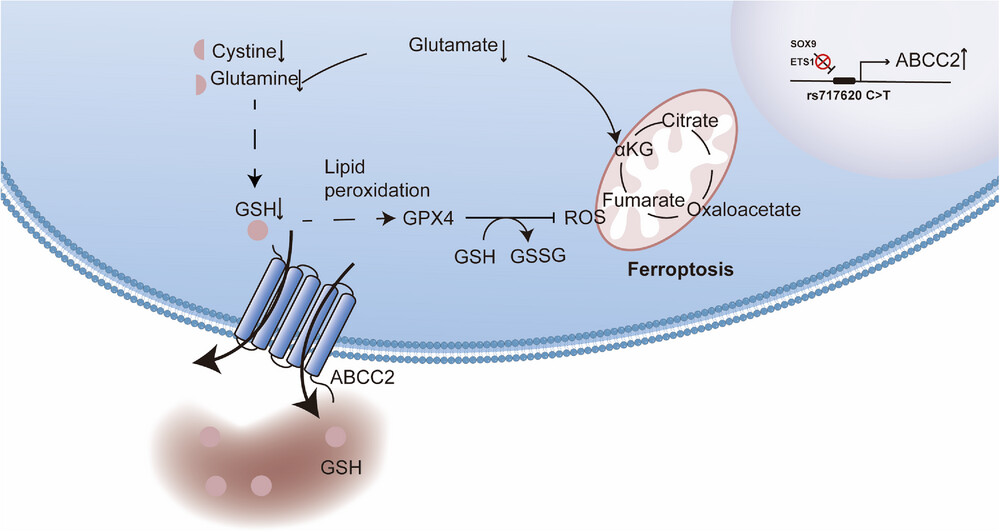 Fig.1 Schematic diagram representation of the mechanism of ABCC2 promoting ferroptosis in GC.1
The three defining characteristics of ABCC2 as found in the available literature will dictate how all reagents developed for it are designed:
The production of the ABCC2 protein, which is worthy of the label "ABCC2", is a matter of respect for size. This includes the emergence of almost 180 kD of a single, correctly assembled chain; the positioning of the front transmembrane module; the folding of both nucleotide engines; the correct placement of the regulatory region; and the prevention of damage to the entire assembly by detergents during handling. Even if a preparation loses the front module, it may still appear as a band on a gel, but will have low cycling efficiency and poorer trafficking. The full length ABCC2 protein was expressed in an optimized cell-based system designed for producing large ABC transporter proteins; in addition, the purification conditions were developed to ensure the preservation of the multi-domain structure of the protein. Validation of each batch involves a two step process. First, we use a gel-based assay to determine the purity of the protein, and then we utilize analytical size exclusion chromatography to confirm the homogeneity of the protein and ensure that there is no aggregation. There are several ways we may generate alternative forms of the full-length protein including: deletion of the first module of the protein (N-terminus); point mutations within specific nucleotides; or alterations in the regulatory region. Additionally, depending upon the type of assay you plan on performing with the protein, we can change the construct design, location of tags, and handling of the protein so that it arrives in an optimal state for either transport or interaction studies.
Not finding the membrane protein product you need? Contact us to start your one-stop custom service!
Cell-based ABCC2 studies have one major hurdle many other transporter targets do not; namely, ABCC2 will only function correctly when expressed at the correct apical surface of a properly polarized cell. Therefore, a cell line that expresses high amounts of ABCC2 yet mis-localizes that protein will provide results regarding the incorrect pool of protein. Our ABCC2 Cell Line Panel includes wild-type over-expression cell lines as well as specific mutant versions of ABCC2 located within the nucleotide binding domains, translocation cavity, and regulatory regions. All cell lines included in our panel are fully characterized prior to shipment to confirm surface localization of the protein, document the base level of functional ABCC2 present in each cell line, thus providing you with a known reference point from which to conduct your initial experiments. We can also adjust expression levels to suit the sensitivity of your efflux readouts and offer variant forms of ABCC2 based on changes in either the regulatory region or nucleotide binding domain as matched pairs for comparative studies. We are able to tailor our cell products to meet your experimental design requirements including adjusting expression levels, variant background genotypes and cell presentation formats allowing you to utilize our cell products directly into your polarized transport experiments.
Not finding the stable cell line product you need? Contact us to start your one-stop custom service!
Antibody development against ABCC2 has two problems: family and topology. Within the ABC superfamily, the nucleotide engines are one of the most conserved surfaces in membrane biology. Therefore, antibodies that target roughly these engine areas may react with many other transporters. On the other hand, the surfaces that distinguish the transporters from each other (the regulatory region and apical loops) are sensitive to conformational changes; therefore, they will only be completely exposed when the protein is correctly folded in its native environment on the membrane. Our recombinant anti-ABCC2 antibody panel is composed of sequence-defined clones that have been screened for reactivity with family members. These clones recognize both the accessible apical surfaces as well as the native folding of the transporter body. Since our clones are sequence-defined, their performance remains constant across each lot produced; thus, long-term studies can avoid the gradual drift in signal that appears to be due to biological change. We are willing to adjust the conjugation format, clone arrangement, and validation of our antibodies against your samples as needed. We can optimize our antibodies to meet the needs of your detection, localization, and characterization experiments so that the signals generated will be specific to ABCC2.
Not finding the recombinant antibody product you need? Contact us to start your one-stop custom service!
A membrane protein project should read like a sequence of clear decisions, not a leap of faith. Our workflow keeps each step visible and tied to your research design:
The front transmembrane module, the two transport half modules and the regulatory region all contribute to the formation, trafficking and cycling of ABCC2. Since truncated forms of ABCC2 lack properties required for studying its role in transport or interactions, the use of full length presentation of ABCC2 will be the only acceptable starting point for conducting research on these topics.
All ABCC2 products and services on this page are intended strictly for preclinical research. They are not designed, validated, or authorized for any application involving human subjects.
Transporter cycle mechanism research, compound efflux and substrate screening in preclinical research, excretion pathway studies in preclinical model systems, barrier transport research, and antibody development programs are the standing areas of use.
Yes. Defined variants of the nucleotide engines, the regulatory region, or the cavity can be produced and characterized side by side, which is the cleanest format for comparing individual steps of the transport cycle.









