
Creative Biolabs is offering the most comprehensive services for antibody development projects. With strict regulation and effective execution, we are dedicated to providing the most valuable solutions to complete your projects.
HighlightsCreative Biolabs is offering the most comprehensive services for antibody development projects. With strict regulation and effective execution, we are dedicated to providing the most valuable solutions to complete your projects.
HighlightsCreative Biolabs has established a broad range of platforms for developing novel antibodies or equivalents. These cutting-edge technologies enable our scientists to meet your demands from different aspects and tailor the most appropriate solution that contributes to the success of your projects.
HighlightsWith deep understanding in antibody-related realms and extensive project experience, Creative Biolabs offers a variety of references to help you learn more about our capacities and achievements, including infographic, flyer, case study, peer-reviewed publications, and all kinds of knowledge that can assist your projects. You are also welcome to contact us directly for more specific solutions.
HighlightsGet a real taste of Creative Biolabs, one of the most professional custom service providers in the world. We are committed to providing highly customized comprehensive solutions with the best quality to advance your projects.
Highlights Loading...
All listed services and products are For Research Use Only. Do Not use in any diagnostic or therapeutic applications.
ATP-binding cassette subfamily C member 6 (ABCC6) is an ATP-binding cassette transporter of approximately 1,500 amino acids implicated in ABCC6-dependent extracellular ATP release and systemic pyrophosphate homeostasis. It is mostly concentrated on the basolateral membrane of hepatocytes, with only a small amount present in the proximal renal tubules of the kidneys. Structurally, this protein has two nucleotide-binding domains that bind and hydrolyze ATP, as well as three transmembrane segments formed by a large number of transmembrane helices—this is the iconic structure of the C-subfamily of ABC transporters; all transporters in this subfamily possess this core set of structures. After decades of research, it has been found that the function of ABCC6 differs from that of ordinary transporters. It is not a conventional pump that only packages and transports specific "cargoes" out of cells; instead, it is specifically responsible for regulating extracellular purine metabolism: ABCC6 activity facilitates extracellular ATP release, and the released ATP is then processed by ectonucleotidases on the cell surface, ultimately contributing to inorganic pyrophosphate (PPi) and adenosine production. Whether ATP itself is directly transported by ABCC6 remains unresolved. ABCC6 expression is barely detectable in those mineralized tissues—those skin and blood vessels that grow excess minerals barely produce ABCC6 themselves. This critical transporter only resides in the liver and kidneys, so how can it regulate tissues located far away? This phenomenon just supports the "circulating factor" model proposed by the academic community: when ABCC6 activity in the liver and kidneys supports extracellular nucleotide release and PPi generation, it can help maintain an anti-mineralization environment in the blood, and this protective effect is delivered to all parts of the body via blood circulation, even tissues far from the liver and kidneys can receive this protection.
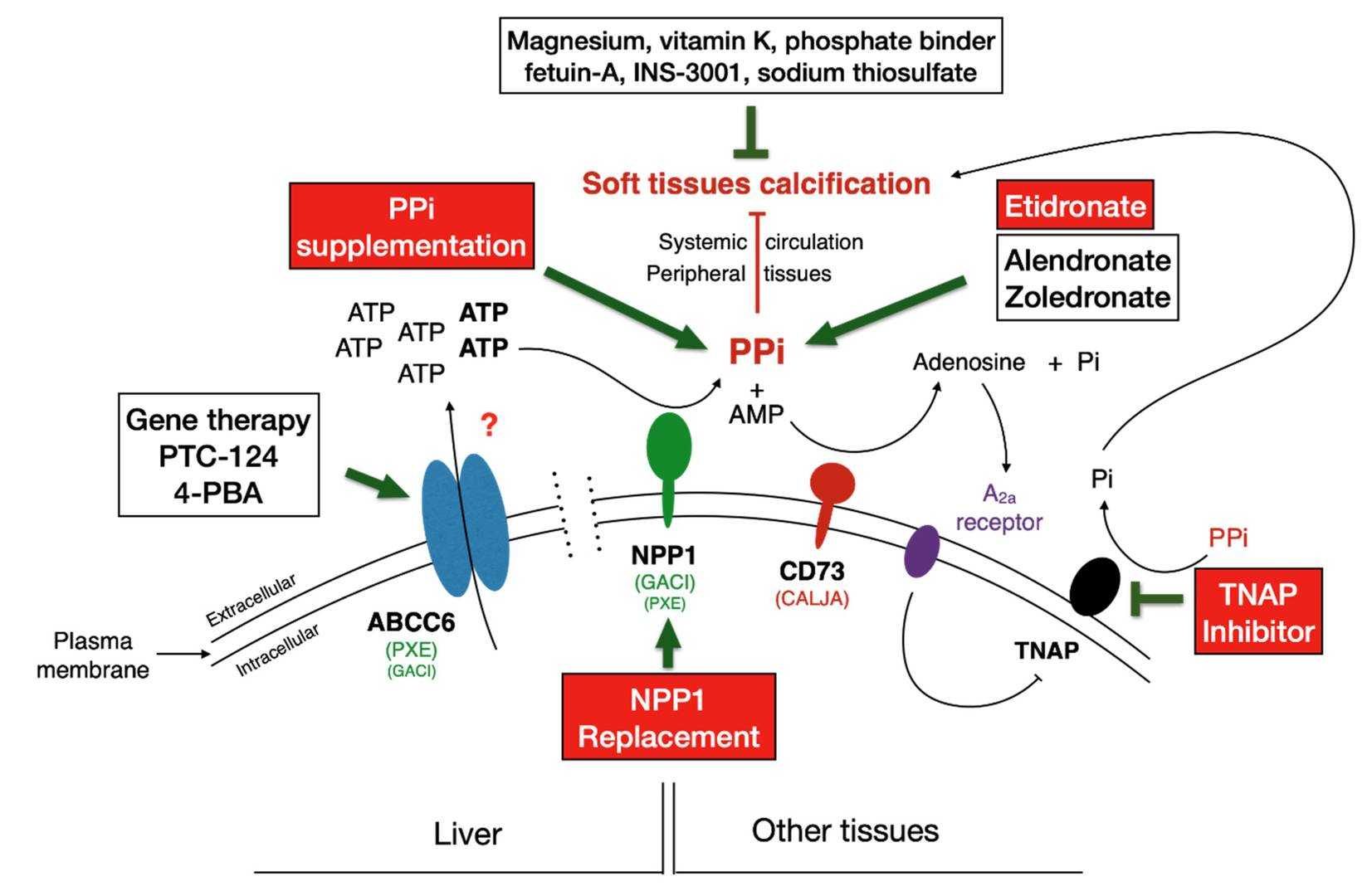 Fig.1 Tested therapeutic Interventions targeting different steps in the ABCC6 pathway to prevent calcification in PXE/GACI.1
Ongoing studies continue to refine the picture of what ABCC6 does—and how it fails:
Our product line includes full-length ABCC6 protein, all prepared in an optimized eukaryotic expression system. This system is specifically built to preserve these core attributes that maintain protein activity, so it will not damage the key conditions necessary for ABCC6 to perform its functions during the preparation process, and will not cause research to fail due to defects in the protein itself. Every batch of produced protein undergoes strict quality verification, and no unqualified products are released: first, SDS-PAGE is used to detect purity, confirming that no miscellaneous proteins are mixed in with the target protein; then analytical size-exclusion chromatography is used to confirm monodispersity, ensuring all proteins exist stably as individual entities and will not aggregate to affect experimental results.
Not finding the membrane protein product you need? Contact us to start your one-stop custom service!
When ABCC6 function is abnormal, specific tissues that express it can trigger systemic symptoms. Therefore, cell models used for experiments must meet two requirements simultaneously; lacking either makes it impossible to reproduce the real pathogenic logic and obtain reliable experimental results. First, the receptor density must be controllable, that is, the number of related receptors on the cell surface can be precisely regulated to meet the design requirements of the research. Second, the protein must be accurately anchored to the cell membrane, and must not appear in the wrong position inside the cell, which would prevent it from performing its intended transport function. We can provide customized stable cell lines with high ABCC6 expression. These cell lines are constructed through sequence optimization and stable integration technology, which ensures that the protein expression level remains stable and consistent across all experiments. There will be no situations where the expression level is too high in one batch of cells and too low in the next, nor will the protein stop being expressed after several generations of culture, supporting long-term, stable experimental development. Among these cell lines, there are cell strains that can stably overexpress wild-type ABCC6 at a preset level, that is, they can stably produce the number of native, normal ABCC6 proteins that meet experimental requirements; there are also cell strains that have undergone intentional mutation modification to study the structure-function relationship of the protein, making it convenient for researchers to modify specific gene fragments, observe changes in ABCC6 function, and clarify the connection between structure and function. Every cell clone must complete a full set of phenotypic verification experiments to confirm that all its characteristics meet the requirements before it is delivered for use, and untested cells will never be provided to researchers.
Not finding the stable cell line product you need? Contact us to start your one-stop custom service!
Paired with our recombinant antibody portfolio, ABCC6 detection can be incorporated into analytical and cell-based workflows. Sequence-defined clones can be selected according to epitope, sample type, and intended application, and application-specific validation can be used to assess selectivity and performance. Recombinant production from verified sequences supports controlled lot-to-lot performance. If your project requires a specific antibody format or validation context, these parameters can be aligned with the intended experimental workflow.
Not finding the recombinant antibody product you need? Contact us to start your one-stop custom service!
Extending well beyond our standard catalog, we deliver fully customizable discovery and manufacturing solutions meticulously tailored to the sophisticated demands of ABCC6-targeted research and precompound development:
Yes. Full-length preparations are supplied in defined buffer systems that preserve native folding and membrane context.
We can. Within the same quality framework as the wild-type materials, we can produce and purify the engineered custom constructs.
Yes. Both constitutive and inducible formats are available, so you can match expression tier to your experimental design.
All ABCC6 products and services are provided strictly for preclinical research. They are not designed, validated, or authorized for any use involving human subjects.









