Creative Biolabs is offering the most comprehensive services for antibody development projects. With strict regulation and effective execution, we are dedicated to providing the most valuable solutions to complete your projects.
HighlightsCreative Biolabs is offering the most comprehensive services for antibody development projects. With strict regulation and effective execution, we are dedicated to providing the most valuable solutions to complete your projects.
HighlightsCreative Biolabs has established a broad range of platforms for developing novel antibodies or equivalents. These cutting-edge technologies enable our scientists to meet your demands from different aspects and tailor the most appropriate solution that contributes to the success of your projects.
HighlightsWith deep understanding in antibody-related realms and extensive project experience, Creative Biolabs offers a variety of references to help you learn more about our capacities and achievements, including infographic, flyer, case study, peer-reviewed publications, and all kinds of knowledge that can assist your projects. You are also welcome to contact us directly for more specific solutions.
HighlightsGet a real taste of Creative Biolabs, one of the most professional custom service providers in the world. We are committed to providing highly customized comprehensive solutions with the best quality to advance your projects.
Highlights Loading...
All listed services and products are For Research Use Only. Do Not use in any diagnostic or therapeutic applications.
The ATP-binding cassette subfamily D member 1 (ABCD1) is a peroxisomal ATP-binding cassette half-transporter, with a single nucleotide-binding domain (NBD) and six transmembrane helices making up the substrate-translocation pathway, encoded by the ABCD1 gene on human chromosome Xq28. ABCD1 is best characterized for its role in peroxisomal import of very long-chain fatty acid (VLCFA)-CoA esters. Once inside the organelle, these fatty acids are degraded by β-oxidation, a catabolic mechanism that shortens the acyl chain and avoids toxic accumulation. Biochemical studies have shown that ABCD1 has intrinsic acyl-CoA thioesterase (ACOT) activity and releases VLCFA from acyl-CoA prior to or concomitant with membrane translocation as free fatty acid and CoA. This enzymatic activity is coupled to the transport process, and mutations that disrupt ACOT activity can also affect substrate translocation. Pathogenic mutations in ABCD1, including missense, nonsense, frameshift, and splice-site variants, can disrupt peroxisomal VLCFA metabolism and lead to the pathological lipid accumulation that characterizes X-linked adrenoleukodystrophy (X-ALD).
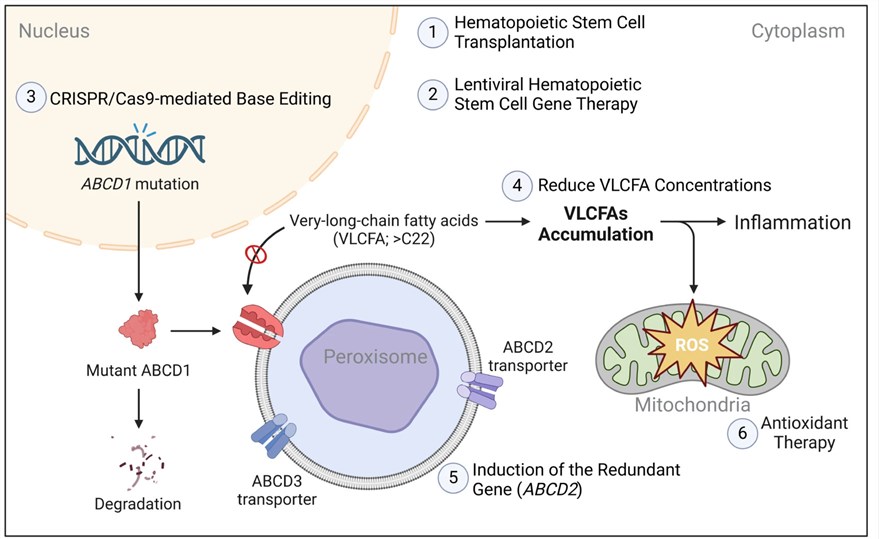 Fig.1 Therapeutic Targets in X-ALD Linked to ABCD1 Mutations.1
ABCD1 has been studied for its biological properties across multiple inter-related metabolic and disease contexts:
Jumpstart your gene and metabolism programs with our well-characterized glycolipids catalog of recombinant ABCD1 membrane proteins. We acknowledge that the proper orientation in the peroxisomal membrane, homodimeric assembly and ATP-dependent conformational cycling of ABCD1 are significant challenges for production. To address these challenges, we utilize a variety of expression platforms to produce stable and correctly folded, membrane-embedded ABCD1 constructs that maintain native ATPase activity and substrate-binding characteristics. ALDP is offered in either full-length wild-type, or disease-associated forms mouse. Each preparation is subject to thorough biophysical validation by SDS-PAGE, analytical size-exclusion chromatography, ATPase activity assays and ACOT functional measurements to ensure appropriateness for structural studies, inhibitor screening and antibody development.
Not finding the membrane protein product you need? Contact us to start your one-stop custom service!
Reliable and reproducible cellular models are needed to elucidate ABCD1-driven biology and test therapeutic candidates. We have generated stable cell lines expressing wild-type or pathogenic human, mouse and rat ABCD1, as well as knocked-down endogenous expression for loss-of-function studies. These platforms can be accurately optimized for VLCFA uptake assays, peroxisomal β-oxidation quantification, ATPase activity measurements as well as high-throughput screening of pharmacological chaperones or gene therapy vectors – providing the experimental reproducibility necessary to coordinate needs across multi-phase research initiatives.
Not finding the stable cell line product you need? Contact us to start your one-stop custom service!
As a leader in the field with years of experience, our catalog offers high-affinity anti-ABCD1 recombinant monoclonal antibodies that hold immense potential for strict researchers. Produced with cutting-edge recombinant technologies, these antibodies provide improved specificity, sensitivity and batch-to-batch consistency compared to traditional polyclonal antibodies. Our recombinant ABCD1 antibodies are confirmed for WB, ELISA, FCM, IF, ICC, IHC and IP applications that deliver high specificity in both detection and quantification of ABCD1 protein in multiple sample types such as peroxisomal membrane preparations, human fibroblast lysates and X-ALD tissues.
Not finding the recombinant antibody product you need? Contact us to start your one-stop custom service!
In addition to our catalog products, we provide customized services focused on membrane protein and antibody discovery and development. Drawing on our unique experience in both peroxisomal function as well as in rare disease, we can support you with:
No, these products/services are not intended for clinical diagnosis, prevention, treatment or cure of any disease.
We offer mouse and rat ABCD1 reagents in our catalog. However, additional orthologs or engineered mutants can be produced upon request.
Yes. We offer a tier of pricing plans flexible enough to meet both theoretical and practical level needs for academia and industry scale up requirements. Submit your expected volume and time in our inquiry portal to get a customized quote.
Absolutely. Our cell engineering team routinely generates tetracycline-inducible systems and lines co-expressing ABCD1 with PMP70, catalase, or peroxisomal targeting signal reporters for comprehensive organelle transport studies. We welcome detailed discussions regarding your preferred expression architecture and phenotypic requirements.