Creative Biolabs is offering the most comprehensive services for antibody development projects. With strict regulation and effective execution, we are dedicated to providing the most valuable solutions to complete your projects.
HighlightsCreative Biolabs is offering the most comprehensive services for antibody development projects. With strict regulation and effective execution, we are dedicated to providing the most valuable solutions to complete your projects.
HighlightsCreative Biolabs has established a broad range of platforms for developing novel antibodies or equivalents. These cutting-edge technologies enable our scientists to meet your demands from different aspects and tailor the most appropriate solution that contributes to the success of your projects.
HighlightsWith deep understanding in antibody-related realms and extensive project experience, Creative Biolabs offers a variety of references to help you learn more about our capacities and achievements, including infographic, flyer, case study, peer-reviewed publications, and all kinds of knowledge that can assist your projects. You are also welcome to contact us directly for more specific solutions.
HighlightsGet a real taste of Creative Biolabs, one of the most professional custom service providers in the world. We are committed to providing highly customized comprehensive solutions with the best quality to advance your projects.
Highlights Loading...
All listed services and products are For Research Use Only. Do Not use in any diagnostic or therapeutic applications.
ATP-binding cassette sub-family D member 3 (ABCD3) is a half-size ATP-binding cassette (ABC) transporter with a molecular weight of approximately 70–75 kDa that is localized in the peroxisomal membrane. ABCD3 mediates the import of a wide array of CoA-esterified substrates from the cytosol into peroxisomes for β-oxidation and other catabolic processes. Its substrates include long-chain fatty acyl-CoAs, branched-chain fatty acids (e.g., phytanic acid), dicarboxylic acids, as well as the C27 bile acid intermediates dihydroxycholestanoic acid (DHCA) and trihydroxycholestanoic acid (THCA). ABCD3 also has intrinsic fatty acyl-CoA thioesterase activity that hydrolyzes fatty acyl-CoA substrates to free fatty acids and CoA before or during ATP-dependent peroxisomal transport. This enzymatic activity is coupled to the transport mechanism of ABCD3 and contributes to the translocation of its lipid substrates across the peroxisomal membrane.
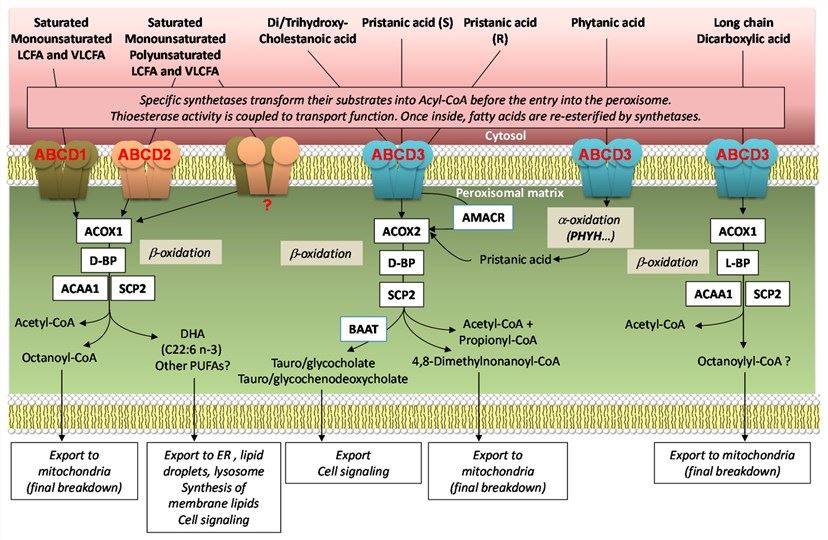 Fig.1 Peroxisomal ABC transporters and their involvement in lipid metabolism.1
ABCD3 biological impact—a key and pleiotropic regulator of several metabolic and pathological processes-spans multiple overlapping domains:
Accelerate your peroxisomal metabolism and lipid biology projects with our high quality recombinant ABCD3 membrane protein catalogue. The localization of both the peroxisomal membrane, as well as the homodimeric assembly and ATP-dependent conformational cycling of ABCD3 pose unique secretion concerns. We overcome these by utilizing a range of expression systems to obtain well-folded and functional, membrane-embedded ABCD3 constructs that maintain native ATPase and substrate-binding capabilities. Featuring complete-length mouse PMP70 as well as disease-associated variants. All preparations are biophysically characterized by functional measurements for being used in structural studies, inhibitor screening or antibody development.
Not finding the membrane protein product you need? Contact us to start your one-stop custom service!
A comprehensive understanding of the ABCD3 driven biology and identification of key therapeutic candidates critically depend on reliable, reproducible cellular models. Our stable cell lines expressing wild-type or pathogenic forms of ABCD3 (mouse or rat) as well as anti-ABCD3 knockdown for loss-of-function studies are available. The platforms are further finely tuned for fatty acid oxidation assays, assessment of bile acid precursor transport, determination of lipid droplet-peroxisome contacts and high-throughput screening of pharmacological modulators to provide the level consistency needed across multiple phases of research.
Not finding the stable cell line product you need? Contact us to start your one-stop custom service!
Our extensive collection includes high-affinity recombinant antibodies against ABCD3, designed to serve diverse research requirements. These engineered research reagents offer high specificity, sensitivity, and consistent lot-to-lot reproducibility. ABCD3 recombinant antibodies may be suitable or available for selected research applications, including Western Blotting (WB), ELISA, Flow Cytometry (FCM), Immunofluorescence (IF), Immunocytochemistry (ICC), Immunohistochemistry (IHC), and/or Immunoprecipitation (IP), depending on the specific product. They can support the detection of ABCD3 in various research sample types, such as peroxisomal membrane preparations, tissue lysates, and tissue sections from model systems.
Not finding the recombinant antibody product you need? Contact us to start your one-stop custom service!
In addition to our catalog products, we provide specialized custom services for membrane protein and antibody discovery and development. We are always at your service based on our comprehensive knowledge in peroxisomal biology and metabolic diseases:
ABCD3 is a highly abundant peroxisomal membrane protein and acting as a key gatekeeper of peroxisomal lipid metabolism. Congenital bile acid synthesis defect 5 (CBAS5) results from mutations and is associated with disorders of the Zellweger syndrome spectrum. ABCD3 regulates lipid droplet-peroxisome contacts and chemoresistance in cancer. It is crucial to understand its transport mechanism for developing therapies against metabolic and neoplastic diseases.
No, all ABCD3 products and services are for research use only; they are not to be used for clinical diagnosis, prevention, treatment or cure of any disease.
We offer a range of products including recombinant full-length ABCD3, disease-associated variants, stable cell lines with ABCD3 overexpression or knockdown, and high-quality recombinant ABCD3 antibodies, along with comprehensive custom services.
Absolutely. The engineered cell lines are then raised that co-express ABCD3 with PMP70, catalase or other PEX proteins and lipid droplet markers to monitor organelle interactions on a routine basis by our cell engineering team. We are open to discussion of your preferred expression architecture and phenotypic needs in detail.