
Creative Biolabs is offering the most comprehensive services for antibody development projects. With strict regulation and effective execution, we are dedicated to providing the most valuable solutions to complete your projects.
HighlightsCreative Biolabs is offering the most comprehensive services for antibody development projects. With strict regulation and effective execution, we are dedicated to providing the most valuable solutions to complete your projects.
HighlightsCreative Biolabs has established a broad range of platforms for developing novel antibodies or equivalents. These cutting-edge technologies enable our scientists to meet your demands from different aspects and tailor the most appropriate solution that contributes to the success of your projects.
HighlightsWith deep understanding in antibody-related realms and extensive project experience, Creative Biolabs offers a variety of references to help you learn more about our capacities and achievements, including infographic, flyer, case study, peer-reviewed publications, and all kinds of knowledge that can assist your projects. You are also welcome to contact us directly for more specific solutions.
HighlightsGet a real taste of Creative Biolabs, one of the most professional custom service providers in the world. We are committed to providing highly customized comprehensive solutions with the best quality to advance your projects.
Highlights Loading...
All listed services and products are For Research Use Only. Do Not use in any diagnostic or therapeutic applications.
ATP-binding cassette (ABC) transporter E subfamily member 1 (ABCE1, also known as RNase L inhibitor/RLI, OABP, or HP68) is encoded by the ABCE1 gene located on chromosome 4q31.21. This gene encodes a highly conserved protein consisting of 599 amino acids (with a molecular weight of approximately 67 kDa); the protein is present in all eukaryotes and archaea but is absent in bacteria. Although ABCE1 belongs to the ATP-binding cassette (ABC) superfamily, it is unique in lacking transmembrane domains; its structure comprises an N-terminal iron-sulfur (FeS) cluster domain containing two [4Fe-4S]²⁺ clusters, two nucleotide-binding domains (NBD1 and NBD2), and two hinge regions that arrange the NBDs into a characteristic V-shape. The FeS domain binds to NBD1 via an extensive interface that includes the Y-loop; the Y-loop also participates in ADP binding through aromatic ring stacking with Tyr-87 and hydrophobic interactions with Phe-92. ABCE1 is primarily localized in the cytoplasm, consistent with its function during translation; additionally, it associates with the small ribosomal subunit during the ribosomal cycle.
ABCE1 functions as an essential ribosome-recycling factor that mediates the dissociation of post-termination ribosomal complexes into their subunits. After translation termination, ABCE1 binds to the ribosome in an ATP-dependent manner and, upon ATP binding, undergoes a conformational switch from an open to a closed state that drives ribosome splitting. The FeS domain is required for this process, translating the ATPase activity of the NBDs into the mechanical action needed for subunit dissociation. Beyond ribosome recycling, ABCE1 also participates in translation initiation by remaining bound to the 40S subunit after splitting and serving as a platform for subsequent re-initiation. ABCE1 was originally identified as an inhibitor of the interferon-inducible ribonuclease L (RNase L), acting as a negative regulator of the 2-5A/RNase L antiviral pathway. Early studies reported an interaction with RNase L and a possible regulatory effect on the 2-5A/RNase L pathway in the systems examined. ABCE1 has also been reported to suppress RNA silencing in selected experimental models and has been implicated in HIV-1 capsid assembly.
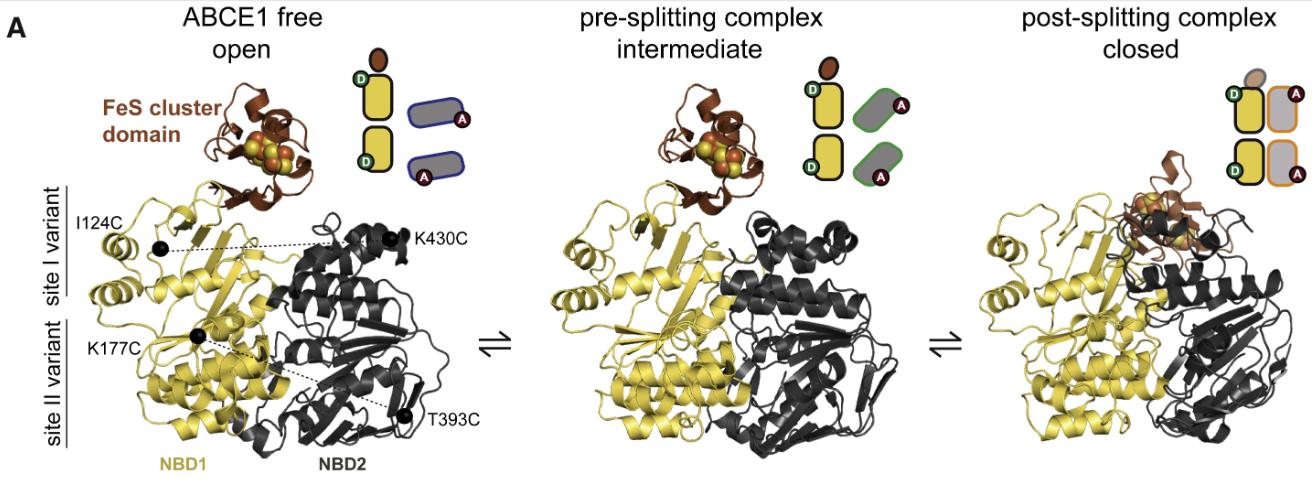 Fig. 1 smFRET probes for ABCE1 sites I/II on crystal structures, and cryo-EM structures of intermediate and closed states.1
ABCE1, encoded by the ABCE1 gene, functions as an essential Fe-S cluster ABC ATPase that regulates ribosome recycling and translation:
Creative Biolabs provides ABCE1 recombinant protein products produced using optimized expression systems. These include full-length ABCE1 protein that retains the native FeS cluster domain, two nucleotide-binding domains, and hinge regions, as well as isolated domain variants including the FeS domain and NBD fragments. The FeS domain mediates ribosome binding and mechanochemical coupling, while the NBDs form the ATP-binding cassette that drives the conformational cycle, making these proteins suitable for studies of ribosome recycling mechanisms, ATPase activity, and Fe-S cluster-dependent protein function characterization. All ABCE1 proteins undergo strict quality control to support consistent performance across applicable research platforms.
Not finding the protein product you need? Contact us to start your one-stop custom service!
Creative Biolabs provides custom-engineered ABCE1 stable cell lines, including overexpression and knockdown models. These cell lines are optimized for studies of ribosome recycling, translation termination, RNase L regulation, and ABCE1-associated RNA silencing suppression. Each cell line undergoes stringent validation to ensure stable expression profiles and consistent functional performance in diverse experimental contexts.
Not finding the stable cell line product you need? Contact us to start your one-stop custom service!
High-specificity recombinant antibodies targeting ABCE1 are developed using antibody engineering techniques for research applications involving ABCE1 expression and localization. These antibodies can be used in studies of ABCE1 distribution in the cytoplasm and ribosomal fractions and may also support characterization of ABCE1-containing recycling complexes in combination with appropriate detection reagents.
Not finding the recombinant antibody product you need? Contact us to start your one-stop custom service!
Beyond catalog products, Creative Biolabs offers specialized custom services for ABCE1 research:
ABCE1 is an essential Fe-S cluster ABC ATPase that mediates ATP-dependent dissociation of post-termination ribosomes into subunits, linking translation termination to re-initiation.
ABCE1 is essential for ribosome recycling and translation in all eukaryotes and archaea. It also regulates RNase L antiviral activity and suppresses RNA silencing, making it important for studies of translation, RNA regulation, and innate immunity.
No, all ABCE1 products and services are strictly for research use only, not intended for clinical diagnosis or treatment.
Offerings include full-length ABCE1 proteins, domain variants, specific detection antibodies, and custom stable cell lines for ribosome recycling and translation research.
ABCE1 proteins may support research on ATPase activity and ribosome splitting, depending on protein format and experimental context.









