Creative Biolabs is offering the most comprehensive services for antibody development projects. With strict regulation and effective execution, we are dedicated to providing the most valuable solutions to complete your projects.
HighlightsCreative Biolabs is offering the most comprehensive services for antibody development projects. With strict regulation and effective execution, we are dedicated to providing the most valuable solutions to complete your projects.
HighlightsCreative Biolabs has established a broad range of platforms for developing novel antibodies or equivalents. These cutting-edge technologies enable our scientists to meet your demands from different aspects and tailor the most appropriate solution that contributes to the success of your projects.
HighlightsWith deep understanding in antibody-related realms and extensive project experience, Creative Biolabs offers a variety of references to help you learn more about our capacities and achievements, including infographic, flyer, case study, peer-reviewed publications, and all kinds of knowledge that can assist your projects. You are also welcome to contact us directly for more specific solutions.
HighlightsGet a real taste of Creative Biolabs, one of the most professional custom service providers in the world. We are committed to providing highly customized comprehensive solutions with the best quality to advance your projects.
Highlights Loading...
All listed services and products are For Research Use Only. Do Not use in any diagnostic or therapeutic applications.
Alkaline ceramidase 3(ACER3) is a membrane-bound hydrolase encoded by ACER3 gene and located in endoplasmic reticulum and Golgi apparatus. It plays a catalytic role in alkaline environment, mainly distributed in glial cells, intestinal epithelium and placental tissues, and specifically degrades C18:1, C20:1 and other unsaturated long-chain ceramides. Compared with ACER1 and ACER2 in the same family, ACER3 has more unique substrate specificity, which can hydrolyze unsaturated ceramide with pro-apoptosis and pro-inflammatory effects to generate sphingosine, providing a precursor for downstream lipid S1P to produce anti-proliferation signal. Under normal physiological conditions, ACER3 can maintain the steady state of cell proliferation and inhibit the basic inflammatory reaction by scavenging toxic ceramide. The mutation of ACER3 function loss will lead to the abnormal accumulation of C18:1 ceramide in the central myelin sheath, which will lead to progressive white matter lesions in children. The decrease of ACER3 expression in intestinal tract will lead to the accumulation of mucosal ceramide, aggravate intestinal inflammation and promote the occurrence of inflammation-related colorectal cancer. Because other ceramidase can not replace the specific hydrolysis function of ACER3 on unsaturated ceramide, up-regulating ACER3 can effectively alleviate lipid-mediated neuroinflammation and inhibit the development of intestinal tumors, making it a key target for targeted research on sphingolipid metabolic enzymology, degenerative diseases and intestinal diseases.
ACER3 relies on the membrane structure of endoplasmic reticulum-Golgi apparatus to play the role of alkaline hydrolase, and specifically recognizes unsaturated long-chain ceramides through the conserved zinc ion catalytic domain, and has no obvious catalytic effect on saturated lipids. This unique substrate selection makes it clearly distinguished from ACER1 and ACER2, and it is a key functional protein that specifically removes inflammation-related lipids in nerve and intestinal tissues. ACER3-mediated ceramide -S1P metabolic transformation can link lipid toxic stress with inflammatory signal, and dynamically regulate cell survival and tissue inflammatory state according to the accumulation level of sphingolipids in the body. This protein is involved in many physiological and pathological processes such as central myelin homeostasis maintenance, intestinal mucosal immune regulation and colorectal cancer inhibition. The lack of catalytic activity of ACER3 will lead to the accumulation of toxic ceramides and induce persistent tissue inflammation, which is an important research object for sphingolipid metabolism research and disease targeted screening.
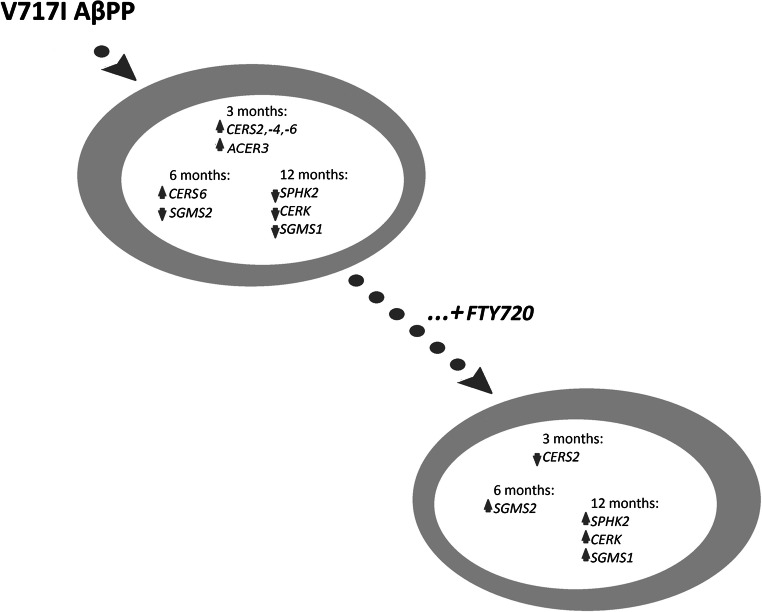 Fig. 1 Time-dependent sphingolipid enzyme changes in V717I AβPP mice following experimental pathway modulation.1
The biological functions of ACER3 are fully focused on selective unsaturated ceramide cleavage and sphingosine generation:
Creative Biolabs offers high-quality ACER3 proteins through optimized eukaryotic expression systems, including full-length ER/Golgi dual-localized enzyme and isolated catalytic domain variants. These products retain native unsaturated ceramide hydrolytic activity, suitable for sphingolipid metabolic inhibitor screening assays. All ACER3 proteins undergo strict quality control to ensure consistent performance across lipid research platforms.
Not finding the membrane protein product you need? Contact us to start your one-stop custom service!
Creative Biolabs provides custom-engineered ACER3 stable cell lines, including wild-type overexpression and blank empty vector control models. These cell lines are optimized for alkaline ceramidase profiling and sphingolipid inflammatory signal functional analysis. Each cell line undergoes stringent validation to ensure stable expression profiles during long-term neural epithelial cell culture, and can be deployed for neuroprotective compound screening workflows.
Not finding the stable cell line product you need? Contact us to start your one-stop custom service!
High-specificity recombinant antibodies targeting ACER3 are developed via advanced antibody engineering technologies, with no cross-reactivity with ACER1/2 isoforms. These antibodies are validated for ER/Golgi membrane localization detection and brain/colon tissue expression profiling, and can be combined with ceramide metabolic marker reagents to analyze sphingolipid turnover complexes in glial cell models.
Not finding the recombinant antibody product you need? Contact us to start your one-stop custom service!
Beyond catalog products, Creative Biolabs offers specialized custom services for ACER3 research:
ACER3 is an ER/Golgi alkaline ceramidase that selectively degrades pro-inflammatory unsaturated long-chain ceramides into sphingosine.
Loss-of-function ACER3 variants cause hereditary leukodystrophy, while intestinal ACER3 regulates colitis and colorectal cancer progression.
No, all ACER3 products and services are strictly for research use only, not intended for clinical diagnosis or treatment.
Offerings include full-length ACER3 lipid enzymes, isoform-specific detection antibodies and custom stable cell lines for sphingolipid research.
ACER3 proteins are validated via C18:1 ceramide hydrolytic catalytic functional testing.