
Creative Biolabs is offering the most comprehensive services for antibody development projects. With strict regulation and effective execution, we are dedicated to providing the most valuable solutions to complete your projects.
HighlightsCreative Biolabs is offering the most comprehensive services for antibody development projects. With strict regulation and effective execution, we are dedicated to providing the most valuable solutions to complete your projects.
HighlightsCreative Biolabs has established a broad range of platforms for developing novel antibodies or equivalents. These cutting-edge technologies enable our scientists to meet your demands from different aspects and tailor the most appropriate solution that contributes to the success of your projects.
HighlightsWith deep understanding in antibody-related realms and extensive project experience, Creative Biolabs offers a variety of references to help you learn more about our capacities and achievements, including infographic, flyer, case study, peer-reviewed publications, and all kinds of knowledge that can assist your projects. You are also welcome to contact us directly for more specific solutions.
HighlightsGet a real taste of Creative Biolabs, one of the most professional custom service providers in the world. We are committed to providing highly customized comprehensive solutions with the best quality to advance your projects.
Highlights Loading...
All listed services and products are For Research Use Only. Do Not use in any diagnostic or therapeutic applications.
ADAM metallopeptidase domain 10 (ADAM10) is a conserved type I transmembrane disintegrin and metalloprotease enzyme encoded by ADAM10 gene, widely expressed across embryonic, epithelial, neural and immune cell populations, functioning as the primary constitutive sheddase responsible for regulated ectodomain cleavage of dozens of cell surface signaling substrates including Notch receptors, cadherins, amyloid precursor protein and multiple cytokine membrane precursors. The mature ADAM10 ectodomain contains a zinc-dependent catalytic metalloprotease pocket, a disintegrin adhesion fold and cysteine-rich regulatory segments, while a short cytoplasmic tail interacts with intracellular partners to regulate protease membrane trafficking and substrate cleavage activity upon cellular stimulation. During embryonic developmental patterning, ADAM10 executes rate-limiting S2 proteolytic cleavage of Notch receptor extracellular domains; subsequent S3 cleavage carried out by γ-secretase releases membrane-tethered Notch intracellular fragments that translocate into cell nuclei and drive lineage-specific transcriptional programs governing tissue differentiation. Under mature tissue physiological states, basal ADAM10 shedding activity balances cell-cell adhesion molecule turnover and cytokine soluble ligand generation to sustain tissue homeostasis; upon inflammatory or neurotoxic stimulation, elevated ADAM10 catalytic activity drives constitutive non-amyloidogenic α-processing of APP, which suppresses the production of neurotoxic amyloid peptide fragments linked to degenerative brain pathology. Distinct from stimulus-dependent ADAM17/TACE paralog, ADAM10 mediates housekeeping and developmental substrate shedding under resting cellular conditions and bears exclusive non-redundant roles in canonical Notch signal activation that cannot be compensated by other ADAM family proteases. Loss of ADAM10 function abrogates Notch-dependent embryonic tissue patterning and causes lethal developmental defects, while dysregulated hyperactive ADAM10 shedding amplifies pro-inflammatory soluble ligand release, establishing ADAM10 as a core research target for disintegrin metalloprotease biology and developmental/neurodegenerative disease mechanism exploration.
ADAM10 executes core ectodomain shedding catalytic function anchored to plasma membranes via single-pass transmembrane segments, relying on zinc ion coordination within conserved metalloprotease active sites to hydrolyze substrate peptide bonds proximal to cell membrane lipid bilayers and release soluble extracellular ligand fragments. Its upstream cysteine-rich and disintegrin domains mediate substrate recognition and substrate membrane proximity docking to selectively target specific cell surface receptors and adhesion proteins without indiscriminate proteolysis of unrelated membrane polypeptides. Conserved cytoplasmic tail motifs dynamically regulate ADAM10 intracellular vesicle trafficking to control surface protease abundance and overall tissue shedding capacity matching developmental or inflammatory stimulus intensity. ADAM10-mediated substrate cleavage sustains balanced developmental and tissue homeostatic signaling, covering ordered Notch lineage differentiation and controlled soluble cytokine/amyloid peptide generation. ADAM10 participates in extensive physiological processes including embryonic Notch patterning, epithelial adhesion remodeling, neurogenic protein processing and innate inflammatory ligand release. Sustained ADAM10 hyperactivity generates excess toxic soluble cleavage products and accelerates degenerative and inflammatory tissue pathology. Therefore, ADAM10 represents a pivotal research target for ADAM metalloprotease enzymology and protease inhibitor modulator screening.
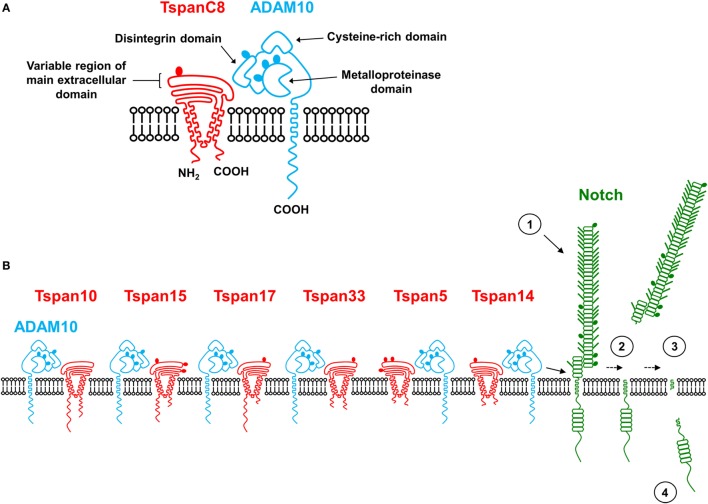 Fig. 1 Distinct tetraspanin members remodel ADAM10 molecular conformation, enabling stepwise proteolytic cleavage and downstream activation of Notch signaling receptors.1
The biological functions of ADAM10 are focused on zinc-dependent ectodomain proteolysis, Notch receptor activation and cell surface substrate shedding:
Creative Biolabs offers high-quality ADAM10 proteins through optimized expression systems, including full-length membrane protease and isolated extracellular catalytic/disintegrin domain variants. These products retain native conformational characteristics and zinc-dependent substrate shedding biological activity, suitable for membrane protein cleavage interaction assays and metalloprotease inhibitor screening for neurodevelopment and neurodegeneration research. All ADAM10 proteins undergo strict quality control to ensure consistent performance and reliable application across diverse research platforms.
Not finding the membrane protein product you need? Contact us to start your one-stop custom service!
Creative Biolabs provides custom-engineered ADAM10 stable cell lines, including wild-type catalytically active and protease-inactive mutant control models. These cell lines are optimized for Notch signaling profiling and membrane substrate ectodomain shedding functional analysis. Each cell line undergoes stringent validation to ensure stable expression profiles and consistent functional performance in diverse experimental contexts.
Not finding the stable cell line product you need? Contact us to start your one-stop custom service!
High-specificity recombinant antibodies targeting ADAM10 are developed via advanced antibody engineering technologies, with no cross-reactivity with ADAM17 and other ADAM family metalloproteases. These antibodies are validated for cell membrane and neural tissue localization detection, and can be paired with Notch1 and APP detection reagents to quantify complete substrate-protease complex assembly in developmental and neurodegenerative research models.
Not finding the recombinant antibody product you need? Contact us to start your one-stop custom service!
Beyond catalog products, Creative Biolabs offers specialized custom services for ADAM10 research:
ADAM10 is a zinc-dependent transmembrane metalloprotease that mediates constitutive ectodomain shedding and serves as the essential sheddase to activate canonical Notch signaling.
ADAM10 controls embryonic cell fate and modulates neurotoxic amyloid generation, making it a core target for developmental biology and neurodegenerative therapeutic screening.
No, all ADAM10 products and services are strictly for research use only, not intended for clinical diagnosis or treatment.
Offerings include full-length ADAM10 membrane protease proteins, isoform-specific detection antibodies and custom stable cell lines for developmental and neurobiology research.
ADAM10 proteins are validated via zinc-dependent substrate ectodomain cleavage functional testing.









