
Creative Biolabs is offering the most comprehensive services for antibody development projects. With strict regulation and effective execution, we are dedicated to providing the most valuable solutions to complete your projects.
HighlightsCreative Biolabs is offering the most comprehensive services for antibody development projects. With strict regulation and effective execution, we are dedicated to providing the most valuable solutions to complete your projects.
HighlightsCreative Biolabs has established a broad range of platforms for developing novel antibodies or equivalents. These cutting-edge technologies enable our scientists to meet your demands from different aspects and tailor the most appropriate solution that contributes to the success of your projects.
HighlightsWith deep understanding in antibody-related realms and extensive project experience, Creative Biolabs offers a variety of references to help you learn more about our capacities and achievements, including infographic, flyer, case study, peer-reviewed publications, and all kinds of knowledge that can assist your projects. You are also welcome to contact us directly for more specific solutions.
HighlightsGet a real taste of Creative Biolabs, one of the most professional custom service providers in the world. We are committed to providing highly customized comprehensive solutions with the best quality to advance your projects.
Highlights Loading...
All listed services and products are For Research Use Only. Do Not use in any diagnostic or therapeutic applications.
ADGRE1, the adhesion G protein-coupled receptor E1 originally named EMR1 upon its discovery, occupies a unique position within the GPCR superfamily. The adhesion GPCR class it belongs to is itself the most structurally distinctive branch of the GPCR superfamily, and ADGRE1 is one of the most extensively studied members within this branch. Between the seven transmembrane helices of a canonical GPCR lies a compact ligand-binding pocket, which functions to bind the signal molecules the receptor is meant to receive. The transmembrane core structure of adhesion GPCRs matches that of canonical GPCRs, but adhesion GPCRs also have an enormous extracellular structure attached to this core—a long N-terminal region studded with EGF-like repeats, which can extend far from the cell surface to interact with surrounding matrices and neighboring cells. This hybrid structure, half adhesion molecule and half signal-transducing receptor, is the origin of the family's name, and also defines its research positioning. ADGRE1 expression is species-dependent. In mice, F4/80 (Adgre1) is widely used to identify many macrophage populations and is associated with macrophage differentiation, whereas human ADGRE1/EMR1 is not a general macrophage marker and is prominently expressed by eosinophils. Accordingly, ADGRE1-based cell identification should be interpreted in the context of species and cell type.
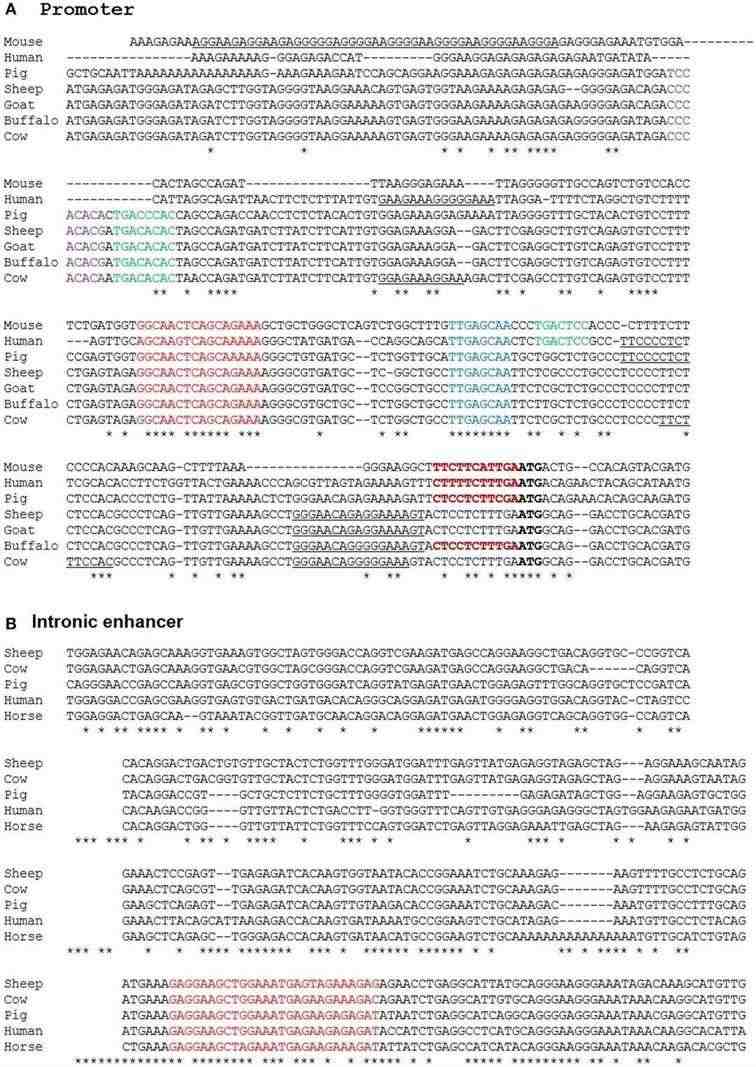 Fig.1 Alignment of promoter (A) and enhancer (B) regions of mammalian ADGRE1 genes.1
Several research currents keep converging on this receptor:
To stably produce qualified ADGRE1, we must simultaneously support production scale while reserving sufficient space for it to complete its natural processing course. Its extracellular region is exceptionally large: all repeat domains within this region must fold into their native conformations, and its built-in self-cleavage module must complete cleavage as predetermined. Products that have not completed cleavage are not functional receptors capable of exerting biological effects; they are entirely distinct substances. Every batch of products includes a processing status verification step before delivery, confirming that it has completed the required cleavage and folding, so that unqualified products will never be delivered to you. Each shipment is accompanied by purity data verified via SDS-PAGE, allowing you to clearly understand the purity of the batch upon receipt without spending additional time testing basic parameters yourself. If your research requires non-cleavable mutants, specific extracellular fragment variants, or special formats adapted for certain adhesion assays, we can adjust our preparation protocols to perfectly match your experimental plan—our products are designed to serve your research, not restrict your work.
Not finding the membrane protein product you need? Contact us to start your one-stop custom service!
Cell models used for ADGRE1 research must simultaneously meet two conditions: sufficient expression level and qualified processing accuracy. If either condition is unmet, the entire foundation of the experiment becomes untenable. If a receptor only completes folding but not cleavage, or completes cleavage but cannot be transported to the cell surface, the results obtained will deviate from real physiological processes, and the time and effort you invest in the experiment will ultimately yield invalid data that fails to reflect actual conditions. We have cell lines that stably overexpress wild-type ADGRE1, which can provide calibrated receptor expression densities suitable for research on cell identity markers and adhesion-related studies; we also offer a series of engineered mutant cell lines for researchers to explore how the two-component structure of ADGRE1 affects its function. Every cell line undergoes comprehensive verification before delivery: we quantitatively detect its ADGRE1 expression level using calibrated standards, ensuring that before you launch your first experiment, you already have a clear understanding of the basic performance of this cell model, eliminating the need to spend several weeks characterizing the cell's expression profile yourself, so you can directly advance your core experiments. If your project requires a specific mutation background, a specific expression level matching your research needs, or an expression schedule synchronized with your cell differentiation timeline, our platform can customize and adjust accordingly—this cell line is built to advance your experimental design, not constrain your research.
Not finding the stable cell line product you need? Contact us to start your one-stop custom service!
Developing antibodies against ADGRE1 presents a challenge arising from its repeat domains: the EGF-like motifs that form the core of ADGRE1's extracellular region share highly similar sequences across the entire adhesion GPCR family. If an inappropriate antigen epitope is selected during antibody screening, the resulting antibody clone is highly likely to cross-react with other non-target proteins in the family, disrupting the accuracy of quantitative detection. Ultimately, the measured ADGRE1 content will be contaminated with signals from other proteins, rendering the entire experiment's quantitative data invalid. Our recombinant antibody panel is designed for selective ADGRE1 recognition, with clone selection guided by epitope, sample type, and intended application. Sequence-defined recombinant production supports controlled lot-to-lot performance, and application-specific validation can be matched to the requirements of the study. If your project requires custom conjugates, validation for specific sample types, or adjustments to the antibody format to adapt to your exclusive experimental workflow, you can submit your requirements for on-demand adjustments—this antibody panel can flexibly meet all the unique needs of your research project.
Not finding the recombinant antibody product you need? Contact us to start your one-stop custom service!
Extending well beyond our standard catalog, we deliver fully customizable discovery and manufacturing solutions meticulously tailored to the sophisticated demands of ADGRE1-targeted research and precompound development:
Yes. Its lineage-defining expression supports marker use, while its adhesion and signaling behavior supports functional interrogation. Format selection follows which role an experiment emphasizes.
Interaction mapping on the extracellular region often proceeds well with defined fragments, while processing, adhesion, and signaling studies require full-length material. The two are complementary rather than interchangeable.
Clones are screened against related adhesion-GPCR members during selection, and the off-target panel results accompany the product documentation so specificity claims remain transparent.
All ADGRE1 products and services are provided strictly for preclinical research. They are not designed, validated, or authorized for any use involving human subjects.









