Creative Biolabs is offering the most comprehensive services for antibody development projects. With strict regulation and effective execution, we are dedicated to providing the most valuable solutions to complete your projects.
HighlightsCreative Biolabs is offering the most comprehensive services for antibody development projects. With strict regulation and effective execution, we are dedicated to providing the most valuable solutions to complete your projects.
HighlightsCreative Biolabs has established a broad range of platforms for developing novel antibodies or equivalents. These cutting-edge technologies enable our scientists to meet your demands from different aspects and tailor the most appropriate solution that contributes to the success of your projects.
HighlightsWith deep understanding in antibody-related realms and extensive project experience, Creative Biolabs offers a variety of references to help you learn more about our capacities and achievements, including infographic, flyer, case study, peer-reviewed publications, and all kinds of knowledge that can assist your projects. You are also welcome to contact us directly for more specific solutions.
HighlightsGet a real taste of Creative Biolabs, one of the most professional custom service providers in the world. We are committed to providing highly customized comprehensive solutions with the best quality to advance your projects.
Highlights Loading...
All listed services and products are For Research Use Only. Do Not use in any diagnostic or therapeutic applications.
Agrin (AGRN) is a secreted heparan sulfate proteoglycan encoded by AGRN gene, distributed within skeletal muscle basement membrane and peripheral nerve terminals, belonging to extracellular matrix glycoprotein family and acting as master organizer of neuromuscular junction (NM) formation. AGRN carries multiple evolutionarily conserved laminin-binding domains and receptor-interacting C-terminal segments across species, serving as an essential signaling bridge between motor axon terminals and muscle fiber membranes. Apart from embryonic synapse formation, AGRN also participates in adult neuromuscular junction structural maintenance and regulates post-injury synaptic remodeling in muscle tissues; sustained loss of functional AGRN will lead to disassembly of postsynaptic receptor clusters and weaken neuromuscular transmission efficiency. AGRN-mediated extracellular matrix signaling exerts decisive effects on triggering postsynaptic acetylcholine receptor aggregation during embryonic muscle innervation. Furthermore, AGRN coordinates muscle fiber differentiation and peripheral nerve axon guidance cascades. Distinct from general basement matrix proteins, AGRN holds exclusive synaptic organizing capacity specific to neuromuscular contact sites.
AGRN executes biological functions via proteolytically processed C-terminal fragments binding muscle LRP4 receptors to activate MuSK kinase signaling, driving dense clustering of acetylcholine receptors on postsynaptic muscle membrane and shaping mature neuromuscular junction architecture. Its heparan sulfate modification sites mediate matrix anchoring to fix signaling gradients at synaptic regions. AGRN participates in embryonic innervation and adult synaptic structural maintenance. Defective AGRN signaling disperses postsynaptic receptor clusters and causes congenital myasthenic syndromes. Therefore, AGRN constitutes a pivotal research target for neuromuscular developmental biology and synaptic disease mechanisms.
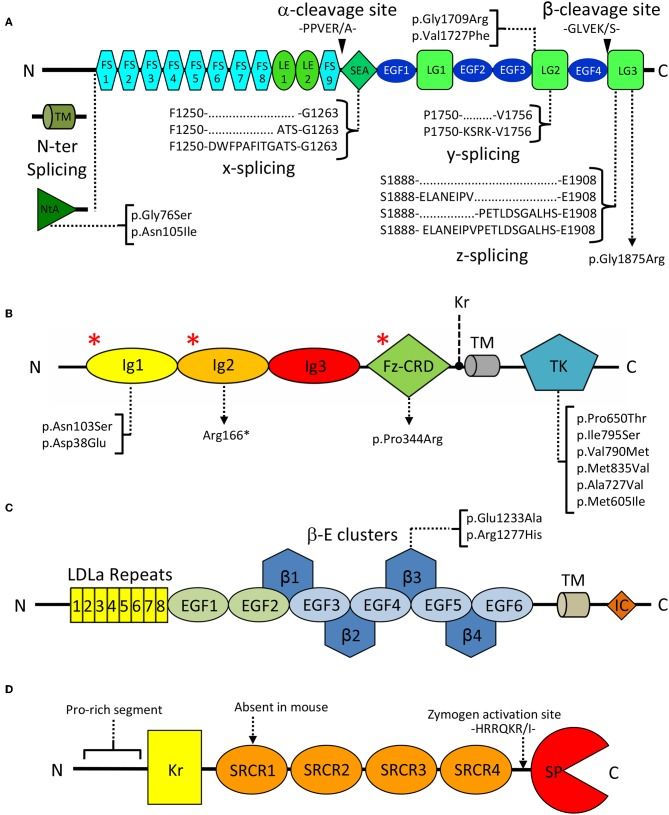 Fig. 1 Domain architecture of human AGRN (A) and its functional partners MuSK (B), LRP4 (C), Kr (D), highlighting alternative splicing sites, proteolytic cleavage sites, pathogenic myasthenia mutations and key receptor-interacting domains.1
The biological functions of AGRN are focused on LRP4-MuSK signal activation and postsynaptic receptor aggregation:
Creative Biolabs offers high-quality AGRN proteins via optimized expression systems, covering full-length AGRN and bioactive C-terminal truncated variants. These products retain native heparan sulfate modification sites and LRP4 binding activity, suitable for neuromuscular synapse formation and myasthenia compound screening. Purification removes inactive proteolytic breakdown fragments, and special matrix-compatible buffer preserves glycoprotein tertiary structure during long-term storage. All AGRN proteins undergo rigorous quality control to guarantee consistent functional performance and reliable application across diverse research platforms.
Not finding the membrane protein product you need? Contact us to start your one-stop custom service!
Creative Biolabs provides custom engineered AGRN stable cell lines, including overexpression and gene silencing models. These cell lines are optimized for neuromuscular junction developmental research. Multi-round clonal screening selects strains with steady secreted AGRN levels without expression fluctuation in continuous passage, with full secretion quantification records provided. Each cell line undergoes strict validation procedures to ensure steady target expression levels and uniform functional performance across multiple experimental scenarios.
Not finding the stable cell line product you need? Contact us to start your one-stop custom service!
High-specificity recombinant antibodies targeting AGRN are developed with advanced antibody engineering workflows, without cross-reactivity against other basement proteoglycans. These antibodies are validated for muscle tissue immunofluorescence and culture supernatant detection, formulated without harsh detergents to preserve extracellular matrix antigen signals. Pre-screening eliminates off-target binding signals against laminin and collagen.
Not finding the recombinant antibody product you need? Contact us to start your one-stop custom service!
Beyond catalog products, Creative Biolabs offers specialized custom services for AGRN research:
AGRN is a secreted matrix proteoglycan that binds muscle LRP4 to activate MuSK and induce postsynaptic acetylcholine receptor clustering at neuromuscular junctions.
AGRN is the core organizer of neuromuscular synapses; functional defects cause congenital myasthenic transmission disorders, establishing it as a vital research target.
No, all AGRN products and services are strictly for research use only, not intended for clinical diagnosis or treatment.
Offerings include AGRN glycoproteins, high-specificity recombinant antibodies and custom stable cell lines for neuromuscular synapse research.
AGRN proteins undergo functional verification via LRP4 receptor binding and acetylcholine receptor clustering capacity evaluation.