
Creative Biolabs is offering the most comprehensive services for antibody development projects. With strict regulation and effective execution, we are dedicated to providing the most valuable solutions to complete your projects.
HighlightsCreative Biolabs is offering the most comprehensive services for antibody development projects. With strict regulation and effective execution, we are dedicated to providing the most valuable solutions to complete your projects.
HighlightsCreative Biolabs has established a broad range of platforms for developing novel antibodies or equivalents. These cutting-edge technologies enable our scientists to meet your demands from different aspects and tailor the most appropriate solution that contributes to the success of your projects.
HighlightsWith deep understanding in antibody-related realms and extensive project experience, Creative Biolabs offers a variety of references to help you learn more about our capacities and achievements, including infographic, flyer, case study, peer-reviewed publications, and all kinds of knowledge that can assist your projects. You are also welcome to contact us directly for more specific solutions.
HighlightsGet a real taste of Creative Biolabs, one of the most professional custom service providers in the world. We are committed to providing highly customized comprehensive solutions with the best quality to advance your projects.
Highlights Loading...
All listed services and products are For Research Use Only. Do Not use in any diagnostic or therapeutic applications.
Apoptosis-inducing factor mitochondria-associated 2 (AIFM2), also known as AMID, PRG3, or ferroptosis suppressor protein 1 (FSP1), is encoded by the AIFM2 gene on chromosome 10q22.1. The gene spans approximately 20.66 kb and contains 14 exons. AIFM2 encodes a 373-amino-acid flavoprotein oxidoreductase that belongs to the FAD-dependent oxidoreductase family and shares approximately 22% amino acid identity with AIFM1. The protein contains a short N-terminal hydrophobic region followed by a flavin adenine dinucleotide (FAD)-dependent oxidoreductase domain. AIFM2 was historically described as a p53-responsive gene, while pro-apoptotic activity was also reported in specific overexpression models independently of p53. The protein localizes to multiple subcellular compartments, including mitochondria, cytoplasm, nucleus, and plasma membrane, with a substantial pool at the plasma membrane in a myristoylation-dependent manner.
AIFM2 was later renamed ferroptosis suppressor protein 1 (FSP1) following the discovery that it functions as a potent inhibitor of ferroptosis, a form of iron-dependent regulated cell death driven by lipid peroxidation. At the plasma membrane, AIFM2/FSP1 acts as a CoQ oxidoreductase that uses NAD(P)H to reduce coenzyme Q10 (ubiquinone-10) to ubiquinol-10, a lipophilic radical-trapping antioxidant that halts the propagation of lipid peroxides and prevents ferroptosis. This function operates in parallel to, and independently of, the glutathione-dependent GPX4 pathway. The anti-ferroptotic activity of AIFM2/FSP1 is mediated by its CoQ10-reducing activity at the plasma membrane, and the N-terminal myristoylation signal is essential for this localization and function. AIFM2/FSP1 expression positively correlates with resistance to GPX4 inhibitors across hundreds of cancer cell lines, and its loss sensitizes cells to ferroptosis induced by chemical ferroptosis inducers in experimental models. In addition to its ferroptosis-suppressing role, AIFM2 retains pro-apoptotic activity: it binds single-stranded DNA and is thought to contribute to apoptosis in the presence of bacterial and viral DNA. The dual role of AIFM2—ferroptosis suppression alongside context-dependent pro-apoptotic effects—positions it at the intersection of two distinct cell death pathways, making it a valuable research target for studies of redox biology, lipid peroxidation, and cell death regulation.
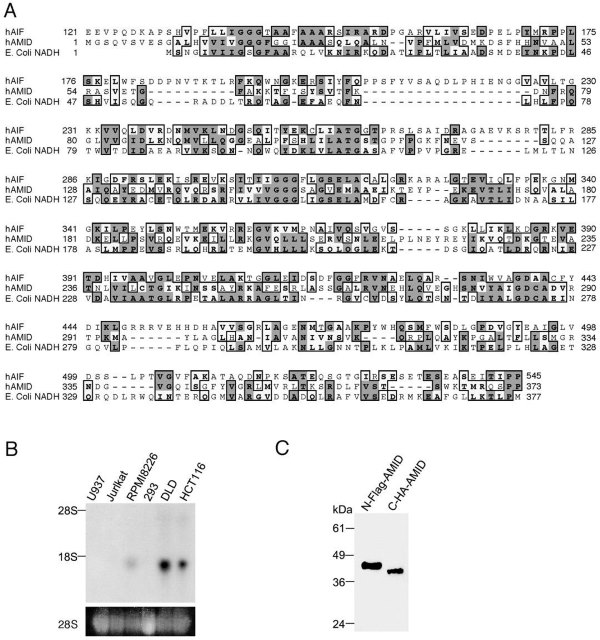 Fig. 1 Early AMID (AIFM2) sequence and expression data.1
AIFM2, encoded by the AIFM2 gene, functions as a bifunctional oxidoreductase with roles in ferroptosis suppression and apoptosis regulation:
Creative Biolabs provides recombinant AIFM2/FSP1 protein products produced using optimized expression systems. These include full-length AIFM2 protein that retains the native N-terminal myristoylation signal and FAD-dependent oxidoreductase domain, as well as isolated oxidoreductase domain variants. The FAD-dependent oxidoreductase domain mediates CoQ10 reduction and NAD(P)H-dependent redox activity, making these proteins suitable for studies of ferroptosis suppression mechanisms, CoQ10 metabolism, and oxidoreductase activity characterization. All AIFM2 proteins undergo strict quality control to support consistent performance across applicable research platforms.
Not finding the protein product you need? Contact us to start your one-stop custom service!
Creative Biolabs provides custom-engineered AIFM2 stable cell lines, including overexpression and knockout models. These cell lines are optimized for studies of ferroptosis suppression, CoQ10 metabolism, GPX4-independent lipid peroxidation defense, and p53-dependent apoptosis. Each cell line undergoes stringent validation to ensure stable expression profiles and consistent functional performance in diverse experimental contexts.
Not finding the stable cell line product you need? Contact us to start your one-stop custom service!
High-specificity recombinant antibodies targeting AIFM2 are developed using antibody engineering techniques for research applications involving AIFM2 expression and localization. These antibodies can be used in studies of AIFM2 distribution in mitochondria, plasma membrane, and other subcellular compartments and may also support characterization of AIFM2-containing redox complexes in combination with appropriate detection reagents.
Not finding the recombinant antibody product you need? Contact us to start your one-stop custom service!
Beyond catalog products, Creative Biolabs offers specialized custom services for AIFM2 research:
AIFM2 is a NAD(P)H-dependent CoQ oxidoreductase that reduces coenzyme Q10 to ubiquinol-10 at the plasma membrane, suppressing ferroptosis independently of the GPX4 pathway.
AIFM2/FSP1 is a key ferroptosis suppressor that operates in parallel to GPX4, and its expression correlates with ferroptosis resistance across cancer cell lines. It is important for studies of redox biology, ferroptosis, and p53-dependent apoptosis.
No, all AIFM2 products and services are strictly for research use only, not intended for clinical diagnosis or treatment.
Offerings include full-length AIFM2 proteins, oxidoreductase domain variants, specific detection antibodies, and custom stable cell lines for ferroptosis and redox biology research.
AIFM2 proteins may support research on CoQ10 reduction and NAD(P)H oxidation, depending on protein format and experimental context.









