Creative Biolabs is offering the most comprehensive services for antibody development projects. With strict regulation and effective execution, we are dedicated to providing the most valuable solutions to complete your projects.
HighlightsCreative Biolabs is offering the most comprehensive services for antibody development projects. With strict regulation and effective execution, we are dedicated to providing the most valuable solutions to complete your projects.
HighlightsCreative Biolabs has established a broad range of platforms for developing novel antibodies or equivalents. These cutting-edge technologies enable our scientists to meet your demands from different aspects and tailor the most appropriate solution that contributes to the success of your projects.
HighlightsWith deep understanding in antibody-related realms and extensive project experience, Creative Biolabs offers a variety of references to help you learn more about our capacities and achievements, including infographic, flyer, case study, peer-reviewed publications, and all kinds of knowledge that can assist your projects. You are also welcome to contact us directly for more specific solutions.
HighlightsGet a real taste of Creative Biolabs, one of the most professional custom service providers in the world. We are committed to providing highly customized comprehensive solutions with the best quality to advance your projects.
Highlights Loading...
All listed services and products are For Research Use Only. Do Not use in any diagnostic or therapeutic applications.
ALG1 (ALG1 chitobiosyldiphosphodolichol beta‑mannosyltransferase) is an endoplasmic reticulum‑resident glycosyltransferase encoded by ALG1 gene. This enzyme associates with endoplasmic reticulum membrane and its catalytic domain faces the cytosolic side of the endoplasmic reticulum membrane. ALG1 contains conserved catalytic polypeptide segments that carry residues responsible for sugar‑unit transfer reaction. The enzyme acts upon lipid‑anchored dolichol‑pyrophosphate linked glycan acceptors on the cytosolic face of the endoplasmic reticulum membrane. Polypeptide translation completes at cytoplasmic ribosomes before targeting to endoplasmic reticulum. Enzyme molecule inserts into endoplasmic reticulum membrane with proper topological orientation to place catalytic region on the cytosolic side. ALG1 expression can be detected across most cell types, and its abundance correlates with cellular demand for de novo dolichol‑linked oligosaccharide precursor generation. Correct membrane anchoring and catalytic domain folding are prerequisites for acquiring enzymatic competence.
ALG1 catalyses transfer of mannose sugar unit onto pre‑formed chitobiose‑diphosphodolichol glycan acceptor substrates. This reaction represents one defined early step within dolichol‑linked oligosaccharide biosynthetic cascade. GDP‑mannose serves as the donor substrate on the cytosolic face of the endoplasmic reticulum membrane for this enzymatic reaction. After extension to the Man5GlcNAc2‑PP‑dolichol intermediate, the glycan is flipped to the ER lumen for further elongation. Loss of functional ALG1 interrupts normal elongation of dolichol‑linked glycan precursor. Other glycosyltransferase enzymes inside endoplasmic reticulum cannot fully substitute for this specific mannose‑transfer catalytic activity. Variation in ALG1 functional abundance changes overall cellular capacity to generate complete lipid‑linked glycan precursor molecules. Structural change within catalytic domain may reduce sugar‑transfer turnover rate or modify substrate acceptor preference. Disruption of this early biosynthetic step further influences downstream processing events that rely on fully assembled dolichol‑linked glycan precursors.
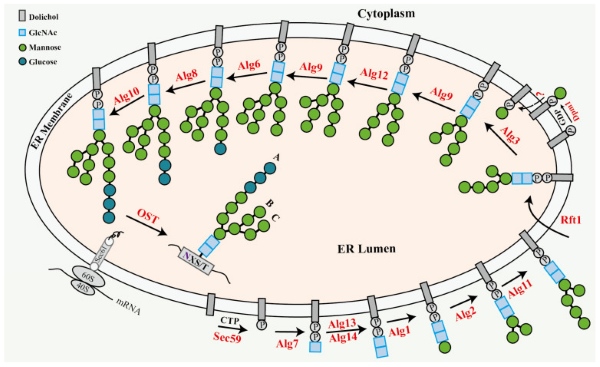 Fig. 1 Overview of dolichol‑linked‑oligosaccharide biosynthesis in ER membrane. ALG1 catalyzes mannose transfer during early glycan‑precursor assembly.1
The biological functions of ALG1 are focused on dolichol‑linked glycan precursor elongation, mannose moiety catalytic transfer and early N‑glycosylation pathway progression:
Creative Biolabs offers purified ALG1 protein samples via standardized preparation workflows, including full length ALG1 constructs and isolated catalytic domain variants. Isolated catalytic domain fragments may not support complete lipid‑anchored glycan acceptor‑dependent catalytic behaviours, while full length constructs may be suited for early dolichol‑linked glycan biosynthesis‑associated research. All samples receive routine quality screening, and functional relevant observation may only be carried out with full length samples under appropriate simulated molecular environments. All sample batches follow unified processing standards to maintain consistent structural features for comparative laboratory analysis across separate test groups.
Not finding the membrane protein product you need? Contact us to start your one-stop custom service!
Creative Biolabs provides adjustable ALG1 expression cell models with varied expression levels, applicable to endoplasmic reticulum‑associated glycosyltransferase structural characteristic observation and lipid‑linked glycan biosynthesis related research. Sample evaluation includes sustained target expression detection and preliminary substrate‑interaction associated observation, which can support comparative analysis of enzyme relevant behaviours under different expression statuses. These cell systems can be matched with diverse laboratory analysis schemes to observe changes of glycan‑processing associated efficiency under different target expression abundances.
Not finding the stable cell line product you need? Contact us to start your one-stop custom service!
Antibody reagents targeting ALG1 are generated via mature protein preparation workflows, compatible with multiple routine laboratory detection methods for subcellular localization profiling and molecular complex identification, to support systematic analysis of ALG1 distribution and glycosylation relevant molecular complexes across diverse laboratory research setups. The antibody series can cooperate with other common laboratory detection reagents to complete multi dimensional observation of target distribution inside tissue samples.
Not finding the recombinant antibody product you need? Contact us to start your one-stop custom service!
Beyond catalog products, Creative Biolabs offers specialized custom services for ALG1 research:
ALG1 may function as endoplasmic reticulum‑resident glycosyltransferase and participate in mannose unit transfer during early dolichol‑linked glycan precursor elongation.
ALG1 functional status may influence early lipid‑linked glycan precursor assembly, serving as a major regulatory mediator of N‑glycosylation‑related biological processes.
No, all ALG1 related products and services are strictly for research use only, not intended for clinical related operations. All material designs and functional tests are only optimized for basic laboratory research scenarios, without matching clinical application standards.
Offerings include full length ALG1 protein, target specific recombinant antibodies and adjustable expression cell research models, supporting dolichol‑linked glycan biosynthesis research.
Laboratory observation schemes may include glycan precursor‑dependent sugar‑transfer related tests to analyse enzyme‑relevant behaviours under simulated molecular environments.