
Creative Biolabs is offering the most comprehensive services for antibody development projects. With strict regulation and effective execution, we are dedicated to providing the most valuable solutions to complete your projects.
HighlightsCreative Biolabs is offering the most comprehensive services for antibody development projects. With strict regulation and effective execution, we are dedicated to providing the most valuable solutions to complete your projects.
HighlightsCreative Biolabs has established a broad range of platforms for developing novel antibodies or equivalents. These cutting-edge technologies enable our scientists to meet your demands from different aspects and tailor the most appropriate solution that contributes to the success of your projects.
HighlightsWith deep understanding in antibody-related realms and extensive project experience, Creative Biolabs offers a variety of references to help you learn more about our capacities and achievements, including infographic, flyer, case study, peer-reviewed publications, and all kinds of knowledge that can assist your projects. You are also welcome to contact us directly for more specific solutions.
HighlightsGet a real taste of Creative Biolabs, one of the most professional custom service providers in the world. We are committed to providing highly customized comprehensive solutions with the best quality to advance your projects.
Highlights Loading...
All listed services and products are For Research Use Only. Do Not use in any diagnostic or therapeutic applications.
Autocrine motility factor receptor (AMFR, GP78) is a multifunctional integrated membrane protein encoded by AMFR gene, which contains two independent functional domains: cell membrane and endoplasmic reticulum, and is widely expressed in epithelial cells, fibroblasts and various tumor cells. Different from single-function receptor or endoplasmic reticulum enzyme, AMFR can integrate tumor invasion signal and lipid metabolism quality control function synchronously. The low expression of AMFR in normal cells can maintain the steady state of cholesterol metabolism without activating abnormal migration signals. AMFR gene mutation will damage the clearance function of endoplasmic reticulum protein and induce metabolic disorder. The high expression of AMFR in tumor tissue is closely related to lymphatic metastasis, distant invasion and poor prognosis, and it is the dual core target of oncology, lipid metabolism research and targeted small molecule drug screening.
AMFR executes dual independent biological activities on ER and plasma lipid bilayers, utilizing separate extracellular ligand-binding regions and cytoplasmic RING catalytic domains to carry out motility signal reception and ubiquitination catalysis simultaneously. Conserved extracellular pocket exclusively matches AMF polypeptide ligands, while the RING finger motif shows high substrate specificity toward HMGCR and other misfolded ER proteins, separating its two functional interactomes from ordinary single-function membrane proteins. AMFR-mediated dual regulatory axis connects intracellular sterol metabolism to extracellular tumor microenvironment stimulation, adjusting cell migratory activity according to cellular transformation degree and nutrient availability. AMFR participates in ER protein quality surveillance, de novo cholesterol biosynthesis, tumor EMT transformation and interstitial invasion processes. Defective AMFR expression simultaneously triggers lipid metabolic disorder and blunts tumor migratory signaling, so it represents a pivotal dual-target research object for tumor metabolism therapeutic screening.
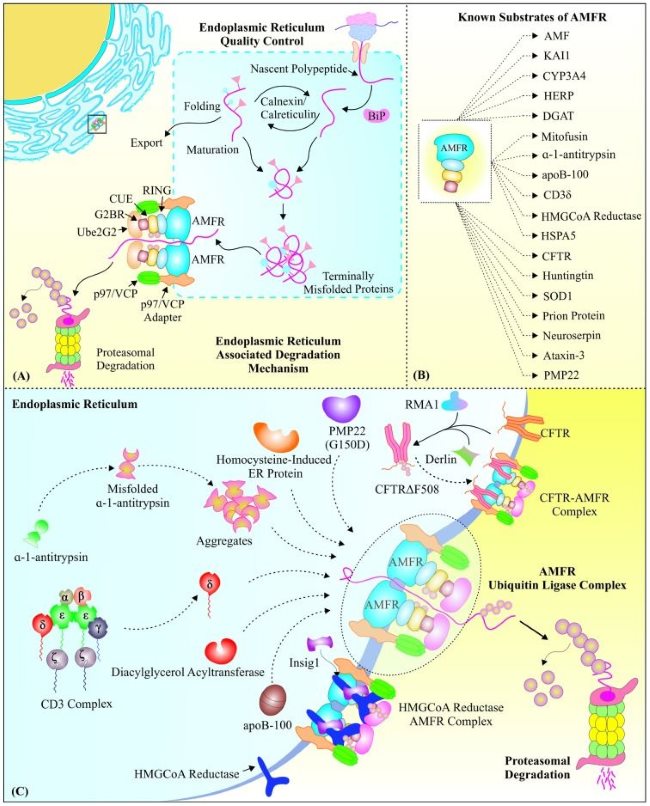 Fig. 1 Schematic diagram of AMFR/Gp78 E3 ligase mediating ERAD and multiple substrate protein degradation.1
The biological functions of AMFR are focused on autocrine motility factor binding and ER substrate ubiquitination:
Creative Biolabs offers high-quality AMFR proteins through optimized eukaryotic expression systems, including full-length dual-functional AMFR and separated ligand-binding/RING domain variants. These products retain intact AMF binding affinity and E3 ubiquitin catalytic activity, suitable for receptor-ligand interaction tests and ERAD pathway functional screening. All AMFR proteins pass rigorous activity verification to guarantee stable performance across cell biology research platforms.
Not finding the membrane protein product you need? Contact us to start your one-stop custom service!
Creative Biolabs provides custom-engineered AMFR stable cell lines, including overexpression and blank empty vector control models. These cell lines are optimized for dual-function membrane protein profiling and tumor migration/ERAD signal functional detection. Each cell line undergoes strict genotyping and expression validation to maintain consistent protein abundance during long-term cell culture experiments.
Not finding the stable cell line product you need? Contact us to start your one-stop custom service!
High-specificity recombinant antibodies targeting AMFR are generated via advanced antibody engineering platforms. These antibodies are validated to detect both ER-resident and plasma membrane AMFR pools, compatible with tumor and metabolic tissue immunostaining, and can be combined with HMGCR or AMF detection antibodies to visualize complete AMFR functional signaling complexes in carcinoma cell models.
Not finding the recombinant antibody product you need? Contact us to start your one-stop custom service!
Beyond catalog products, Creative Biolabs offers specialized custom services for AMFR research:
AMFR is a dual-function membrane protein: cell-surface receptor binding AMF to drive tumor migration, and ER-resident E3 ubiquitin ligase mediating HMGCR degradation to control cholesterol synthesis.
AMFR bridges tumor microenvironment migratory signaling and intracellular sterol metabolism, serving as a key biomarker and dual-action therapeutic target for metastatic cancers.
No, all AMFR proteins, antibodies and cell models are limited to laboratory basic research, not approved for clinical diagnosis or human treatment applications.
Full-length dual-functional recombinant AMFR proteins, domain-specific detection antibodies and customized stable cell lines for tumor metabolism research.
AMFR proteins undergo two parallel functional tests: AMF ligand binding ELISA and in vitro HMGCR ubiquitination catalytic assays.








