
Creative Biolabs is offering the most comprehensive services for antibody development projects. With strict regulation and effective execution, we are dedicated to providing the most valuable solutions to complete your projects.
HighlightsCreative Biolabs is offering the most comprehensive services for antibody development projects. With strict regulation and effective execution, we are dedicated to providing the most valuable solutions to complete your projects.
HighlightsCreative Biolabs has established a broad range of platforms for developing novel antibodies or equivalents. These cutting-edge technologies enable our scientists to meet your demands from different aspects and tailor the most appropriate solution that contributes to the success of your projects.
HighlightsWith deep understanding in antibody-related realms and extensive project experience, Creative Biolabs offers a variety of references to help you learn more about our capacities and achievements, including infographic, flyer, case study, peer-reviewed publications, and all kinds of knowledge that can assist your projects. You are also welcome to contact us directly for more specific solutions.
HighlightsGet a real taste of Creative Biolabs, one of the most professional custom service providers in the world. We are committed to providing highly customized comprehensive solutions with the best quality to advance your projects.
Highlights Loading...
All listed services and products are For Research Use Only. Do Not use in any diagnostic or therapeutic applications.
AMIGO2 is a cell-surface adhesion protein that belongs to a small group of proteins characterized by an extracellular region composed of leucine-rich repeats with an immunoglobulin-like domain at one end. This simple architecture conceals a remarkable variety of functions: AMIGO2 promotes neurite growth during development of the nervous system; regulates the activity of voltage-gated ion channels; mediates cell-to-cell adhesion via homophilic interaction; and, most recently, has emerged as a potentially important player in cancer studies, where increased expression levels have been associated with uncontrolled growth and increased blood vessel formation. This diversity of function is why there is such high demand for reliable AMIGO2 reagents, and why developing such reagents can be deceptively challenging. For example, the repeat architecture of the extracellular region must be folded as a single continuous surface; the transmembrane environment is critical for its ability to regulate channel function; and the fact that AMIGO2 exhibits homophilic binding means that the way it was prepared will affect how active it appears to be. Poorly designed reagents can result in material that looks fine, but performs poorly and produces ambiguous results. We created our protein design service specifically to avoid falling into these traps.
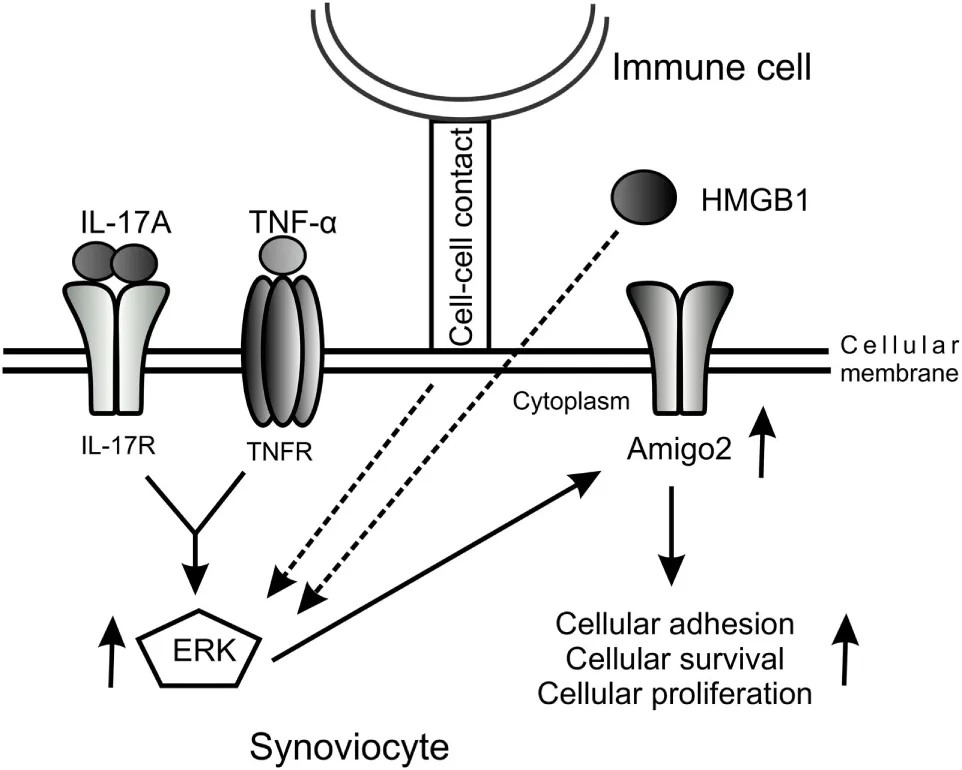 Fig.1 Model of the regulation of Amigo2 expression which promotes cell survival and proliferation.1
Research around AMIGO2 clusters around several active threads:
The AMIGO2 protein that we offer is prepared so that it retains its complete extracellular assembly (the repeat region and Ig-like domain are folded together to form a single surface). This protein is available as either a full-length or extracellular region format, and has been tested for oligomerization properties prior to being released. These preparations will work well for adhesion assays, interaction mapping, and channel partnership projects. We have the ability to modify the construct boundaries, tag placement, and format choices to best fit into your experimental design.
Not finding the membrane protein product you need? Contact us to start your one-stop custom service!
The use of cell models that exhibit a uniform presentation of AMIGO2 on the cell surface and maintain the ability to form partnerships with AMIGO2 are beneficial in the investigation of adhesion and channel-regulation. To support longitudinal studies of adhesion dynamics and growth-signaling cross-talk, we develop stable cell lines using clonal selection for consistent expression levels and homophilic engagements. Your study design may dictate how you configure the level of expression, format of presentation, and host background.
Not finding the stable cell line product you need? Contact us to start your one-stop custom service!
With other repeat-plus-Ig architecture-based proteins in the same family as AMIGO2; identifying AMIGO2 within this family requires that the antibodies used for screening be both carefully developed and screened. The recombinant antibody panels we have created are designed to target unique epitopes in the extracellular region and the intracellular tail of the protein. These allow for the assessment of both total-protein expression and cell surface expression, as well as family-specific identification. To ensure that each candidate antibody is specific to the intended protein, each is counter-screened against the other members of its family. We can customize epitope preference, species profile, and labeling format based upon the requirements of your assay.
Not finding the recombinant antibody product you need? Contact us to start your one-stop custom service!
When catalog materials cannot carry your question, our custom programs pick up from there:
Yes, formats suited to adhesion work are part of the standard offering, with assembly behavior documented.
Candidates are screened against family relatives, and only selective binders are released — with the specificity data shared.
Of course. In fact, most researchers who order proteins will ask for both, the extracellular portion of the protein so they can study how the protein interacts with other molecules and map out where these interactions take place; and the full-length version of the protein so they can examine how it functions when embedded in a cell's lipid bilayer.
Adhesion-affecting variants are a routine custom option, delivered alongside wild-type reference material.









